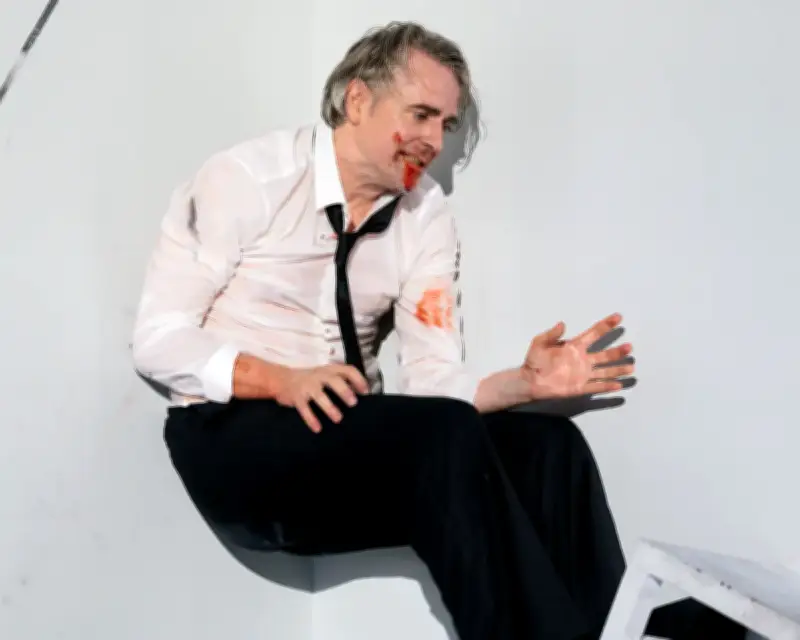
The Berliner Ensemble's staging of Oscar Wilde's De Profundis at London's Coronet theatre is a gripping monologue of righteous rage, with Jens Harzer's anguished physicality illuminating a tortured artist. The production, spoken in German with English surtitles, runs until 7 October.
A letter from the depths
Written as a letter to Wilde's ex-lover after he was jailed for homosexuality, De Profundis reflects soul-crushing torments. Its adaptation into a monologue rarely gets an outing, perhaps because it is so bleak, but this staging comes with heaps of extra angst for good measure.
Harzer dramatises it with great anguished physicality. Only his face is lit up at first, and the set-up looks Beckettian in its bare, black effects: Hansjörg Hartung's lugubrious set design, Jörg Gollasch's variously plangent or flighty musical compositions, and Steffen Heinke's well-crafted lighting. Harzer initially looks deathly, with a luminous outline around him suggesting a man speaking from his grave.
Righteous rage and shafts of light
The letter opens with Wilde's pet name for Lord Alfred Douglas – Bosie – but this production only speaks in direct, accusatory address to “you”. Bosie is decried as something of an anti-muse to the suffering artist – a grasping, sybaritic parasite whose company sucked the creative life out of Wilde.
Harzer does not overplay it or tip into melodrama but blasts the part with righteous rage. He spits or shouts some lines, speaks others with numbed forbearance. In between the anger are shafts of light: remnants of love for Bosie, flashes of his past celebrated glory as a writer. He cannot let himself be filled with hate, he says, yet this monologue is irredeemably bitter.
Gripping in its darkness
Under well-paced direction by Oliver Reese, it is remarkable that none of it feels over-wrought or leaden. It is essentially a static piece of narration but does not feel it here. Harzer is sometimes curled into himself, like Franz Kafka's insect-like Gregor Samsa, and sometimes stretching his arms in the air in Christ-like surrender.
As an interval-free production just 10 minutes short of two hours, it is an accomplishment that a piece drenched in so much darkness is also so gripping in its illumination of an artist in full-throttle throes of despair.