Irina Rozovsky’s latest book, Black Mountain Heart, pieces together a personal and kaleidoscopic view of the Balkan states. The atmospheric images of the region’s inhabitants, wildlife, towns and farms reflect the evolution of old and new ways of life in a naturally dramatic landscape. Rozovsky’s borderless vision drifts through railways, farms, open water, parking lots, fairgrounds and graveyards, balancing vitality and life with suggestions of dark history and subtle signs of violence. The book is published by MACK.
Scenes from Belgrade and Guca
In Belgrade, Rozovsky captured a woman waiting for a bus on a bridge. “She said she was a model, then she turned to see if the bus was coming and the way her body skewed like an off script ballerina seemed beautiful to me,” the photographer said. “I liked discovering later that her head turns towards the word IDEAS which hovers in the background.”
Rozovsky began her journey at a Balkan brass band festival held every summer in Guca, a small mountain village in Serbia. “It turns into a kind of carnival and everyone comes out,” she said. One photograph shows a boy who was assistant to a local teenager making money by letting people be photographed with his two snakes. “I wanted to photograph the boy because he was proud to tag along with his big brother but also seemed nervous about the snakes, or maybe the responsibility.”
Encounters in Montenegro and Albania
In Montenegro, Rozovsky photographed Vesna, a neighbour she met while staying in the Bay of Kotor. “She took interest in my taking pictures and invited me over and together we set up some photos with items she owned and a glass table right on the edge of the sea. The salt from the water is on the glass,” she said.
Outside Belgrade’s bus station, Rozovsky photographed a young couple who had left Syria weeks earlier because of the war and were travelling through the Balkans towards Germany. “They took the baby out and placed it by this tree,” she said, after they asked for a photo of their sleeping child instead of themselves.
On the shore of Lake Ohrid in Albania, with Macedonian mountains on the horizon, Rozovsky captured children pouring bottles of Coke into the water to watch the algae turn it blood red. “This felt like a sunny omen,” she said. “After I took this photo the police appeared and approached a group of people who had gathered near the shore and it seemed they were looking for someone. It got tense, and the colour of the water as a backdrop made it feel more ominous than child’s play.”
Roadside Moments and Wild Flowers
In Montenegro, Rozovsky photographed a roadside cafe where a cook and a woman working the bar were smoking and watching soccer. Out back was a giant dog with its ears cut off on a short metal leash. “The waitress came out and brought it food and started loving on it, something like beauty and the beast, or a prison visitor, or Stockholm syndrome,” she said. “I couldn’t understand the situation but it was very moving.”
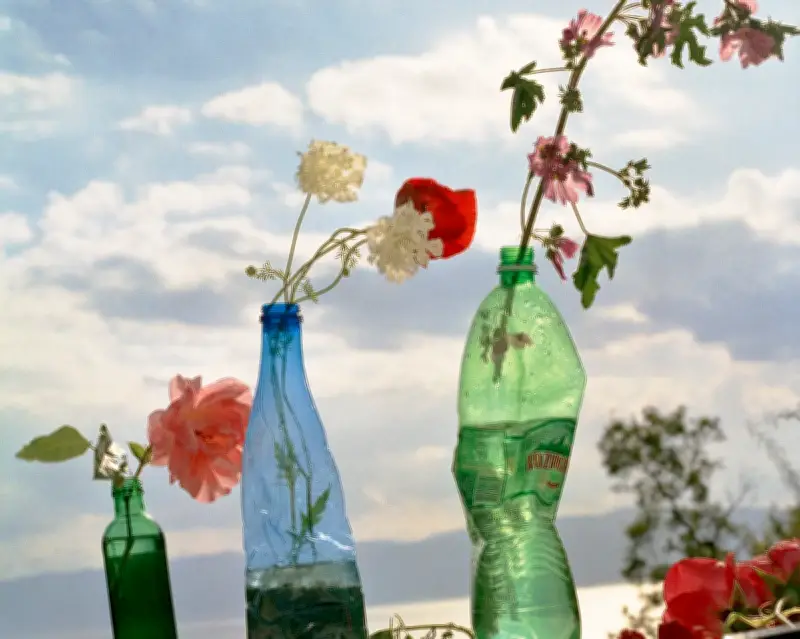
In Macedonia, Rozovsky was struck by untamed wild flowers, especially red poppies, growing without care. “At the same time there was barely a trash can to be found so bottles and cans were also strewn about,” she said. She collected bottles and placed them on the roof of her rental car as vases, with the mountains across the lake in Albania in the background.
Driving late at night, possibly in Croatia or Serbia, Rozovsky slept on the side of the road in March. “I noticed the car’s brake lights in the back mixing with the foggy dawn and the light of someone’s house in the distance like a moon that had descended to earth,” she said.