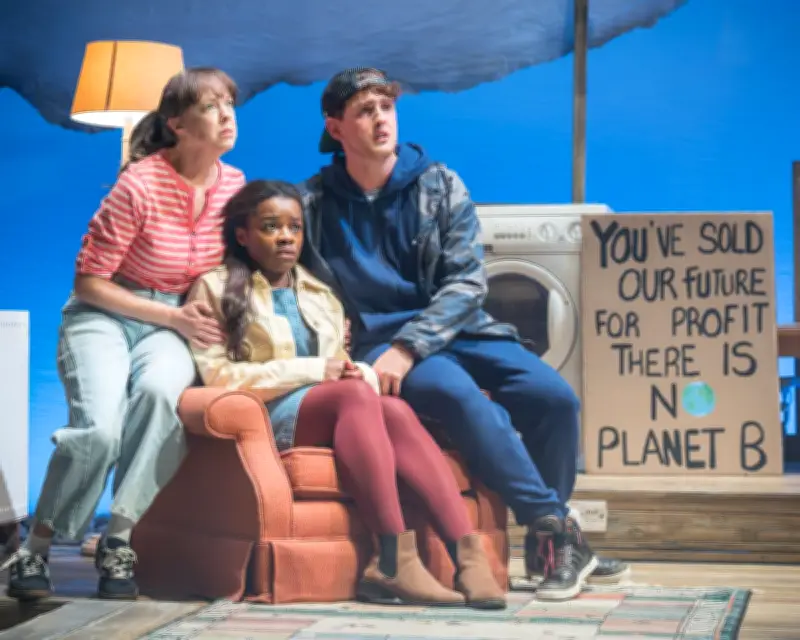
A convincing family dynamic … Catrin Aaron as Claire, Sara Otung as Astrid and Alfie Llewelyn as Phillip. Photograph: Marc Brenner
Atlantis review – Welsh climate crisis drama is a parable for our times
Theatr Clwyd, Mold
Emily White’s lyrical, if contrived, play is based on a real coastal village whose residents are being made climate refugees by rising sea levels. In 2014, residents of Fairbourne in Gwynedd discovered the local council had decided that maintaining sea defences was no longer tenable. Instead, as part of a process of “managed retreat”, this small coastal Welsh village would be abandoned to the sea by 2055.
This timeline has since shifted and been disputed, but while the village is not identified by name, it serves as the inspiration for Emily White’s Atlantis. Focusing on fisherman Bryn and his wife Gwen (Richard Elfyn and Vivien Parry), the action extends from 2011 to 2039, dramatising what has already occurred and imagining what is next as weather systems and a community both come undone.
These are certainly pressing and consequential concerns, and there is lyricism in the play’s unfolding sense of time, from the daily to the generational to the geological. But the beats of the domestic drama through which this catastrophe is refracted are often contrived. The dramatic tension is propelled by conveniently antagonistic exchanges, and exposition is overstated. It gestures towards deeper, more provocative issues such as the burden of environmental consciousness and the imperatives and sacrifices (and indeed the privileges) of activism. But despite its expanded timeframe, the narrative compacts too much into its two acts, and the rich potential of these themes feel underexplored as dramatic detail is elided.
Committed cast … Eirlys Lovell-Jones as Rhiannon and Vivien Parry Gwen, with Llewelyn. Photograph: Marc Brenner
The committed cast do well to fill the gaps. Parry’s matriarchal Gwen is an impassioned foil for Elfyn’s more curmudgeonly, sceptical tendencies. Catrin Aaron as their daughter Claire, with Alfie Llewellyn and a particularly effective Eirlys Lovell-Jones as grandchildren Phillip and Rhiannon sustain a convincing if sometimes inexplicably brusque family dynamic, which Sara Otung as Phillip’s girlfriend Astrid mollifies with a quiet dignity. Directed by Guy Jones, the production occupies a register that is hesitant to be a documentary but insufficiently figurative to be global. As a result, through its cariads and taids and cwtchs, one feels that Wales is sentimentalised as a timeless land of myths and legends, instead of a modern nation that – like every other country with coastline – will have to make decisions about what to do with climate collapse lapping at its shores.
At Theatr Clwyd, Mold, until 4 July, and Chichester festival theatre, 18 July to 15 August