Anish Kapoor, the Turner Prize-winning artist, is opening a major career-spanning show at London's Hayward Gallery. In an exclusive interview, he gives a private tour of his vast south London studio, discussing censorship, controversy, and why disobedience is central to making great art.
A Studio of Epic Proportions
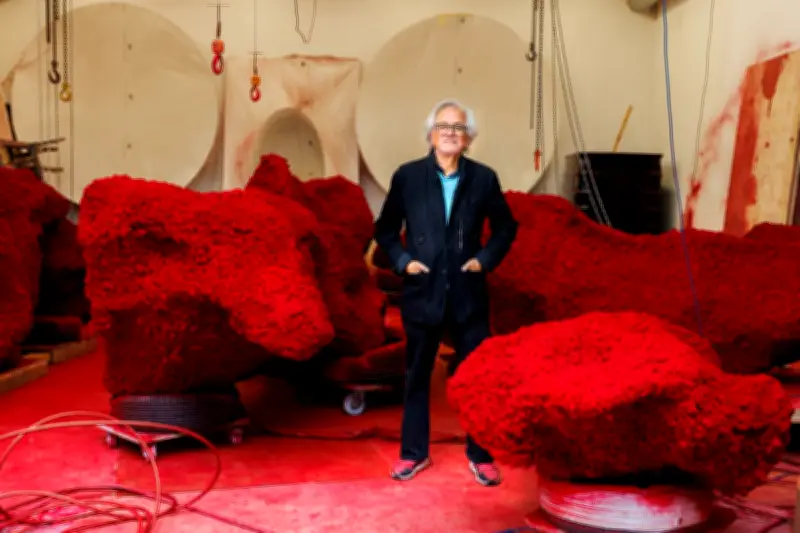
Kapoor's 3,100 sq metre studio complex in south London is a converted dairy factory, housing a staff of 23, including 11 studio assistants, nine office staff, and three stone masons at a yard in Battersea. Many have been with him for decades. The space is a labyrinth of rooms dedicated to different projects: large red installations, small black sculptures, exhibition layout models, lacquered concave mirror paintings, and archival drawings. In the upstairs meeting room, a weekly calendar spans eight sheets of A3 paper, with a long list titled "Unfinished Hayward Works" beneath it. On the windowsill sits a solid cylinder of concrete, excavated from the Hayward Gallery's floor, a gift from outgoing director Ralph Rugoff to celebrate Kapoor's 72nd birthday.
The Hayward Show: A Retrospective
Kapoor's show at the Hayward Gallery opens this week, marking his return to the venue that gave him his first major UK exhibition in 1998. He is one of the few artists invited back for a solo show. "I'm both excited and a little terrified," he says, particularly about pieces the public knows best. The exhibition includes his newest piece, All of Nothing, a red inflatable so large it cannot be seen in full, and Ritual Expiation, floor-based sculptures resembling blood and guts in metal trays. Iconic works like Descent into Limbo and Mount Moriah at the Gate of the Ghetto are also featured.
The Making of Ha Makom
Among the new works is Ha Makom, a giant red mountain-like structure with a signature void carved near its peak. Comprising 31 parts, it is destined for the Hayward. "It's a huge work," Kapoor says, gesturing around the room. Another piece, Ancestor, a meteorite-like form, has been in progress for months. Hazmat-suited assistants apply a red-tinted mixture of sawdust and resin to its pock-marked surface.
Career Highlights and Controversies
Kapoor came to fame in the 1980s with geometric sculptures covered in pure pigment. He represented Britain at the 1990 Venice Biennale, where he presented sandstone monoliths with carved black holes. His later works include Leviathan (2011), a palace-sized balloon; a 12.5-tonne red wax cannon shot at the Royal Academy (2009); and Orbit, a 1,500-tonne steel sculpture for the 2012 London Olympics. He won the Turner Prize in 1991 and the Wilhelm Lehmbruck Prize last year, and is a Royal Academician, French Commandeur de l'Ordre des Arts et des Lettres, and a knight. In 2015, he was one of nine artists featured on British passports.
Despite these accolades, his work has attracted criticism. Orbit was called "a messy, meaningless, plutocrat's plaything." His exclusive license to use Vantablack, the "blackest black," sparked outrage among other artists. Kapoor defends the material, saying it's not paint but a military-grade coating.
Disobedience and Artistic Freedom
Kapoor's studio walls bear the words "disagree, disobey, disavow." He believes disobedience is vital to invention. "It may well be that that's my naughty schoolboy attitude to things. But I do believe it's really important. Disobedience sits alongside invention. It is radical, and I think it is vital."
He has never shied away from politics. He collaborated with Greenpeace to install a blood-red canvas on a North Sea gas rig and has spoken out against voter ID laws, Brexit, and the treatment of Shamima Begum. He criticizes the UK government's approach to pro-Palestine protests, calling it outrageous.
Identity and Art
Kapoor rejects the idea that art should be defined by personal biography. "We can inhabit other states, in all sorts of ways. That is one of the beauties of human consciousness, and I think it's a great disservice to trap the artist." He goes to museums to be surprised and inspired.
At 72, Kapoor continues to make new work that surprises even himself. His challenge is to combine the personal with artistic reinvention and a rebellious mindset. "Anish Kapoor is at the Hayward Gallery, London, 16 June to 18 October."