Novelist Xiaolu Guo, on a journey through China with her 11-year-old daughter Moon, explores the legacy of the Tang dynasty, a period she describes as a proverbial high point of world culture. The trip, which begins in Xi'an, the Tang capital, is an attempt to reconnect with her heritage and to explain the Chinese past to her daughter, who was born and brought up in England.
The Journey Begins in Xi'an
Guo and Moon arrive in Xi'an by high-speed train from Beijing on a searingly hot July day. They stay in a traditional-looking hotel, where they encounter a group of businessmen in black suits, smoking and speaking loudly in Shanxi dialect. The room reeks of smoke, prompting them to venture out immediately. They visit the Giant Wild Goose Pagoda, a Tang-era monument rebuilt in the 16th century after an earthquake, but are not allowed inside due to its fragility.
Guo reflects on Xi'an's history as a palimpsest of cultures, noting that unlike Rome or Athens, nothing in China remains as ruins; the government either recreates the supposed original or builds something new. The city walls, she reads, are 14km in length, mainly built in the Ming dynasty, but the original was Tang.
Teaching History to a British Child
At a street market, Moon asks about lotus root slices, and Guo begins to think about how to educate her daughter about China's immense past. Moon, whose first language is English, finds history difficult to enjoy, but Guo insists, "If you do not know your history, you won't know who you are!" Guo tries to explain the Qin dynasty, Emperor Qin Shi Huang, and the Great Wall, but struggles with the Chinese calendar, which counts years by emperor and dynasty rather than BC/AD.
Guo notes that Xi'an was one of the world's largest cities in the early seventh century, with an estimated 1 million people living within the city walls. By the dynasty's end in the ninth century, the country's population had grown from 50 million to 80 million. She observes that numbers are essential for contemporary Chinese people, who grew up under a governing party obsessed with numerical record-keeping.
The Terracotta Army and the Old Book of Tang
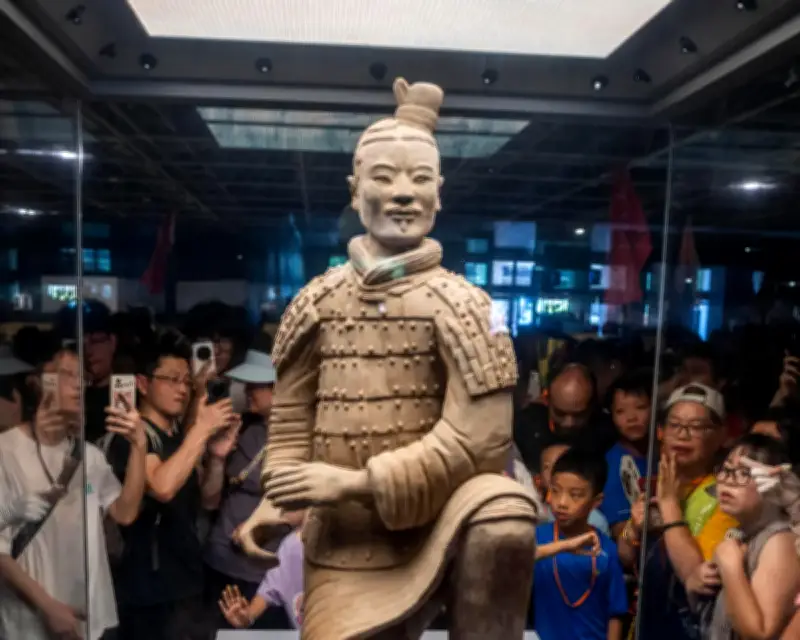
At the Qin tomb site, Guo and Moon join a throng of tourists viewing the terracotta warriors, which are from the Qin dynasty, not the Tang. Guo tells Moon, "If there had been no Qin dynasty, then there would be no Tang," and Moon compares it to the Greeks and Romans. Guo asserts that ancient Chinese culture was as rich and advanced as ancient Greek culture.
Guo mentions the Old Book of Tang, a 200-chapter chronicle of the Tang era written by court ministers, comparing it to the Anglo-Saxon Chronicle and the Domesday Book. She explains that the palace diary was kept by the ladies of the palace, a tradition that highlights the role of women in Tang court culture.
Women of the Tang and the Grand Canal
At the Huaqing hot springs, Guo tells Moon about the five famous sisters of the eighth century who kept the court diary and wrote the Analects for Women. They were educated in poetry and politics, and Emperor Taizong recruited them into palace service as xueshi, masters of learning. Guo reflects that women in the Tang became artists and fashion-makers, changing the tradition of veiled women, and she wonders if it is pretentious to call the Tang one of the earliest feminist eras.
Guo also connects her life in London, where she lives by Regent's Canal, to the Grand Canal in China, the longest and oldest artificial waterway in the world. She first saw the canal in 1993 when she moved to Beijing to study at the Beijing Film Academy, and she reflects on the contrast between the Tang's cultural richness and the Cultural Revolution's functional poverty.
Luoyang and the Longmen Grottoes
Guo and Moon take a high-speed train to Luoyang, the Tang's eastern capital, where Wu Zetian constructed the tallest palace in Chinese history. They visit the Longmen Grottoes, one of the largest Buddhist sites in the world, with 100,000 statues and more than 2,345 caves. Guo reflects on the sublime feeling these monuments induce, similar to Stonehenge or the Egyptian pyramids.
The Qianling Mausoleum and the Afterlife
At the end of their trip, Guo and Moon visit the Qianling Mausoleum, where Tang emperors and empresses are entombed. They enter the tomb of Princess Yongtai, who died at 15, apparently while giving birth, though the New Book of Tang records she was caned to death for disloyalty to Empress Wu. They learn that the tombs of Emperor and Empress Wu are not excavated and cannot be entered.
Walking among the headless statues along the road, Guo thinks of John Keats's "cold pastoral" and feels a shiver in the heat, wondering if time itself is touching their fragile bodies. The journey ends with a sense of lingering mystery and a deeper connection to the past.