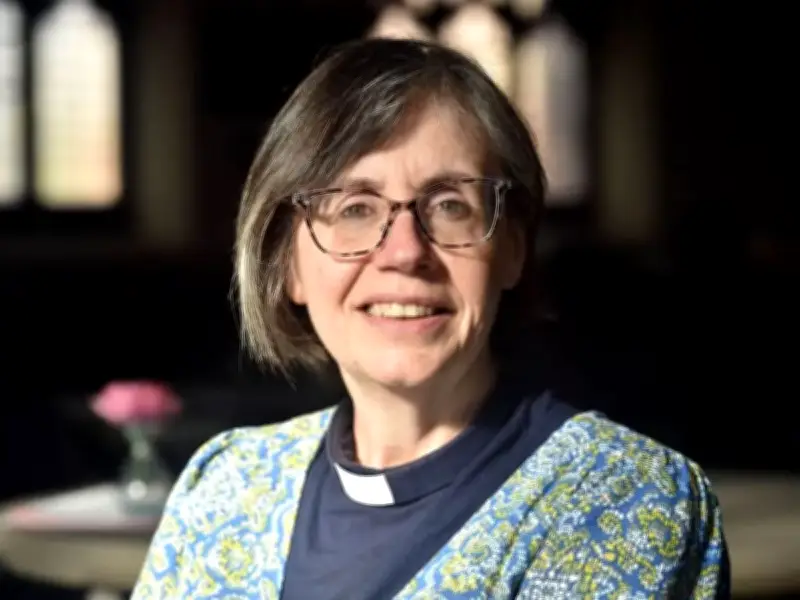
A Wigan vicar who leads five churches, including one where the Prime Minister is a food pantry member, is backing a campaign urging the government to commit to free school meals for every primary school pupil in England.
The Rev Sandra Jones, a former primary school deputy headteacher, said she has seen the impact of hunger on children and the difference a healthy, balanced dinner can make.
"I'm not against jam butties, my own children when they were little, I know jam butty is better than nothing," she said. "But you would see the variation in the lunch boxes. If you can offer a child a good balanced meal it helps with concentration, it helps with learning it helps with their life chances."
Prime Minister's pantry membership
Ms Jones, who leads five churches in Wigan, including in Andy Burnham's Makerfield constituency, is backing the National Education Union's campaign. The Prime Minister is a member of a food pantry at St Thomas Church in Ashton-in-Makerfield, and Ms Jones hopes that experience will persuade him to support the campaign.
"I know there are a lot of people who will say 'Oh well there are parents who can afford it'," she said. "But there are people who are just above the poverty line, so they are not getting free school meals. For me they are the parents who are struggling the most. It's a vicious circle for some people and they are living hand-to-mouth."
"You have to pay your council tax, your mortgage, your gas and electric, and what's the one thing you cut back on? It's your food, because that's the one thing you can cut back on and this is having an impact on so many children."
Prayer at church conference time
On Sunday morning Rev Jones will lead a specially-written prayer on behalf of hungry children at St Thomas' Church, to coincide with the start of the Labour Party conference in Liverpool.
"Andy has been to our food pantry, we signed him up as member the last time he came," she said. "He is already invested in helping people. To me it's a no-brainer. I know it would be a huge cost, but I'm sure it's a cost worth considering. Do we want to invest in the future of our children or not - that's basically the question."
The governments of Scotland and Wales have already introduced free school meals for all primary pupils, while London followed suit at the start of this school year. In England all children in maintained schools are entitled to free school meals up to the end of Year 2.
Cost and impact
This month the Government also expanded free school meals to include children from families claiming Universal Credit. Extending it even further to cover all primary school kids in England would cost more than £1bn a year, but experts says children perform better in schools and are healthier thanks to a nutritious diet.
Mum-of-one Priscilla Rodrigeuz, of Wigan, has a daughter who has just started Year 3. She estimates the family spend around £120 a month on school meals. "I'm Asian, so I prepare real food," said Priscilla, who is originally from the Philippines. "Every day I spend 30 minutes making her meal - chicken stew with rice, noodles, fresh fruit and vegetables."
"My daughter loves fruit, but it's so expensive. Last Saturday we went shopping at Aldi. A small pack of blueberries was £4. We spent around £13 on blueberries, strawberries, blackberries. Luckily at the moment me and me husband are both working, so we can provide that, but we don't know what will happen tomorrow or in the future. And that £120, by next month it will increase."
"Food, electricity, petrol, everything is getting more expensive, but our wages aren't going up. I come from third world country. I know how it feels to have a hard life and I know what a difference this could make for all children."
The Office for National Statistics found that the price of food increased by 30% between April 2022 and July 2026. And recent polling from YouGov commissioned by the NEU found that almost a third of parents have made cutbacks to their food shop to cope with the cost of living.
Working families squeezed
Sairah, a 40-year-old, mum-of-two from Withington, works full-time, while her husband works as a taxi driver. Her youngest son has just started nursery, while her eldest went into Year Three this time round, meaning both are ineligible for free school meals.
Sairah says their school charges £2.85 per dinner, which for the two boys adds up to around £170 every half-term and more than £1,100 across the school year. "We worked out that it's just under one person's monthly wage," said Sairah. "It's a lot of money and it places a significant strain on our budget."
"We discussed going with packed lunches, but with everything going up in price now - especially trying to provide a healthy packed lunch, don't get me started on the price of raspberries, it's extortionate - you're not actually saving that much. As working parents I feel like we are kind of forgotten about a little bit. I would definitely describe ourselves as the squeezed middle."
During her childhood in Fallowfield, both of Michelle McHale's parents worked, but at times the family struggled to make ends meet, meaning she was often a free school meals kid. And Michelle, a trustee at anti-poverty charity Bridging the Gap Manchester which runs Manchester South Central Food Bank, says she now sees many other families in the same situation.
"We are seeing working families struggling, parents accessing food banks," she said. "They are having to make difficult choices about hot school meals, or they are cobbling together packed lunches and they can't spend as much money on their evening meal. It's a consistent pressure families are having to face. Hunger holds children back."
"It affects everything. No child should be sitting in the classroom going hungry, but this is the reality for many families today. It's outrageous. It's not something we should even be talking about."
Daniel Kebede, National Education Union General Secretary, said: "With free school meals for all, we could end the scandal of child hunger in schools, and remove the stigma and shame that divides pupils in the dinner hall and leaves its mark on young people for decades to come."
"England is being left behind. Other countries are adopting school food programmes that drive nutrition, education and wellbeing. A unified policy here will make a huge difference."
A Department for Education spokesperson said: "Our expansion of free school meals to every child in a household on Universal Credit, combined with the removal of the two-child limit, is set to deliver the largest reduction in child poverty in a single parliament since records began. Backed by over £1 billion in funding, this historic expansion means more than three million children across the country now have access to a free school meal."
"That is alongside broader action to give people the breathing space they need including expanding childcare, rolling out free breakfast clubs across the country, cutting back on uniform costs and cutting energy bills."