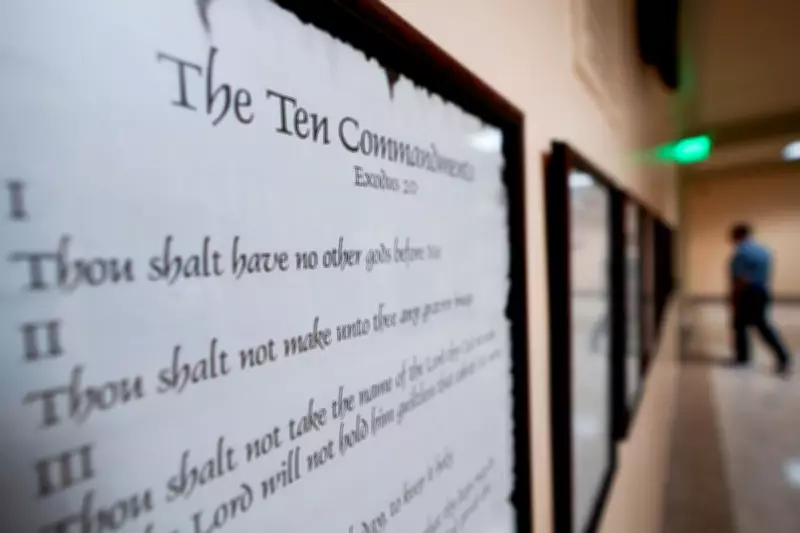
Tennessee Senate Mandates Ten Commandments Display in Public Schools
The Tennessee Senate has passed a controversial bill requiring all public schools to display copies of the Ten Commandments in prominent locations alongside foundational historical documents like the Constitution and Declaration of Independence. The legislation, approved by a vote of 27 to 6 on Thursday, has ignited fierce debate about the separation of church and state and sets the stage for potential legal battles that could reach the Supreme Court.
Democratic Opposition and Legal Concerns
Democratic senators voiced strong opposition during floor debates, arguing the bill inappropriately mixes religion with public education. Senator London Lamar, a Memphis-area Democrat, emphasized that schools should focus on core academic subjects rather than religious instruction. "Our children need to be learning about reading, writing, arithmetic, science, and technology to prepare them as a world-class generation," she stated. "Religious teaching belongs with churches, parents, and private entities, not public classrooms."
Senator Jeff Yarbro of Nashville warned that the legislation would inevitably lead to costly litigation funded by taxpayers. He suggested legislators should focus more on following the commandments themselves rather than mandating their display in educational institutions.

Republican Support and Legislative Details
Republican supporters defended the measure as honoring America's ethical foundations. Senator Mark Pody, the bill's sponsor, insisted "We are not forcing religion on anybody. We are acknowledging that the Ten Commandments were among the founding principles that shaped our nation."
The Senate version, designated SB 303, makes displaying the commandments mandatory, while a previously passed House version makes it optional. The two chambers must now reconcile these differences before the legislation can become law. The House Education Committee is scheduled to consider the bill on March 24.
National Context and Legal Precedents
Tennessee joins a growing number of Republican-led states pursuing similar legislation. Louisiana became the first state to pass such a law in 2024, though its implementation faced immediate legal challenges. In February, a federal appeals court overruled a lower court's block of the Louisiana law, finding challenges premature since posters hadn't yet been displayed.
This week, a federal court struck down a comparable Arkansas law, with Judge Timothy L. Brooks questioning the relevance of religious texts in secular classrooms. "Nothing could possibly justify hanging the Ten Commandments in a calculus, chemistry, French, or woodworking class," he wrote in his ruling. Arkansas has vowed to appeal this decision.
Meanwhile, a federal appeals court has heard arguments regarding Texas's Ten Commandments law but hasn't issued a ruling. This patchwork of conflicting court decisions increases the likelihood of a Supreme Court review, which would test how the conservative-leaning court interprets religious liberty in public education.
Broader Legislative Trends
The same day the Tennessee Senate passed the Ten Commandments bill, lawmakers also approved the "Charlie Kirk American Heritage Act," named for the slain conservative activist. This separate legislation permits public schools to teach about religion's positive historical impacts, though it doesn't mandate such instruction.
These developments reflect a broader national movement among Republican legislators to increase Christian influence in public schools, setting up significant constitutional questions about the boundaries between religious expression and state establishment of religion in educational settings.