Guardian Cartoonists Rowson and Baron Face Off in Unique Trump Drawing Challenge
In a fascinating artistic duel, two of the Guardian's most prominent political cartoonists, Martin Rowson and Ella Baron, have gone head-to-head in what they term a "cartoon-off". The challenge saw both artists tasked with creating cartoons on the same subject – Donald Trump and a world in turmoil – on the same day, revealing stark contrasts in their methods, styles, and perspectives.
Contrasting Techniques: Analog Tradition Versus Digital Innovation
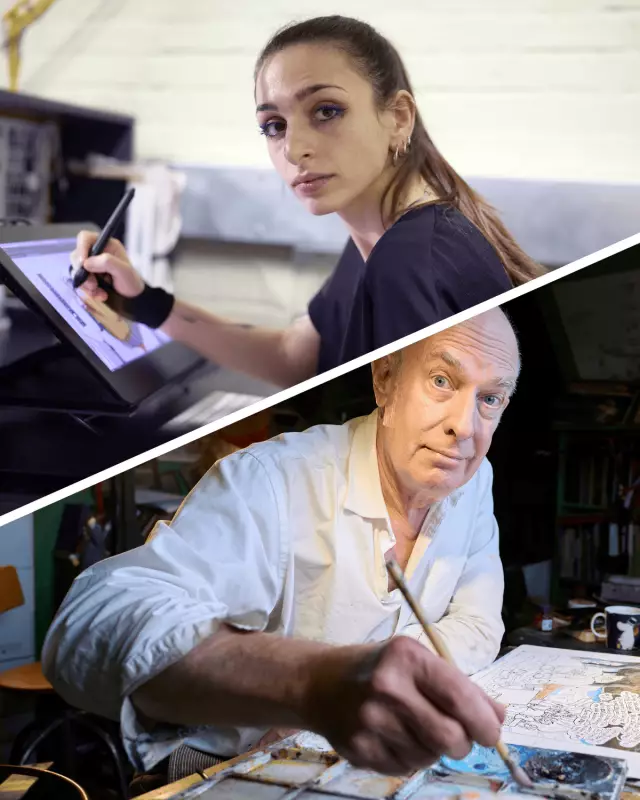
Martin Rowson, who has been contributing to the Guardian since the 1980s, describes himself as "old school". He works exclusively with traditional materials, using pencils, pens, brushes, gouache, and watercolour on paper. "I make marks with something runny on a flattish surface," he explains, embracing what he calls his "ludditism". Rowson cherishes the tactile experience and the "jeopardy" of working with physical media, where mistakes cannot simply be undone with a click.
His process begins each morning with the 7am news headlines, after which he rapidly collides images and scenarios in his mind to form a clear concept. He then sketches in pencil, inks the outlines, and builds up layers of paint. Each cartoon takes approximately six hours from blank sheet to completion, drawn 50% larger than its final printed size to accommodate detail and last-minute developments in the news.

In stark contrast, Ella Baron, who joined the Guardian in 2022, works entirely digitally using a Wacom Cintiq tablet and stylus. She rejects the notion that this isn't "drawing by hand", emphasising the sensitivity of her tools to pressure and rotation. Growing up with easy access to digital technology, this method is intrinsic to her style. Baron appreciates the ability to refine lines with precision, zooming in to tweak individual elements that would risk damaging paper.
Artistic Philosophies and Political Commentary
Rowson operates within what he calls the "great English tradition" of satirical artists like James Gillray and William Hogarth, filling his canvases with dense detail. He deliberately avoids immersing himself in extensive news analysis, believing the paper and its readers want his unique interpretation. "What the paper and its readers want is my analysis, not theirs," he states, having not listened to the Today programme for over thirty years.
For Baron, political cartoons serve to "cut through" the news rather than encapsulate it entirely. She describes them as hypothetical twists on reality that offer new perspectives. "It's a way of holding power to account," she notes, emphasising how cartoons can place powerful figures in close proximity to those affected by their decisions. She finds symbols and idioms particularly useful, preferring to draw metaphorical concepts like "feathered nests" over literal depictions of "men in suits".
The Trump Challenge: Two Distinct Visions
When confronted with the challenge of depicting Trump and global turmoil, their approaches diverged dramatically. Rowson conceived a Shakespearean scene featuring a warped "King Leer" surrounded by snickering world leaders. His Trump has evolved over the decade, becoming "older, flappier, fleshier and madder", though still requiring copious amounts of orange paint.
Baron envisioned Trump squatting in a dystopian nest surrounded by his spoils, using the imagery of plucking feathers to undermine his ego. She focuses on the slippages in Trump's self-projected image – the orange tan that stops at necklines and wrists, the pale patches visible through his comb-over. "I'm interested in the ways in which the image he projects of himself slips," she explains.
Mutual Respect and Evolving Traditions
Despite their methodological differences, both cartoonists express deep admiration for each other's work. Rowson acknowledges that Baron and his digitally-inclined colleagues represent "the way forward", though he regrets the potential loss of the "messiness" he associates with traditional methods. He admits that how Baron produces her "extraordinary work is a total mystery" to him.

Baron, who has admired Rowson's work throughout her life, acknowledges how his caricatures have shaped her perception of politicians. She now faces the "more complicated task" of differentiating her own approach. Initially feeling pressure to prove herself in a male-dominated field by removing femininity from her cartoons, she has gradually been trying to reintroduce it with growing confidence and experience.
Both artists agree on the enduring importance of political satire in an era dominated by figures like Trump. As Rowson puts it, their work serves to "enrage his cultists but comfort and empower the rest of us, the victims of his increasing, capricious madness". Their contrasting methods – one embracing traditional messiness, the other digital precision – demonstrate how political cartooning continues to evolve while maintaining its vital role in holding power to account.