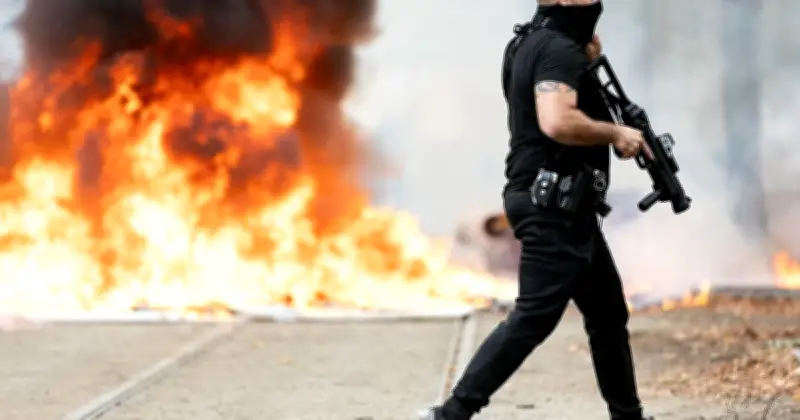
Violence has erupted across France as furious youths torch buildings, attack police and firefighters, and leave a £65.5 million school gutted by fire. Thousands of secondary school pupils have taken to the streets in recent days, with disorder spreading from Paris to Marseille, Rennes, Strasbourg, Lyon, and Lille.
Protests turn violent
The protests began over complaints including overcrowded classrooms, heavy workloads, and shortages of teaching staff. However, the demonstrations have descended into violence, with almost 2,000 arrests made since Monday and 305 security personnel injured, according to French Interior Minister Laurent Nunez.
Mr Nunez described the violence as "intolerable" and vowed those responsible for attacks would be "found and brought to justice".
Shocking footage showed a policewoman being chased through the streets before being knocked to the ground. The youths could be heard shouting "Wallah, kill her". Other footage showed protesters using deodorant cans as makeshift flamethrowers against women, while teachers were also attacked.
School engulfed in flames
Firefighters called to tackle blazes have themselves come under attack, with rioters throwing missiles and setting fire engines alight. One of the most dramatic incidents came in Nantes, where the Nelson Mandela High School was engulfed in flames. The school was built in 2014 at a reported cost of £65.5 million (€77 million).
Images showed the building badly damaged after the fire, with large sections left gutted. French Education Minister Edouard Geffray said a school had been set on fire during Thursday's violence and staff had been doused with petrol. He ordered that classes be held remotely where blockades or damage meant schools could not safely open.
Mr Geffray said: "Violence will not deprive our students of their fundamental right to education." More than 400 schools are due to close on Friday amid fears that the unrest could continue.
Government response
France's Prime Minister Sébastien Lecornu convened a crisis meeting and ordered ministers to cancel planned trips so the Government could concentrate on containing the unrest. A French security source told CNews there had been an "intensification" of the disorder, with a "shift with a change in discourse, more radical" and increasing "urban violence around schools".
The Government has accused Jean-Luc Mélenchon's France Unbowed movement of contributing to an "irresponsible escalation". French intelligence services reportedly believe the unrest is an "organised manoeuvre" involving the party and what they described as its ultra-left proxies.
Mr Mélenchon has denied encouraging violence and said he supports "non-violent methods of struggle". He has instead accused police of using excessive force against young protesters. Mr Mélenchon said: "I am very worried about the police violence against young people." He added: "One young person has already been blinded in one eye. Most of us are parents. What if it were our own?"
Political and financial context
The unrest comes as France faces mounting financial pressure and prepares for next year's presidential election, with President Emmanuel Macron unable to seek a third consecutive term. Public debt stood at €3.596 trillion at the end of June, equivalent to 119% of GDP, according to France's National Institute of Statistics and Economic Studies. The Government has proposed €54 billion in spending cuts for next year's budget as it attempts to tackle the country's finances.
The turmoil has also become a political flashpoint, with National Rally president Jordan Bardella blaming decades of what he described as "laxity and mass immigration" for the violence. Mr Bardella said the attack on the policewoman showed "what France has become".
Across the Channel, Reform UK leader Nigel Farage said he was "horrified by the violence" and described the scenes as a warning over the consequences of hard-left politics. Zia Yusuf, the party's home affairs spokesman, also said the violence should serve "as a warning to Britain".