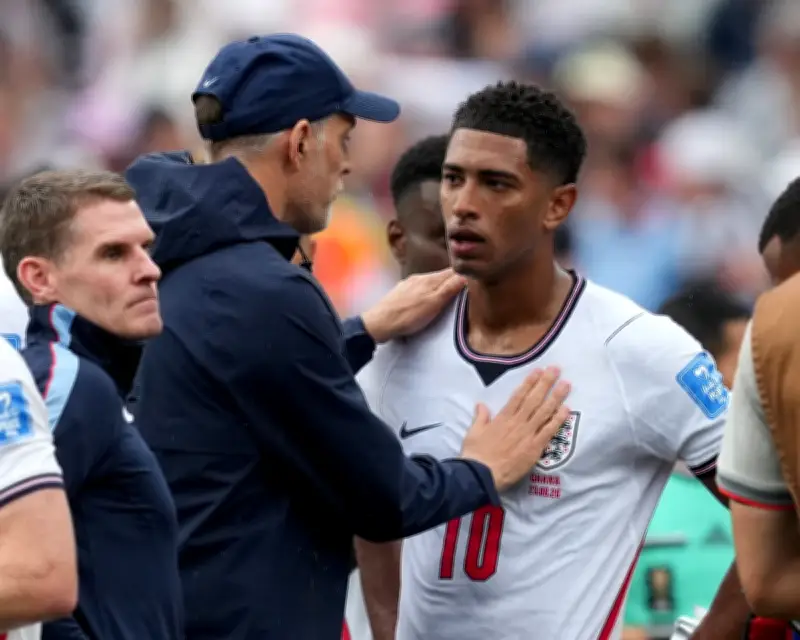
Thomas Tuchel's handling of Jude Bellingham will be key to England's hopes, but the difference between Gareth Southgate and Thomas Tuchel is not as simple as ruthlessness. Cath Bishop argues that the assumption that Tuchel gave his team a rocket against Croatia at half-time is wrong; he did the opposite.
Rejecting the 'Rocket' Narrative
The dominant simplistic narrative that accompanied the shift from Gareth Southgate to Thomas Tuchel was that the former wasn't ruthless enough and therefore the latter will be more ruthless. There are already assumptions and interpretations of Tuchel's actions and words being made through that lens which need challenging. Gary Neville asserted in the second half of England's first match against Croatia that Tuchel had obviously 'blasted them' and given them 'an absolute rocket' at half-time, no doubt remembering his own experiences. Yet Tuchel explained afterwards that in the first game he gave the players some calm time and then in those few short critical moments, chose to remind them explicitly: 'Even if we lost, it will not change my perception of you from the last 17 days, but let's do it our way.'
Psychological Astuteness
How many coaches would feel comfortable, confident and understand why mentioning losing at half-time is a really smart thing to do? It contradicts the outdated but persistent mythology that this might be a moment to be aggressive, cry for victory and deploy some winning rhetoric. Contrary to any 'rocket', Tuchel focuses first on calmness and through his psychological astuteness, breaks the oldest taboo in sport. By acknowledging that losing is a possibility, Tuchel releases tension and reduces the power from a fear of failure to paralyse the players. Psychology explains how a fear of failure becomes less disruptive when it is acknowledged rather than resisted. Accepting the possibility of losing actually frees up the mind to focus back on the performance. It's not about lowering standards but finding the best way to raise them.

Unconditional Support
Tuchel also reassures the players that his view of them won't be changed by the result. It's quite intimate and deeply human to understand that what the players need most in a vulnerable moment as people rather than just football players in order to come together and better focus on playing 'our way'. The outcome clearly matters but he clarifies their worth as players and people doesn't depend on that. It's arguably the most powerful thing a coach can say to a team under massive pressure and removes the always dangerous, hidden threat of turning a high-stakes match of football into a test of self-worth. We've seen how damaging it can be to conflate winning with self-worth from any number of high-profile athletes' stories such as Andre Agassi, Adam Peaty and Bradley Wiggins. Acceptance, or we could call it unconditional love, comes before the result, not after it. It's no coincidence perhaps that in a short video to grassroots coaches, Tuchel's top tips are to coach with love and passion, be in the moment and love your team, and trust your courage and creativity. Love is explicit in two out of three.
Performance-Focused Language
Before the Ghana game, Tuchel stated that they wanted to win, but that a draw was OK. Simply giving facts rather than increasing the pressure with winning talk. This is a feature of the coaches' consistent performance-focused language which we are hearing. Some perceived that the assistant coach Anthony Barry was highly critical of the players at half-time in the Croatia game. What I hear from both coaches is always tightly focused on performance and avoids any blame or judgment of the players. It's an ongoing analysis of what's working, what needs to improve and what they will change – the three critical questions of a high-performance mindset that elite athletes and coaches use all the time to maintain and drive ever-higher standards, regardless of whether you're winning or losing. It's a strong characteristic of a performance environment that is positive, safe and ambitious and necessarily founded on radical candour to tell it how it is.

Consistency and Connection
Performance is about executing your plan to ever higher standards and constantly adapting that plan as you learn. It's the best route to the result you want, while acknowledging external factors also play a role, whether that's luck, injuries or VAR. Tuchel and Barry remain consistent in their analysis of performance regardless of the result, which is why the press conferences sounded so similar after both games. Each time they simply describe what's working well and what they're working to improve. This consistency is extremely important for the players to keep focusing on improving as long as they're in the tournament and contrasts multiple commentators and pundits who remain fixated on discussing and analysing results that now can't be changed. In Olympic rowing, we call it the focus on 'making the boat go faster' in everything we do. Rather than focusing on a future result that we can't fully control or personally criticising individuals, feedback is always about what we need to do next to go faster. Whether we're winning or losing, it's always in our best interests to focus on how we can make the boat go faster together on the next stroke.
This links us to Tuchel's favourite word: 'connection'. Sometimes he seems to use it in every sentence. Tuchel complained bitterly to Fifa about the photographers blocking him during the national anthem because he wanted to 'connect' with his team in that special moment. He answers questions about Bellingham by explaining how he connects into the team. His early approach towards Bellingham was to leave no doubt as to the importance of being a team-player committed to 'our way'. The decision to leave out Phil Foden and Cole Palmer was due to 'cohesion'. Connection is a critical performance tool. It's not separate from tactics, it's what enables tactics to work at speed.
The sports psychologist Jeremy Holt notes that after counting 'we' and 'us' in the speeches of political leaders, the winners leaned on those words more than those who lost (indeed you can see this in Keir Starmer's resignation speech this week that used 'I' throughout and Andy Burnham's byelection campaign motto, 'Andy for us'.) Holt then highlights: 'Tuchel and Harry Kane go further still.' Beyond the highs and lows of the scores, we are all getting a fascinating team leadership masterclass.