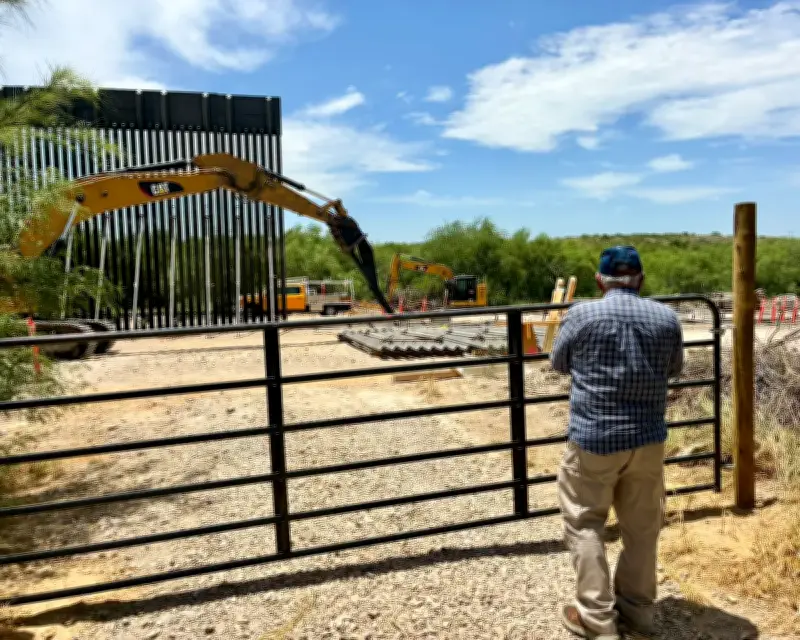
Residents of San Ygnacio, Texas, have temporarily halted federal border wall construction on private land, citing lawsuits and a 1951 precedent, but the reprieve is precarious. The small town of roughly 400 people has stopped construction on disputed riverfront property for now, though the reprieve is a verbal concession, not a court order.
Construction on private land
Joel Ruiz, 90, has lived and run a small fishing business on his riverfront property for decades. In July, heavy machinery gouged the earth and a steel barricade of 30ft-high bars was erected across the riverfront, including on his property just across the Rio Grande from Mexico. Residents say nearly all the riverfront land in the county is privately owned, but the government is building on it anyway, claiming a decades-old right.
The construction is part of the Trump administration's renewed border-wall push, a roughly $46.5bn expansion funded by the One Big Beautiful Bill Act. The Rio Grande is also San Ygnacio's sole source of drinking water, and the wall is being built in its floodplain. To expedite construction, the Department of Homeland Security (DHS) waived 30 federal laws, including the Clean Water Act and the National Environmental Policy Act, eliminating the environmental review that would normally accompany a project of this scale.
Community resistance
Residents have blocked bulldozers, been arrested, unearthed 75-year-old land records, and filed lawsuits challenging the federal government's authority to build here. Elsa Hull, who owns property downriver with her two daughters, was arrested twice. She spent 25 years as an environmental investigator for the Texas commission on environmental quality. "Every part of my life is intertwined with the Rio Grande," Hull said. "To me this river is sacred."
The Laredo-based Rio Grande International Study Center (RGISC) commissioned its own environmental assessment, which warned that the wall and buoy system would worsen flooding and, in places, fail outright. "This is life or death for us," said Tricia Cortez, the center's executive director. "The wall will straitjacket the river, forcing flood waters to rise and move faster."
A precedent from 1951
San Ygnacio had fought the federal government for this land once before, and won. In 1951, when the government built the Falcon dam and scheduled San Ygnacio to be condemned and cleared for the reservoir, more than 200 people signed a petition opposing the measure. The government carved San Ygnacio out of the condemnation, the one stretch along the river bend spared from the reservoir.
Frank "Chip" Briscoe, an architectural conservator, and attorney Ricardo de Anda searched subsequent property records and found no evidence that the federal government had later acquired the excluded land. De Anda met with the US army corps of engineers on Ruiz's behalf, sent a warning letter, and filed two lawsuits against the federal government, alleging it took private property in violation of the fifth amendment. Two more landowners are preparing to sue, and De Anda plans to sue the contractor, Southwest Valley Constructors, in state court.
About a month later, according to De Anda, the county attorney arranged a meeting with contractors and federal officials. "They agreed to stop," he said, and the crews pulled back – for now. The lawsuits are unresolved, the federal money set aside for construction remains in place, and residents know the crews could be back.
Back on Ruiz's land, people have stopped coming to fish; when construction began, it blocked his boat ramp access. The small fishing business he ran here is now, in his words, "kaput". Still, Ruiz keeps coming to the river. In 1973, he helped establish a bird sanctuary beside his property. "My baby," he called it. "I built it." When asked whether his daily walks down to the river had become a way of watching for the crews to return, he shook his head. He was here "just to be here", he said.