Tens of thousands of protesters took to the streets in Madrid, Barcelona, and Valencia on Saturday, October 3, demanding stronger tenant protections amid Spain's housing crisis. Organizers reported that 500,000 people participated in 50 coordinated marches, with many holding signs reading 'right to a roof' and chanting 'your profits, our misery'.
The protests came a day after Prime Minister Pedro Sánchez's government failed to secure parliamentary backing for emergency housing legislation that would have strengthened tenant protections, curbed evictions, and restricted investment funds from buying residential properties. Mass tourism has significantly impacted the housing market in Southern Europe, especially regarding short-term rentals, making it nearly impossible for locals to compete with tourists willing to pay premium prices for holiday lets.
Snap election announced
Early on the morning of October 5, Sánchez officially announced an early election in November, admitting that his government has 'made mistakes and have not managed to do everything we set out to do'. He added: 'The time has come for the Spanish people to decide what future they want for themselves and for their country.'
Last month, activists camped outside the home of an 87-year-old woman in Madrid after an investment firm raised her rent, forcing her eviction. Maricarmen, who relied on volunteers to help pack her belongings, had lived in the flat for 70 years. This case is one of several where locals have expressed frustration over housing conditions.
Anti-tourism demonstrations
Anti-tourism demonstrations often take place across mainland Spain, Mallorca, and the Canary Islands, particularly in the summer. In July, grassroots collective Menys Turisme, Mes Vida (Less Tourism, More Life) gathered 30,000 protesters in Palma, Mallorca to march against the growing number of visitors. Arguing that Mallorca is officially 'at its limit', the group issued a declaration on social media criticizing the government for prioritizing tourism while 'the resident population suffers an unprecedented housing crisis and a progressive decline in living conditions'.
Days before the October protests, in solidarity with Madrid, 45 people in Gran Canaria camped outside the headquarters of the Government Delegation in Canarias. Property prices in Spain are about 13% higher than one year ago, according to the INE's 2026 national housing price index. Officials have introduced a ban on short-term rentals in Barcelona by 2029, but locals have made it clear they want more to be done.
Protests and clashes
One of the biggest marches took place in Madrid, where some people had camped in one of the city's main squares for days. During the protest, locals held banners reading 'There won't be peace for rentism' and 'I study to have a future, not to have a tiny apartment'. They also reportedly shook keys and chanted: 'We have the keys of all the city'.
Speaking with local news outlet RTVE, one protester shared: 'We're not here for pleasure or comfort. We're here out of conviction.' Another protester, 26-year-old librarian Marcos Sainz, told AFP news agency that he used to share a two-bedroom flat with friends, paying 900 euros (£766) a month in rent. Today, he claimed that a one-bedroom flat often costs 1,000 euros, if not more.
While demonstrations remained mostly peaceful, a spokesperson for the Valencia Tenants' Union admitted that there was a 'lot of anger in the streets'. At one point, protesters in Valencia clashed with police officers near the arts centre Palau de les Arts Reina Sofía, where a real estate summit was taking place. When demonstrators began throwing objects at officers, they were met with rubber bullets.
General strike plans
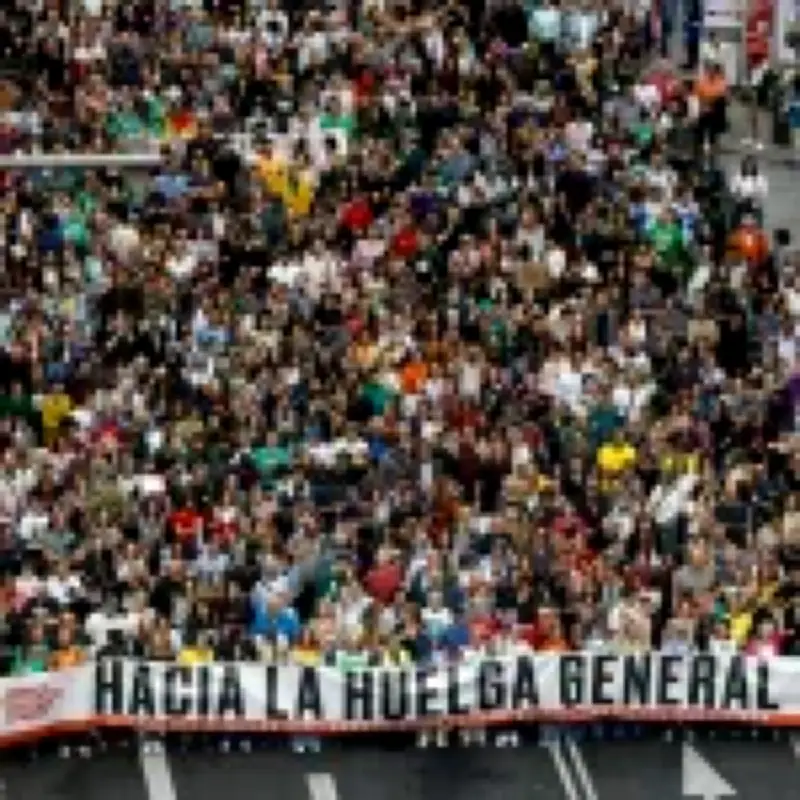
The snap election is due to be held on November 29. However, this may not be swift enough to call off the protesters' plans. At the march in Madrid, demonstrators at the front of the parade held a banner reading 'Towards the general strike'. According to Spanish radio network Cadena Ser, a spokesperson for the tenants' union shared that organizers are in talks with labour unions to call a general strike as soon as possible, with the goal reportedly to 'bring the country to a complete standstill'.
Valeria Racu, another spokesperson for the union, added that they want to achieve something 'historic'. The last time something of this magnitude occurred was in 2012, when two nationwide general strikes were held against Mariano Rajoy's government. If another were to take place, Spanish newspaper Demócrata emphasized that there would need to be 'a formal call by legitimized organizations, with a date, objectives, and the corresponding notice'.