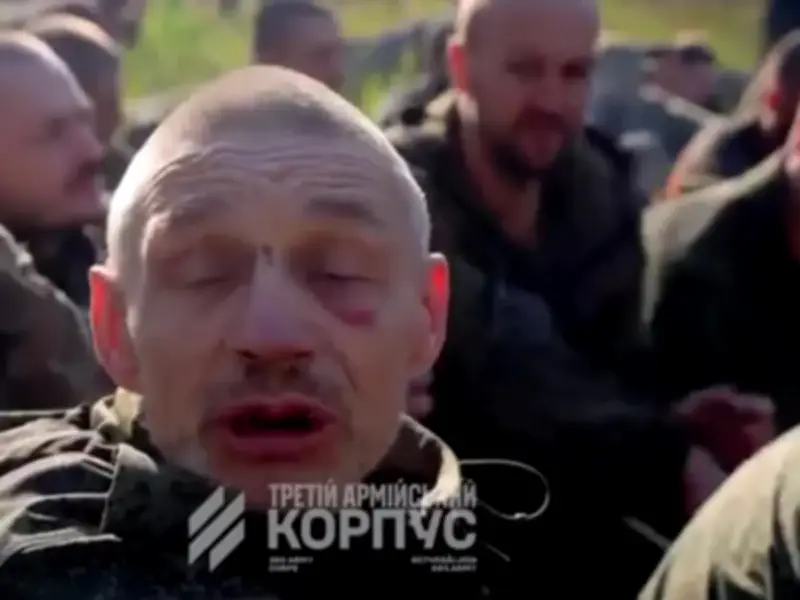
Dozens of Russian soldiers have surrendered on the frontline in Ukraine after being abandoned by Vladimir Putin's commanders and forced to eat grass and drink their own urine to survive. Footage shows a platoon of 94 soldiers giving themselves up in Donetsk as Ukraine progresses with its Operation Vivaldi counteroffensive.
Abandoned by commanders
The most senior Russian officer among the group, Alexander Manankov, 45, a naval captain reassigned to the army as a major, said: "I am addressing our command regarding our surrender. We surrendered to the Ukrainian 3rd Army Corps because we didn't want to die in vain."
One soldier explained how "our officers actually ran away." Another added: "They turned off the radio and told us to set up an all-around defense and hold our ground. That was it, radio off."
Desperate measures on the frontline
Manankov, from Russia's 3rd Motorised Rifle Battalion, outlined the desperate circumstances on the frontline. "We had no water at our positions. We had to drink water from puddles," he said. "We had to drink our own urine."
Just like drinking seawater, consuming urine causes a net loss of bodily fluids, making you much thirstier and speeding up severe dehydration. As you dehydrate, your urine becomes highly concentrated with waste products. Reintroducing urea and ammonia into a stressed system causes a toxic state called uraemia.
Another Russian fighter recalled the horrific incident of having "one of our guys" die from dehydration. Manankov said: "We had no food. We had to eat tree bark and grass." Another captive said: "We ate nettles, cooked them on a burner, made a sort of nettle soup. We were sitting there starving, for f**k's sake."
First proper meal in weeks
The soldiers confessed that their time in captivity marked the first occasion in six weeks they'd enjoyed a proper meal. They also exposed the dire lack of medical supplies for injured frontline fighters in the Donetsk region.
Upon their surrender, the wounded troops received "comprehensive, high-quality medical care" from the 3rd Army Corps. "They removed shrapnel from my head and my side," one soldier added.
Manankov spoke about how "our [Russian] command simply forgot about us. To them, we were merely disposable material. That's why the decision was made to surrender."