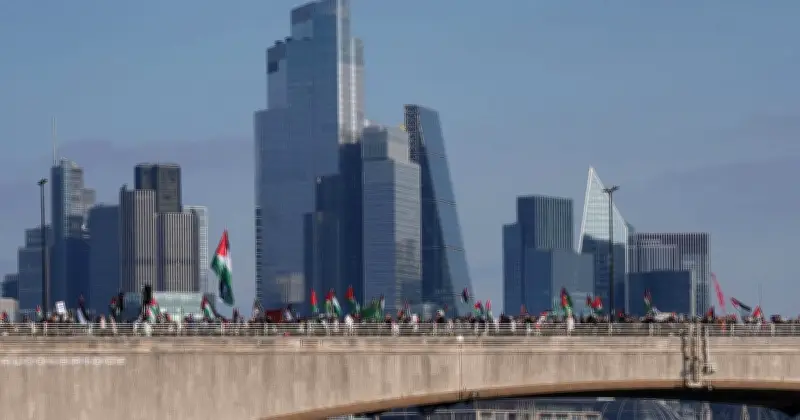
Police have been unable to trace the student organisers of a pro-Palestinian protest march scheduled to take place in London on the third anniversary of the Hamas terror atrocity next week. A group calling itself the University of London Coalition is expected to march from King's College in the Strand to University College in Holborn on Wednesday, demanding an end to what it has described as “a genocide in Gaza”.
The October 7 date marks three years since the terrorist attacks on Israel that left 1,195 people dead and the start of the ensuing conflict in Gaza, which has reportedly resulted in more than 74,000 deaths.
Police urge organisers to reconsider
Metropolitan Police chiefs fear the protest risks provoking huge upset and unrest on the “significant day of mourning” and are pleading with those preparing to take to the streets to reconsider due to the profound impact it would have on London's Jewish communities. Deputy Assistant Commissioner (DAC) James Harman revealed that, despite extensive efforts, his force has so far been unable to locate anyone willing to identify as an organiser of the march.
He said: “We have attempted to find and contact the student organisers to ask them to very carefully consider the impact their event will have and to ask them to hold this event on a different day. But finding the organisers, frankly, has so far proved difficult. I urge them to reconsider and to make contact with us urgently.”
The Union of Jewish Students has heavily condemned the timing of the protest as deliberately provocative.
Legal limits and police response
Police estimate around 300 students will attend, and the Met has formally written to four London universities, asking leadership to take all reasonable steps to ensure Jewish students and staff are not subjected to intimidation, harassment, or an unsafe campus environment. Despite calls to ban the march, DAC Harman admitted that police lack the legal power to outright prohibit protests simply due to insensitive timing or the offence they may cause. Under Section 13 of the Public Order Act, a ban can only be requested from the Home Secretary if there is a threat of serious public disorder that cannot be managed with strict conditions.
He added: “We have no choice but to police it.”
Busy week for the Met
The student march is just one element of a highly demanding week for the Met, with over 600 officers set to be deployed across a string of major events in what Harman described as an “increasingly polarised” capital. On Sunday, an estimated 5,000 people will march in Whitechapel to commemorate the 90th anniversary of the Battle of Cable Street. Later in the week, officers will maintain a visible presence to protect canvassers ahead of the Holborn and St. Pancras by-election on Thursday, October 8, following three arrests last weekend for altercations between political campaigners and protesters.
The week will culminate on Saturday, October 10, with a national Palestine Coalition march expected to draw up to 10,000 demonstrators from the Embankment to Whitehall, alongside an anticipated counter-protest.
These protests are putting a huge financial strain on the force, with DAC Harman revealing that policing 35 large-scale protests over the past three years has cost the Met £26.6million—climbing to £90million when factoring in the true cost of pulling local officers away from frontline neighbourhood duties. With over 17,000 hate crime arrests made since October 2023, the senior officer insisted a robust, zero-tolerance stance on criminality will be in place over the coming days.
“If anyone thinks they can commit crime, intimidate our communities, or stir up hatred towards others, they should think again,” DAC Harman warned. “They will be dealt with swiftly and decisively.”