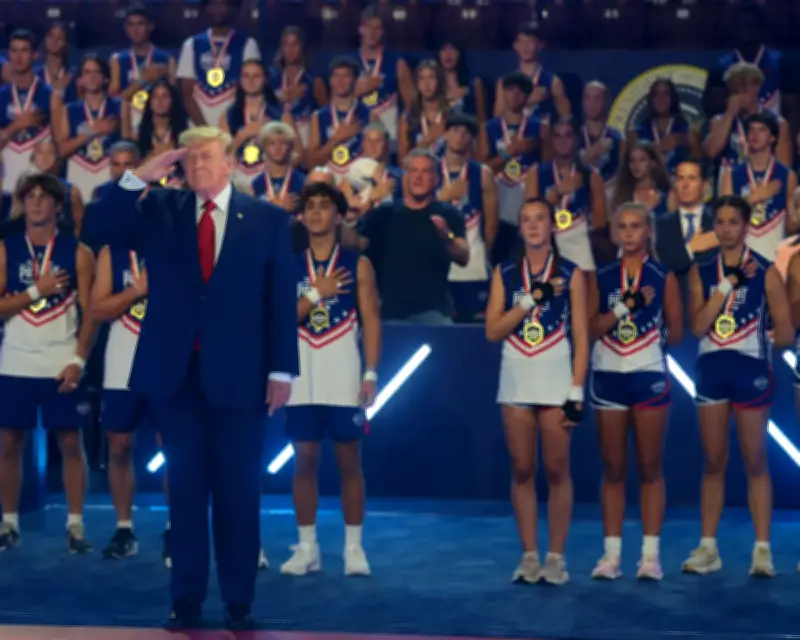
The Patriot Games, held this week in Geneva, Ohio, were intended to be a “national athletic competition celebrating the character, determination, and excellence that define the American spirit,” according to a press release. The competition, which organizers insisted would be nothing like the Hunger Games, was to bring together “outstanding young Americans” from across the country, “to compete, inspire, and showcase the values that have shaped the United States for nearly 250 years.” ESPN, hosting the games, said it would “test excellence in skillsets of beloved American sports.”
A Surprising Display of Events
People tuning into the games on Monday might have been surprised, then, to see that one event involved competitors having to catch a tennis ball, hit a stationary ball off the top of a stick, and serve a volleyball over an unguarded net. The competitors certainly looked determined as they grasped their tennis balls, but sporting excellence this was not. Instead, the Patriot Games seemed to have been inspired by a children’s school sports day. The only thing missing was the sack race.
In fairness, Monday’s events weren’t entirely egg-and-spoon race coded. In the afternoon, there was a tug-of-war, a sporting contest that won’t be included in the Olympics next year, but will be familiar to five-year-olds everywhere, and something called “victory hoops.” Tug-of-war is self-explanatory, but victory hoops, with its enticingly enigmatic name, offered some intrigue. But victory hoops just brought more disappointment. It turned out to be two competitors throwing basketballs through a head-high hoop; after each attempt the basketballs rolled back to the throwers, in a set-up that was literally identical to the game people play at bowling alleys and funfairs.
A Political Spectacle
Was this really what viewers were promised? Did these Dave and Busters-themed activities actually test sporting excellence? Does catching a tennis ball truly showcase the values that shape the US? Did the founding fathers celebrate signing the Declaration of Independence with a tug-of-war? No.
But of course, the Patriot Games aren’t really about any of that, instead simply forming another piece of Donald Trump’s quest to put his gauche stamp on the US’s 250th anniversary. It’s a mission that so far has involved the tragicomedy that was the Great American State Fair and the much-criticized (and costly) Ultimate Fighting Championship (UFC) fight on the White House lawn.
Prizes and Participation
But back to the Patriot Games, where 120 kids, two from each state and two from some US territories, all aged between 14 and 17 years old, were competing for $250,000 in college scholarships: $125,000 to the best boy, and $125,000 to the best girl. It’s a figure which sort of sounds like a lot, until you realize that the government has spent about $40bn on the president’s meandering war with Iran, or when you consider that the Trump family, per the New Yorker, made $4bn during the first year of his second term.
“President Trump is ensuring that America gets the spectacular 250th birthday it deserves. Between the Great American State Fair, the Salute to America Celebration, the Patriot Games, Freedom 250 Grand Prix, and other exciting events, 2026 is sparking a renewal of patriotism and national pride under this president’s leadership,” a White House spokesman said. In reality, the opposite has proven true this year. The response failed to address my question about how much the games cost to organize.
The Freedom Finale
Of course, Trump was always going to attend the games, and his entry at Tuesday night’s finale was perfectly in keeping with his love of pomp. He emerged to a colosseum-esque blast of trumpets and horns, and walked out between blazing pyrotechnics, before taking his seat, emperor-like, above the action. He was there to witness the last event of games: the “freedom finale.” The participating children were not, as the event’s name made it sound, competing for their lives, but instead taking part in a ninja warrior-cum-gladiators eliminator course that involved balancing on things, traversing monkey bars and swinging on hoops.
The crowd, some wearing “Freedom” T-shirts, roared as people raced across the course, chanting “USA, USA” in the manner of a Trump rally – earlier in the week, some crowd members had been wearing Maga hats – before Trump submitted to what an announcer described as “a special half-time conversation celebrating these historic games.” Asked what the games, and the celebration of America’s 250th birthday, meant, Trump dodged the chance for philosophical pondering, instead opted to list a series of events, including an upcoming car race in Washington DC – “they go round the Capitol, round and round” – and the 4 July celebration, which Trump said had the “largest fireworks, ever, ever in the world.”
And in truth, after watching three days of the Patriot Games, it is hard to know what to make of them. Was this a competition which celebrated “the character, determination, and excellence that define the American spirit”? No. Was it something which allowed a vainglorious president to put himself front and center of something which was supposed to be a celebrating of the country? Yes. Yes it was. Perhaps that was the point all along.