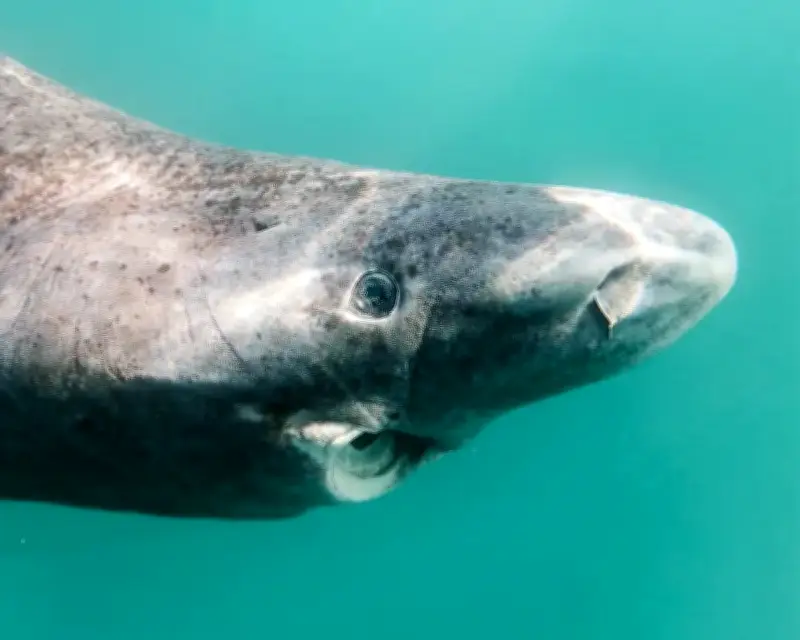
The Greenland shark, the world's slowest shark, can live for more than 400 years but only reproduces after 150 years, making any cull potentially devastating to the population, conservationists say. The species is at the centre of a debate in Greenland, where trawlers compete with the sharks for halibut and cod, leading to clashes between fishers and conservationists over how to manage the misunderstood species.
Henrik Jensen, a 27-year-old fisher from Greenland's west coast, has fished for halibut in Ilulissat, Greenland's third-largest town, for a decade. He works an hour north of the town's main iceberg-laden fishery, which supports nearly 400 fishers. There, the halibut are bigger and more plentiful, but so are the Greenland sharks. “This year I've lost around 6,000 hooks in total. Sometimes we lose 30,000 Danish krone [£3,440] a day,” says Jensen.
An acrimonious coexistence
The Greenland shark is one of the least understood species on the planet. It is the second-largest carnivorous species after the white shark, according to the Shark Trust, reaching about six to seven metres in length. For a long time, they were thought to be completely blind, although scientists have recently discovered this may not be true. The sharks inhabit a vast range across the deep and cold waters of the north and west Atlantic, but their attempts to feed on the northern fisheries' main catch – Greenland halibut and Atlantic cod – often see them tangled in gear and brought in as bycatch.
This acrimonious coexistence has been documented ever since targeted fishing for the sharks' liver oil ceased in the 1960s, but it came to a head earlier this year. The Avannaata municipality, of which Ilulissat is the administrative seat, approved a controversial plan to cull 1,000 sharks, offering 300 krone for every heart of a Greenland shark.
Fisher concerns and cull plans
Lars Erik Gabrielsen, mayor of the municipality, says: “We need to safeguard the income of fishermen and the catch so that we can continue to eat the foods that we have relied on for generations.” For many fishing inshore, working in small teams on dinghies, it brought a longstanding issue to a head. Timotheus Petersen, chair of the fishing association in Kullorsuaq, says: “Our longlines are expensive – one costs 1,599 krone. When the sharks cut our lines, we cannot finish fishing. We have to spend more money and buy new gear.”
The plan was eventually dropped after the government questioned its legality, but the prospect of a future cull remains. In its decision to approve the cull, Avannaata council cited a similar scheme from the early 2000s in the former Aasiaat municipality, where a bounty of 200 krone was offered. According to a 2007 report from the Danish Technical University, another scheme between 1986 and 2001 in the former Uummannaq municipality brought in 19,697 hearts.
Conservation concerns and alternatives
But the marine conservation group Oceans North Kalaallit Nunaat (ONKN) argues that culls do not resolve the issue, highlighting the migratory nature of the species, which can swim up to 1,200 miles (2,000km) a year. “Sharks removed in north-west Greenland would quickly be replaced by individuals arriving from other regions,” ONKN warned. Many fishers also do not consider 300 krone worth the effort of hauling a shark onboard. “It's difficult to catch them,” Jensen says. “You need bigger hooks and chains for the lines, so I don't think anyone wants to try.”
The debate around a possible cull is alarming conservationists. “If somebody says, 'I'm going to cull a couple of thousand Greenland sharks', that's a disaster in my opinion,” says Prof Nick Dulvy, a marine conservationist at Simon Fraser University in British Columbia. The Greenland shark is believed to become sexually mature at 150, which means the species replaces itself extremely slowly and will not rebound from a cull quickly. It is still recovering from targeted fishing throughout the 19th and mid-20th centuries, when, at its peak in 1948, 58,000 were landed. “They are probably – biologically – the most sensitive species in the ocean to overfishing,” Dulvy says. Globally, it is estimated that 3,500 sharks are caught every year as bycatch and the population remains in decline.
Greenland's fishing community highlight their longstanding problem with the sharks, but do not say why it has suddenly escalated. Jenseeraq Poulsen, the director of ONKN, suggests it is due to mounting pressures within a fishing industry that accounts for about 25% of Greenland's GDP. “If every Greenland shark in Baffin Bay vanished tomorrow, the inshore fishery in Avannaata would still face too many boats working a quota under pressure, rising costs and no alternative employment,” he says. “When margins are narrow, a longstanding nuisance becomes intolerable.”
Even though the price of halibut continues to rise, according to the Greenland Institute of Natural Resources, the average size of the fish is decreasing annually. While Jensen maintains he can still make a good living from fishing, he describes putting fewer hooks out and bringing in fewer fish, suggesting this is due to overfishing by offshore trawlers.
Proposed solutions and next steps
For some of those fishing these waters, however, the shark is not the leading cause of losing gear. “There are more and more 'ghost lines' and they are too heavy to pull up by the machine we use,” Jensen says. Ghost lines are discarded or lost gear that can get entangled with new lines, breaking equipment and trapping marine life. Halibut Greenland, a cooperatively owned fish-processing company in Ilulissat, provides funds to clean up ghost gear in the area, which ONKN views as more effective than a shark cull.
Poulsen also proposes a gear-loss compensation scheme, as well as funded trials of acoustic shark deterrents. Rebekka Nygård Bak, an adviser to Greenland's Ministry of Fisheries, Hunting, Agriculture and Self Sufficiency, suggests new bycatch-friendly equipment regulations could be a solution. She says a campaign for better bycatch reporting will also be key to any next steps. For Poulsen, the sharks and those fishing these waters are two components of the same ecosystem, facing growing pressures in changing seas. “The shark is the visible, tangible version of a problem whose real drivers are structural,” he says.