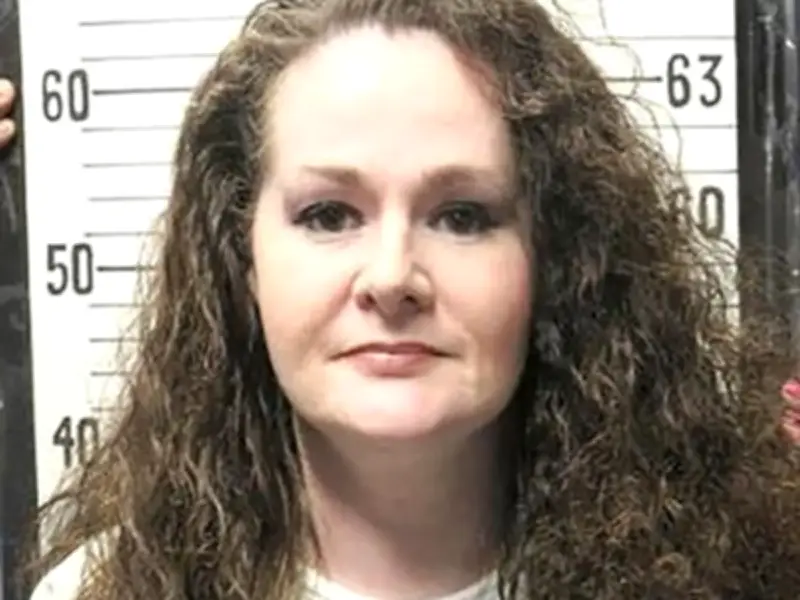
Death row convict Christa Pike survived an attempt to execute her by lethal injection and was audibly snoring despite having been given two doses of the lethal drug, her lawyer explained. Her legal team revealed on Thursday that she remains unresponsive in hospital but is not in a coma.
Her solicitor, Randy Spivey, slammed the state of Tennessee over the bungled execution, calling it "inefficient, cruel, and torturous." He continued: "Christa is alive. We don't have a sense of her prognosis or much update on her health." He claimed that the executioners at the Riverbend Maximum Security Institution in Nashville spent an hour trying to find a vein.
"I counted at least seven needles used in her left arm alone," the defence solicitor said. "One of which appeared to be bent when it was pulled from her left arm after an unsuccessful attempt."
Lawyers describe 'unnecessary agony'
Stephen Ferrell, Pike's other solicitor, said his client had repeatedly assisted the execution team, directing them on where to locate IV lines. "Ms Pike was not just cooperative, but was trying to help instruct the people placing the IV lines of where they could find them," Mr Ferrell said. "She over and over again said, 'Please, try up on my shoulder higher. Please, try here, please try here. I think it will be Okay,' and she thanked them, at least when they thought they had established a line."
The Tennessee inmate's legal team filed an emergency motion to stop the execution on Wednesday and said she was in "unnecessary agony," claiming her right to be executed free of cruel and unusual punishment had been violated. One of her attorneys told the media she was being given "life-saving measures" due to her being alive after she was given two doses of pentobarbital. The legal team had previously filed for a last-minute delay to her execution, but this was overturned and the execution was allowed to proceed later that day.
The Mirror reports that the Supreme Court's three liberal justices, Sonia Sotomayor, Elena Kagan and Ketanji Brown Jackson, dissented from the ruling, with Ms Sotomayor stating that it clears the way for the execution to happen "before her still-pending legal challenges to her conviction can be properly considered."
'Abnormally long' execution as Pike 'gasped' and 'snored'
The execution went ahead on Wednesday evening with witnesses allowed to observe from a separate room. The curtains were raised at 7.27pm, showing Pike strapped to a gurney. In her 'last words', Pike said she was at peace, saying: "I'm going to leave this world the way I spent most of my life and that is in love." However, according to witnesses, the curtains separating Pike from the viewing area were closed at 7.46pm and suddenly opened again just three minutes later at 7.49pm. Pike was heard gasping and moaning as she kicked her bedsheet. One said: "Her mouth fell open a few times, and she began to loudly snore. She gasped a few times."
Journalists at the scene explained that at one point Pike was awake and had complained of having a burning spot in her arm that she thought was going to burst. She raised her head and asked jail staff if it was normal. By 8.26pm, witnesses reported that another dose of pentobarbital was administered. But, Pike continued snoring behind the closed curtain until the microphone was switched off at 8.53pm and there was an announcement to escort media witnesses away from the area.
Tori Gressner, anchor for local station WKRN, told a conference: "When the curtains were opened she was kind of inconsistently going in and out of snores and silence. When the curtains closed the final at 8.05pm we could consistently hear her snoring, and then it developed into a snore and squeak. Then even at 8.53pm, when the microphone was cut off, we could still hear snoring." Pike's legal team said following the botched attempt: "Ms Pike has lost consciousness and still has a heartbeat and is audibly snoring."
Catherine Sweeney, a reporter for local outlet WPLN, said at a conference: "They went through two rounds and she was still breathing at the end, it was very ragged. She lifted her head up and was looking around at one point. She said that there was a spot that was burning and hurting and asked if it was normal. None of it was normal."
'Unparalleled' situation as investigation launched
Afterwards, Robin M. Maher, the executive director of the Death Penalty Information Center, said the incident was "unparalleled" and added that although people have survived due to executioners failing to find a vein to administer the drugs, nobody had survived the lethal injections. Pentobarbital, also known as Nembutal, slows down brain and nerve activity and has been widely used across the globe in euthanasia and assisted dying cases.
Tennessee's protocol for executions demands a secondary set of drug syringes to be administered "if the inmate is not deceased" after the first injection. But, there were no rules in place if the subject remains alive after a second dose. The Tennessee Department of Correction said in a statement that they "followed every step of the State's lawful, established execution protocol approved by the Attorney General's Office."
Pike's legal team said: "We take no pleasure in being right, but the concerns raised by Ms Pike proved to be true: difficult vein access, blown veins, degraded pentobarbital, no emergency medical care available when things inevitably go wrong, all under a protocol that remains veiled in secrecy." Tennessee is among the US states who maintain secrecy laws allowing them to withhold information about the lethal injection process. The state does not disclose pharmacy and compounding source details about where materials used in the drugs were sourced or how it was tested and stored.
Governor Lee ordered a review into the botched execution "to determine exactly what occurred" and announced none of the scheduled executions would go ahead this year. He added: "Carrying out a lawfully imposed sentence is among the State's most serious responsibilities, and the people of Tennessee expect it to be done in a manner that is not only legal and constitutional, but is effective." Dr Joel Zivot, a professor at the Emory University School of Medicine in Atlanta, Georgia, told the BBC he had been retained by Pike's legal team as a medical expert. He claimed she likely had never reached a sufficient blood level of pentobarbital to cause apnoea and cardiovascular failure during the botched execution attempt.
Victim's mum calls botched execution 'a mess'
After the botched execution, Ms Martinez told NBC News: "It was a mess." May Martinez was helped by a group to raise funds for her and her husband to travel from Florida to Tennessee to witness the execution. Colleen's mum explained over the weekend it has taken decades for Pike's sentence to be carried out. She said ahead of the execution attempt: "Every time I think about it, I think about Colleen feeling that pain and trying to get up and run." She previously said: "Not a day goes by, or a minute goes by that I do not think about Colleen. Holidays are the worst."
Legal challenges before botched execution attempt
Pike's attempted execution had been scheduled for 10am local time, however, an appeals court stopped the lethal injection just an hour before it was due to start and it took place at 8pm. Witnesses had gathered at the jail already when the 6th Circuit US Court of Appeals voted 2-1 to grant a stay. The court explained that the delay was needed to consider whether Pike's allegations of childhood sexual abuse were fully considered at her sentencing in the 90s. However, the attorney general's office appealed to the Supreme Court, and argued that stopping the execution at the last moment traumatised Colleen's family and rewarded "abusive delay tactics" by Pike's attorneys. Hours later, the high court cleared the way for the execution to proceed that night. The conservative majority did not explain their order, while the three liberal members signed a dissent that said Pike's claims deserved a closer look.
Murder of Colleen Slemmer
Pike would have been the first woman in more than 200 years to be executed in Tennessee. The last was Martin Eve (sometimes listed as Eve Martin), who was hanged in 1820. Pike has been on death row for decades and her legal team argued she was diagnosed with bipolar disorder and post-traumatic stress disorder. Colleen's body was discovered with a pentagram carved onto her chest and her head brutally caved in by a piece of asphalt. The pentagram attracted widespread attention due to fears of Satan worship amid the 'satanic panic' of the 1980s and 1990s in the US. Two other convicts at the camp later testified that Pike had bragged about the murder before and after, even showing them a piece of Colleen's skull.
Prosecutors said in court that Pike feared Colleen was trying to steal her boyfriend Tadaryl Shipp and lured her to a wooded area in January 1995. Shipp later admitted it was him who carved a pentagram into her body. He was 17 when the crime took place and was sentenced to life in prison with possibility of parole. In her petition for clemency, she pleaded that she only wanted to fight Colleen but killed her in a frenzied attack and claimed she couldn't "put the brakes on." Pike did not deny the murder, but supporters argued the state should consider her age at the time, her mental illness and her allegations of being sexually abused. In a statement, Pike previously said: "I was a mentally ill 18-year-old kid. It took me numerous years to even realise the gravity of what I'd done. Even more to accept how many lives I affected. I took the life of someone's child, sister, friend. It sickens me now to think I had the ability to commit such a crime."