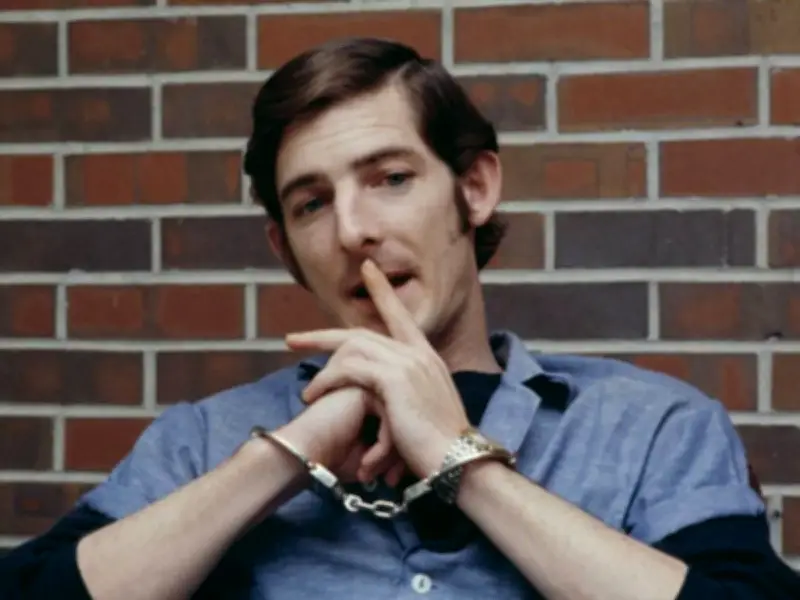
Smoke and the nauseating stench of cooking flesh billowed from a hooded Death Row prisoner in a ghastly botched execution. John Louis Evans III's head and leg began to smoulder, his fists gripped tight and his body thrashed against his restraints as the electric current coursed through him. Appalled onlookers believed he might need to be shot as successive execution attempts proved unsuccessful.
Doctors found him alive twice
Adding to the nightmare, witnesses observed a medic summoned to verify Evans' death give a nod after examining his pulse. Initially, they assumed this signalled confirmation of his demise. Actually, it indicated he remained alive. Doctors approached the body twice expecting to confirm he was dead — in fact, they found him still alive both times.
Evans had been found guilty of the 1977 killing of a shopkeeper in front of his youngsters during a brutal crime spree. He declared to the jury during his trial: "if you don't come back with a death penalty, I'm going to get out and I'm going to do it again", allegedly even threatening to hunt down each juror for retribution.
Yellow Momma at Holman Prison
When a judge initially issued a stay of execution merely six hours before his scheduled death, Evans was reportedly "dismayed, crying and visibly very upset". Yet a fortnight later, on April 22, 1983, Evans was secured to an electric chair dubbed "Yellow Momma" at Holman Prison, Alabama, nicknamed for its vivid yellow hue. It had been constructed by a prisoner at the facility almost 60 years previously and hadn't been utilised in nearly 20 years.
But while Evans seemed composed when confronted with his approaching demise, his execution was far from smooth. One observer, journalist Mark Harris, recounted "the chilling sight of Evans' chest rhythmically rising and falling after what was supposed to be an instantaneously lethal dose of electricity".
Three charges and 14 agonising minutes
He revealed that prior to electrocution, Evans had been secured to the chair at his legs, chest, arms and torso, with a black strap across his brow. He noted his "face was pure calm" before being concealed under a black hood.
"At the instant [prison governor JD] White pulled the switch and sent 1,900 volts burning into Evans, who clenched his fists and arched his body rigidly into the restraining straps, the folly of being prepared was gone," Harris recalled. "A moment later, as spark and flame crackled around Evans' head and shaven, razor-nicked left leg, white smoke seeped from beneath the veil and curled from his head and leg. Midway through the surge of electricity his body quivered, then fell back into the chair as the current ended."
Two doctors filed out of the witness room to examine the body and pronounce Evans dead. The prison doctor, dressed in a blue surgical costume and tan loafers with tassels, placed a red stethoscope to the smock, turned and nodded, the natural signal for 'yes, he's dead'. But the nod meant he had found a heartbeat. The other doctor confirmed the gruesome discovery.
As Evans' chest rhythmically rose and fell with "slow deep breathing", Harris described how "spark and flame again accompanied the onset of the second charge, but this time, for a grim second, the veil slipped a fraction of an inch on the left side, giving the impression it was burning through and would fall away, exposing the face I'd noted was handsome minutes earlier. When the second charge subsided the doctors re-examined Evans and again it was clear they found a pulsating heart."
Witnesses pleaded for the "cruel and unusual punishment" to cease as a third charge surged through Evans's body. "Again Evans' head and leg smouldered," Harris recounted. "His fists, which clenched with the first jolt, remained locked on the chair's arms. I was convinced things were out of hand and was not sure the chair, for whatever reason, was capable of killing Evans. I seriously thought they would have to bring in a gun and shoot Evans in the chair."
However, this third charge did prove fatal for Evans, in an execution that spanned 14 agonising minutes. Another witness reported that "sparks and flames erupted from the electrode tied to Mr Evans' left leg" and "a large puff of grayish smoke and sparks poured out from under the hood that covered Mr Evans' face", while "an overpowering stench of burnt flesh and clothing began pervading the witness room... the stench of burning flesh was nauseating".
No explanations have ever been provided for the burning and smoking of Evans' body. Evans, who was 33, became the first prisoner to face execution in Alabama since capital punishment was restored in the US in 1976.
Crimes and legacy
Evans and his accomplice, Wayne Ritter, launched a two-month criminal rampage that allegedly encompassed over 30 armed robberies and nine abductions spanning seven states. On January 5, 1977, they robbed, shot and murdered Edward Nassar, a pawnshop proprietor in Mobile, Alabama, while his two young daughters witnessed the attack. Evans admitted guilt upon capture, but prosecutors allegedly rejected his guilty plea as they sought capital punishment, which required a jury conviction.
Throughout his first-degree murder trial, he expressed zero regret and claimed he would repeat his actions given the opportunity. He even menaced the jury members, warning that if they failed to impose a death sentence, he would break free and kill each one of them. "I've been at it a long time," he said in court. "And if you don't come back with a death penalty, I'm going to get out and I'm going to do it again... I have no intention whatsoever of ever reforming in any way and I would rather die by electrocution than spend the rest of my life in a penitentiary."
Nevertheless, while behind bars he declared: "Any family I have hurt and particularly the little children who have suffered by what I have done, to them I say I am deeply, deeply sorry and hope that someday they will find it in their hearts to forgive me." He revealed that from the age of 14 "I have robbed and burglarised and stole and murdered and always was a few feet ahead of the law. Oh yes, I enjoyed it. It was fun while it lasted but look where it has brought me."
His accomplice Ritter similarly urged jurors during his trial to hand down the death penalty and instructed his legal team to halt their final appeals while he awaited execution on Death Row. He was put to death on August 28, 1987.
A 2004 study from Cambridge University Press documented 34 bungled executions between 1977 and 2001. Rather than showing improvement in recent times, numerous cases have occurred since, including Kenneth Smith's ordeal in 2022 when he endured 81 minutes restrained on a gurney while repeated lethal injection attempts failed to end his life, and last week's incident involving Christa Pike, who also survived the deadly injection, leaving her fighting for life in hospital with an uncertain outlook.