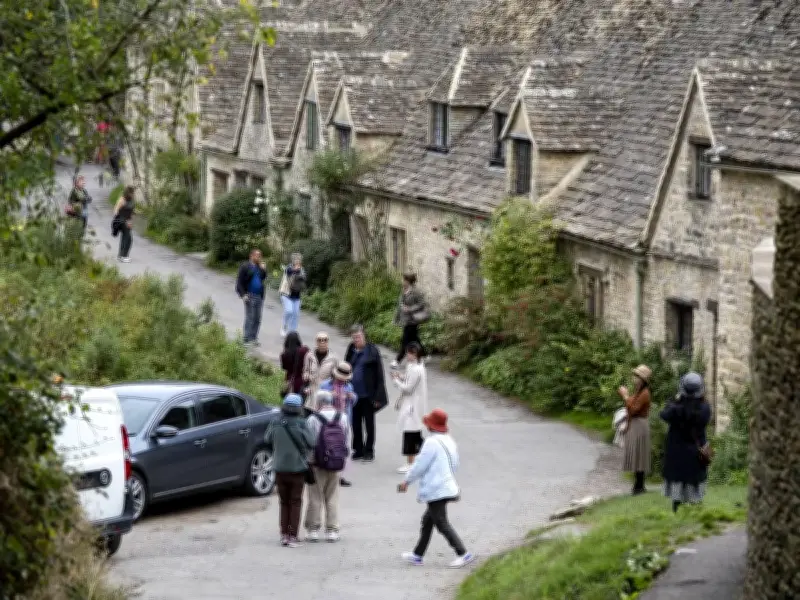
Residents of Bibury, a Cotswolds village once hailed by William Morris as "the most beautiful village in England" and recently crowned the world's most beautiful village by Forbes, are taking steps to curb tourist behaviour they say is damaging the environment.
The accolade has long proved a double-edged sword for locals, who find tourism brings as many headaches as advantages. Managing the volume and conduct of visitors has occupied villagers' thoughts and parish council meetings for years.
River fencing plan to protect wildlife
Their most recent proposal involves installing fencing to prevent tourists from wading into the shallow River Coln, which winds through the village centre past honey-hued cottages and willow trees. It flows alongside Arlington Row, among the world's most photographed streets.
Parish councillors say they are alarmed by the environmental damage caused by visitors wading into the river. Photos and council minutes reveal that over the summer, tourists were not only paddling but dragging chairs in to sit on, putting local wildlife at risk — including swans, ducks, voles and fish. Talks are reportedly set to be held with the National Trust, which owns the Arlington Row cottages, regarding cordoning off a further stretch of riverbank near those properties.
Parish council chairman Craig Chapman told The Independent: "Over the summer with the hot weather, people would not just sit on the river bank but would go in the water and even bring chairs in to sit on to cool down. The main concern is the wildlife, but also the whole area with people using it like it is a recreational area. When they go into the water they can upset the habitat."
'More like a car park than a village'
The village of around 600 people has been grappling with visitor numbers for years, introducing measures including additional double yellow lines to combat inconsiderate parking — a clampdown that saw wardens hand out up to £45,000 worth of fines last year, along with a record number of monthly tickets in May. A trial coach drop-off zone is set to become permanent, while pay and display parking is being planned, with a potential £7 charge for a two-hour stay.
Despite a car park with capacity for 300 vehicles, residents say it proves insufficient on certain days. Locals have complained that coaches "park where they want" and cars are left "abandoned". Kris Watts, who moved to Bibury a decade ago, filmed footage in August showing a coach failing to use the designated drop-off point, saying: "This has got to stop".
She said: "The coach was just parked up on the left hand side. You couldn't see what was coming. When we eventually got past it all the passengers were walking across the road bridge. You just think, why? The coach bays the other side were empty. They just don't take any notice. They tend to park where they want."
Watts believes Bibury's troubles have been worsened by misleading social media posts portraying the village as idyllic and traffic-free. "We moved here ten years ago and we knew it was a tourist village but since Covid it has just got worse and worse and worse," she said. "I think it's to do with influencers. People are posting reels showing you an idyllic traffic-free village and then when you get here it's absolutely rammed."
Mr Chapman told the BBC in 2025 that its status as one of the world's most beautiful villages is a "double-edged sword", and that the scale of tourism is "problematic" and comes "at a cost for locals".
Tourists 'don't put any money into the village'
Residents express frustration that visitors fail to spend money in the village. Victoria Summerley, a journalist and author who has lived there since 2012, previously remarked: "[The villagers] would say [the tourists] don't put any money into the village."
Lynn Edward, who has lived in Bibury for six years, told The Guardian: "We have such a beautiful place that we want to share, but the level of tourism and the hordes of people that come has just made it entirely unpleasant, and the infrastructure doesn't really cope with it. All they want to do is come and take a photograph. They don't stay in the village. They don't linger enough to really ingest the beauty and historic value of the place. It's literally, I think, to take a selfie."
One visitor who made the trip during the summer of 2025 commented: "I didn't appreciate just how many people there would be on a random weekday afternoon. It was obvious even before I got to the village centre, with groups of tourists strolling in the middle of the road en route, long lines of parked cars beside the river, several different languages from all over the world to be heard and people of all nationalities standing on Bibury's pretty stone bridges to grab a selfie."