One astronaut uttered a horrifying final statement before he was consumed by a deadly fireball seconds before his spacecraft took off.
In 1967, the space race saw three men die in a test flight for the inaugural Apollo mission. NASA scientists were working towards getting men on the moon and had just developed a new rocket fit for humans. But many said it was rushed, and on the fateful rehearsal day disaster struck with one astronaut saying helplessly: "We've got a fire in the crew deck".
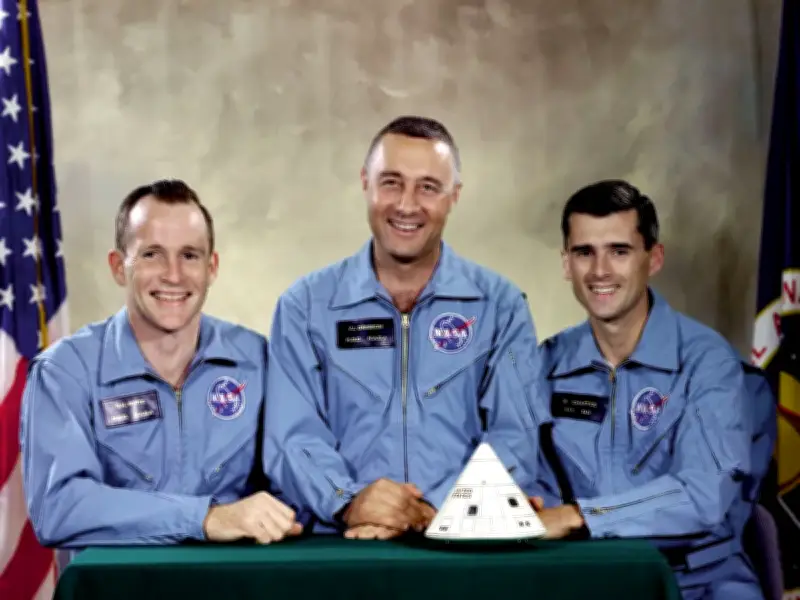
The doomed Apollo 1 crew
NASA intended to send a crew of three men into a low Earth orbit, manned by the crew itself. The command capsule was a small, cone-shaped capsule for a three-man crew, measuring just 3.9 meters at its base and 3.65 meters tall, as per America Space.
The Apollo mission 1 starred two of America's most iconic astronauts, Command Pilot Virgil 'Gus' Grissom, who was the second American in space and harboured ambitions of being the first man on the moon, and Senior Pilot Ed White, who was the first American to perform a space walk. They were set to be joined by space novice, 31-year-old Pilot Roger B. Chaffee, the youngest person ever chosen for a NASA mission. The launch date was scheduled for 21 February 1967.
Concerns ignored before disaster
Early in their training for the mission, the crew voiced some concerns about the very small spacecraft, primarily due to the quantity of flammable nylon material inside the cabin.
Several experts also believed the immense pressure of John F Kennedy's deadline for a moon mission led to NASA and contractor North American Aviation cutting corners and risking the safety of the crew. One such decision was the choice to use the lighter, single chamber gas system instead of the heavier dual chamber system. This meant the module would be filled with 100 percent oxygen for the crew to breathe - creating a highly flammable environment. Another was to install an inwardly opening hatch, as well as the decision to omit explosive bolts to secure it, which are designed to release in the event of an explosion or extremely high pressure.
Other team members on the project also reported damaged wiring and electrical faults within the spacecraft's cabin. Nevertheless, they continued with the February launch schedule.
The fatal 'plugs out test'
Four weeks before the big date, the rocket and spacecraft received approval for what became known as a 'plugs out test' - a rehearsal where the crew would board the command module as preparation for the actual mission.
On January 27 1967, the three Apollo 1 astronauts entered the cramped spacecraft at Cape Kennedy Air Force Station Launch Complex 34. This would be their tragic final act. Immediately on entering, the trio smelled something coming from the oxygen tank. Then a chilling alarm sounded, signalling excessive oxygen flow within the cabin. They struggled to make clear radio contact with one asking: "How are we going to get to the moon if we can't talk between two or three buildings?"
The practice continued, and just as they prepared to start the practice launch countdown, eight terrifying words echoed from their capsule: "We've got a fire in the crew deck". Instantly the fire tore through the craft, and it became an inferno. The emergency escape procedure required at least 90 seconds, but in less than 30 seconds, the flames and poisonous smoke had engulfed the ship.
Aftermath and investigation
Despite the desperate ground crews' best efforts, it took a full five minutes to pry open the hatch, which had been jammed shut by the internal cabin pressure. When they finally managed to force the door open, they only found the remains of the crew. All three men were killed almost instantly, with a post-mortem revealing they died from asphyxiation due to carbon monoxide and other toxic gases released by the fire.
The Apollo space programme was suspended for over a year while investigations were conducted into the disastrous end of the mission. NASA flight director Gene Kranz took responsibility for himself and NASA regarding the Apollo 1 fire, delivering an emotional speech just a week afterwards where he acknowledged the team had let down the astronauts. He said: "Spaceflight will never tolerate carelessness, incapacity, and neglect. It could have been in design, build or test. Whatever it was, we should have caught it. Somewhere, somehow, we screwed up." Kranz said "every element of the program was in trouble" and that they were not ready for mission to go ahead. He added: "We were rolling the dice, hoping that things would come together by launch day, when in our hearts we knew it would take a miracle."