The remains of a further 22 infants have been uncovered at the site of a former mother and baby home in Co Galway. The search, which began in July last year, has so far unearthed the remains of 99 infants at the location.
The most recently discovered remains were found during the search period from June 1 to July 15, in an area that had been covered with gravel and used for vehicle access, with no surface markers to indicate the presence of burials.
Excavation and Identification Efforts
The excavation of the former St Mary's mother and baby home in Tuam is endeavouring to identify the remains of infants who perished at the home between 1925 and 1961. In 2014, research spearheaded by local historian Catherine Corless indicated 796 babies and young children were interred in a sewage system at the Co Galway institution across that period.
The Office of the Director of Authorised Intervention Tuam (ODAIT), which is overseeing the search, confirmed that coffined infants were recovered and that hand-excavation is ongoing. The Identification Programme team gathered an additional seven DNA reference samples during this period, bringing the total number collected to 62.
In 2017, a commission discovered "significant quantities" of child and infant remains in subsurface chambered tanks situated in the memorial garden area of the site.
Challenges and Progress
Speaking on Wednesday, Daniel MacSweeney, director of ODAIT, stated that the progress of the project to date has vindicated the decision not to begin the search in that area. "To date we have started outside of the memorial garden, in an area where there is a map from a Galway County Council planning file from the 1970s that shows a burial ground, but there's nothing on the surface to indicate that there's any burials there and then when we've excavated there, this is where we found 99 sets of remains, really very closely together," he said.
"So this concentration of remains buried very closely together, is extremely challenging because each burial is an archaeological context of its own and has to be recovered in that way. Then at the other end of the site we've dealt with and resolved a very large area where we found no remains whatsoever. So there's all these different elements that are difficult, but I think a year in, I'm quite happy that we've now recovered 99 sets of remains in a place where we didn't really know there were any remains there, so it has, I think, justified our decision not to start with the memorial garden, but to leave it until later."
Forensic Challenges
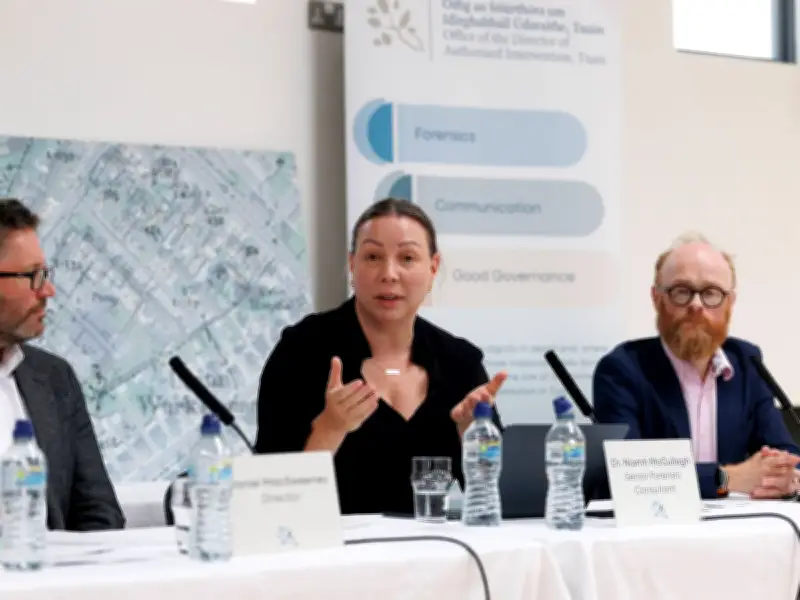
Senior forensic consultant at ODAIT, Dr Niamh McCullagh, highlighted several factors that render the search "particularly challenging." "If I work from the outside in, the challenge of the physical location of the site, it's within a housing estate that is populated with people living there, the rears of their gardens all face onto this playground area," she said. "The physical situation of the chamber tank where the remains were discovered in that sample excavation, they're over three metres beneath the surface, they're in 20 individual chambers, all adjacent to one another, and that in itself is also a very physically challenging situation. So, from an archaeological perspective, it is not like going out and excavating a greenfield site or an open area where we would have a lot more space, we have to try and manage the space that we have to get the access that we need to to recover the remains."
St Mary's home for unmarried mothers and their children was operated by the Bon Secours Sisters, a Catholic religious order of nuns. In 2021, Irish premier Micheál Martin apologised on behalf of the state for the treatment of women and children who were housed in mother and baby homes across Ireland.