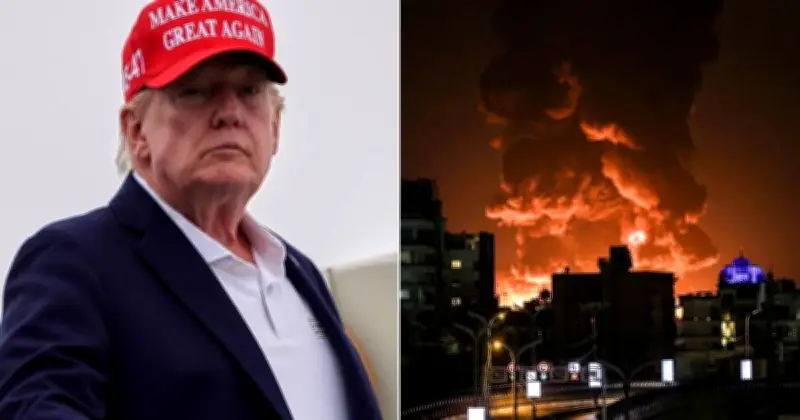
President Donald Trump has warned Iran that he will "hit back 100 times harder" if it escalates the conflict, as tensions continue to rise. In a recent interview, Trump declared that any escalation by Iran would not alter his approach to the war, even if it were to occur close to this November's midterms.
President's Stance on Iran
When questioned by reporters regarding a potential escalation, the president responded that he believes the American public backs him in preventing a "lunatic nation from having an atomic bomb."
"They can not have nuclear weapons. It's very simple. I say it all the time," he told Fox News' Alexis McAdams. "Everybody agrees with it. We're doing really great with the Hormuz Strait. We have a blockade that's like a wall of steel."

Public Opinion and Polls
Trump continues to maintain that the war in Iran, which has now lasted nearly six months, retains broad support amongst Americans, despite a series of recent polls suggesting otherwise.
Recent surveys conducted by Reuters and Ipsos earlier this month indicate that roughly one in three Americans approve of the US strikes on Iran, while 62% stated they disapprove. Nearly 70 per cent of respondents also said they believe Trump has not "clearly explained the goals of U.S. military involvement in Iran."
Iran's Negotiation Tactics
Tehran is reportedly approaching ongoing negotiations with the U.S. with a timetable designed to keep the Trump administration entangled in the war long enough to deal a significant blow to Republicans in the November elections, The Guardian reported last week. Tehran is reportedly hoping the damage would be similar to that suffered by President Jimmy Carter during the U.S. embassy hostage crisis in 1979.
Iran's focus on the midterms became increasingly apparent last week when Deputy Foreign Minister Kazem Gharibabadi told the official IRNA news agency that, having agreed a route for commercial shipping through the Strait of Hormuz, it would take two to four months to reach the second phase of negotiations on Iran's nuclear programme.
The original plan, to commence the nuclear phase of talks within 30 days of signing June's memorandum of understanding with the U.S., had been abandoned by the Trump administration, Gharibabadi said. To reach that second stage, he has now reportedly laid out a lengthy course encompassing the lifting of sanctions, the end of the U.S. blockade of Iranian ports, the unfreezing of Iranian assets and fresh commitments on peace — a process that could extend well beyond the midterms.