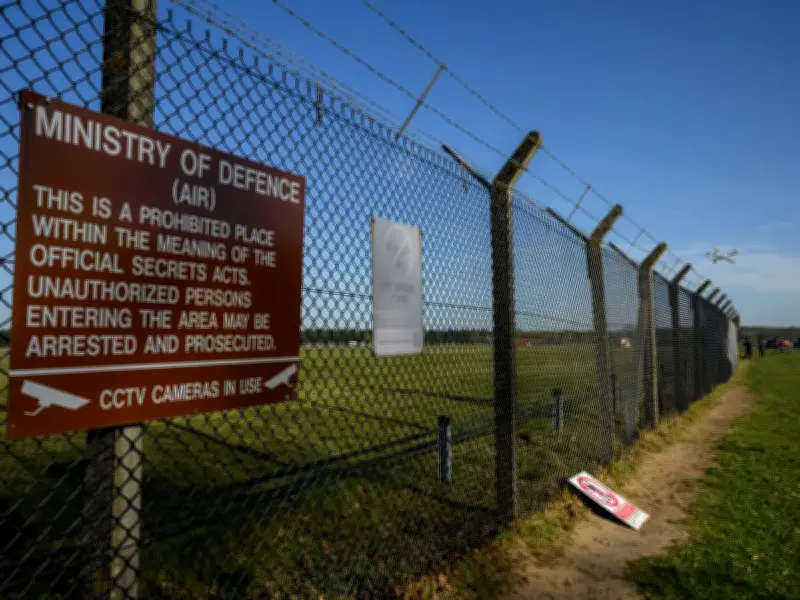
A British police helicopter pilot feared he was heading to his death during a late-night hunt for enemy drones allegedly controlled by the Kremlin, according to a new report. The pilot was forced to execute a dive at a military base in the Suffolk countryside to avoid the apparent Russia-planted drones he had been told to track. The drones were reportedly launched by a shadow fleet tanker docked in Hull.
Incident Over RAF Lakenheath
The airman had been instructed to investigate drones above RAF Lakenheath in November 2024 following sightings. The base was one of four selected to house American nuclear weapons. A number of Cobra meetings were called in the wake of the hostile entries, which also occurred over RAF Fairford, RAF Mildenhall, and RAF Feltwell.
A source told The Times that a deadly crash was a real possibility, saying: "He had a real fear the drones would bring the chopper down. The pilot was worried he was going to die." The man in charge of the helicopter, from the National Police Air Service, saw "red flashing lights" and believed that the drones were carrying out "orbits of Lakenheath airfield" during the operation to try to disable the devices.

Russian Involvement Confirmed
Intelligence experts have officially accused Vladimir Putin of launching the spy drones on Royal Air Force bases and Britain's nuclear weapons. A report published by the International Institute for Strategic Studies (IISS) claims drones flew over four "sensitive" US military bases across the UK as part of a "sustained" 15-month surveillance campaign.
The IISS discovered that HAV Dolphin, a Russian-crewed cargo vessel, was docked near Hull, East Yorkshire, at the time of some of the incursions. The report stated: "The pattern of sightings across 15 months and 13 countries cannot be explained by misidentification or opportunism alone. Russia has demonstrated, repeatedly and in public, that it can penetrate the airspace of Nato member states, including over nuclear sites, without triggering a collective allied response."
Strategic Implications
The unmanned aerial vehicle (UAV) campaign operated with substantial impunity across European airspace, representing both a series of tactical successes for the Kremlin and a strategic failure of allied air defence. According to the report, Russia's success rested on a "basic strategic insight" that "Europe's air-defence architecture was designed to detect and defeat conventional air threats operating in a recognisable battlespace."
A Whitehall source told The Times at the time: "The drones are very sophisticated, very fast. This is not the work of hobbyists, but no one is confident of attribution at the moment." A Ministry of Defence spokesman said: "The UK takes the security of military bases seriously and works closely with allies, law enforcement partners and other authorities to protect defence people, sites and capabilities. Through the Armed Forces Bill, we're giving our defence personnel greater powers to defeat drones threatening our bases and we have invested significantly in counterdrone capabilities."