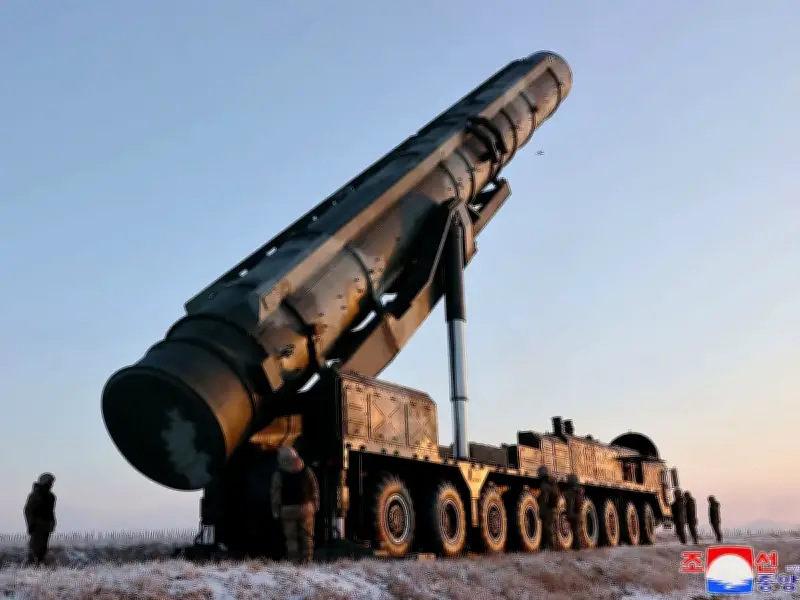
North Korea has tested a missile with nuclear capabilities, intensifying World War 3 fears just days after issuing threats against the US and South Korea. The launch occurred overnight, with South Korean and Japanese defence forces detecting a ballistic missile fired from the coastal area of Wonsan.
Missile flew 400 miles before crashing into sea
The weapon, which analysts suspect could be part of an advanced hypersonic or tactical nuclear programme, flew more than 400 miles before crashing into the sea. The test is widely seen as a direct protest against the upcoming Ulchi Freedom Shield military drills between Washington and Seoul.
The missile used in testing was not thought to have had a nuclear warhead attached. Officials in South Korea, the US and Japan are said to be analysing its trajectory to determine where it could have gone if it had not been programmed to crash into the nearby sea.

State media condemns allied naval exercise
State media recently lashed out at a massive US-led naval exercise, condemning the joint drills with South Korea and Japan as a blatant war rehearsal of aggression. A North Korean military commentator publicly stated that the combined forces of the US, Japan and South Korea were creating a severe new security crisis in the Asia-Pacific region.
The spokesperson warned that it is the regime's strict policy to respond to new levels of threat with entirely new levels of deterrence, heavily implying that catastrophic retaliation is on the table.
Analysts suggest Hwasong-11 upgrade
Yang Moo-jin, a senior professor at the University of North Korean Studies, told Yonhap news: “It could be a repeat of last week's launch following its suspected failure and is believed to be a test-firing aimed at improving its missile capabilities.”
He added: “Given the intensifying war in Ukraine, it could also be a test to upgrade the Hwasong-11 missiles, which are designed to carry tactical nuclear warheads.” The Hwasong-11 missile can carry nuclear or chemical warheads and has been used by Russia's army during its invasion of Ukraine since North Korea sent more than 50,000 troops to support the Russian effort.
No actual images of the test have been made public, although it was picked up on closed satellite networks.