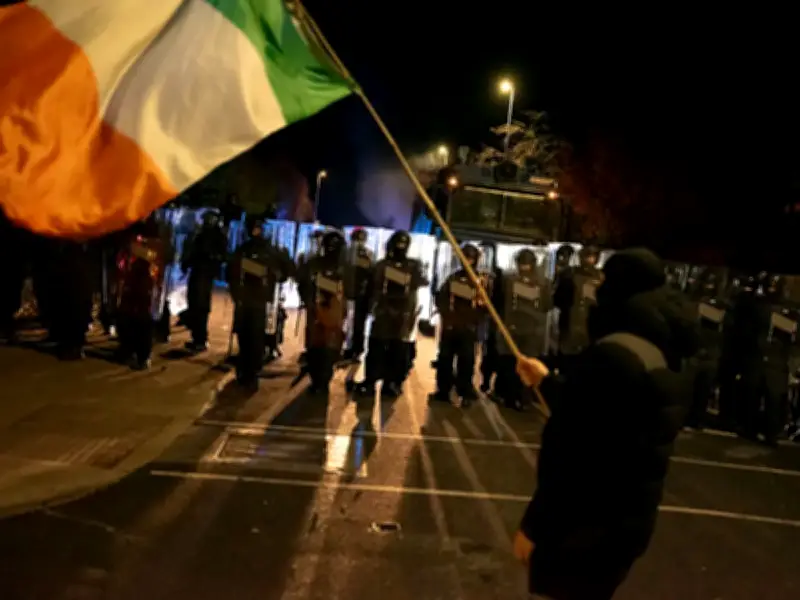
The New IRA, a proscribed paramilitary group, has threatened to bring "civil war" to the British Isles, but experts have warned that while the risk of localised civil unrest is real, the threat of an actual civil war is "highly exaggerated."
Threat to migrants and civil war warning
In a recent video, a masked spokesperson for the terror group issued a chilling ultimatum on social media, stating: "It is now going to be time for civil war, and that is exactly what these guys are going to be doing and can you blame them? This will be a major wake-up call for the authorities. These guys will show them how it's done and give them 24 hours to leave. They will take control, and they will give an ultimatum, not to politicians but to the illegal migrants who are in the country."
Experts fear the New IRA are plotting to capitalise on tensions around migration and could use the anxieties to launch an intimidation campaign against vulnerable communities.

Expert analysis on the group's origins and capabilities
Speaking to the Daily Star, Christian Kaunert, director of the International Centre for Policing and Security at the University of South Wales, explained the origins of the New IRA. He said: "The New IRA is a dissident republican paramilitary group that formed in 2012 by merging several violent factions. The group rejected the 1998 Good Friday Agreement and the subsequent Northern Ireland peace process. It was created when the Real IRA joined forces with Republican Action Against Drugs (RAAD) and independent vigilante groups. They refer to themselves simply as the 'Irish Republican Army'."
Kaunert stated that the paramilitary group's claims to threaten the country with "civil war" are "highly exaggerated," but added that "the risk of localised civil unrest is real." He said: "The New IRA is attempting a major ideological pivot by latching onto anti-immigration sentiment. They are using online rhetoric to threaten migrant communities directly. However, their ability to organize a large-scale armed conflict is severely restricted. The main danger is not a coordinated military campaign. It is the potential for localized riots, arson, and intimidation against vulnerable communities."
Shift in ideology and potential for unrest
Kaunert added: "While the risk of localized civil unrest is real, the threat of an actual 'civil war' is highly exaggerated. Paramilitary groups are trying to hijack public anxieties surrounding immigration to regain social relevance. The New IRA's violent anti-migrant stance represents a strange, contradictory shift for an organization historically rooted in left-wing anti-imperialism. Across continental Europe, populist and anti-immigration sentiment is usually expressed through legitimate political parties or far-right street movements. In contrast, the New IRA remains an illegal, proscribed terrorist organization. Their adoption of anti-migrant rhetoric mirrors European far-right talking points."
Professor Elizabeth Pearson, associate professor in criminology at Royal Holloway University London, told the Star that armed groups in Ireland have previously claimed to protect communities from crime through vigilante action. She said: "Different Irish paramilitary groups have for a long time claimed to protect communities from crime, such as drug-dealing, through vigilante action. So they will try to exploit the current climate, where 'migrant crime' is a key political issue, just as far right groups do - and to attract supporters."
The expert in counter-terrorism studies added: "The official IRA were actually linked to left-wing Marxist ideologies in the 1960s, but we are increasingly seeing the mainstreaming of what are essentially far right 'accelerationist' ideas which promote violence and disorder to stoke collapse, and rebuild a different type of society. In the marketplace of ideas, if an armed group thinks this will prove popular with its base audience, it will pursue this."