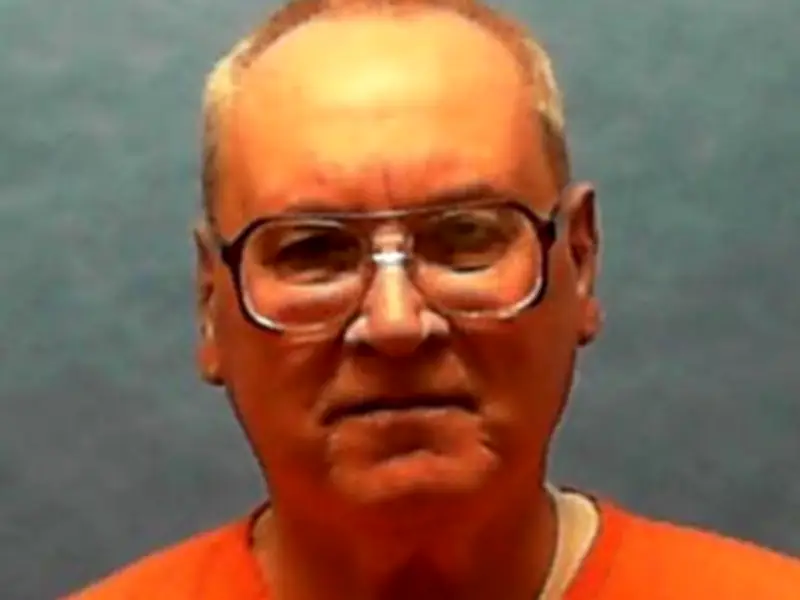
Daniel Owen Conahan Jr., known as the 'Hog Trail Killer', is scheduled to be executed by lethal injection on September 10 at Florida State Prison in Stark. The execution window runs from noon on September 10 to noon on September 17, and Governor Ron has signed off on the death warrant.
Conahan, now 72, lived in Punta Gorda, Florida, where he appeared to be a quiet and unremarkable nurse. In reality, detectives believe he may have killed at least a dozen victims in his criminal career, according to Crime & Investigation.
Early Life and Criminal Beginnings
Conahan came out as gay as a teenager, which was not well received by his homophobic parents, who sent him to psychiatrists. "It wasn't the kind of thing you were open about in the 1970s," Conahan later told investigators. "But I found a gay bar, and if I got there early, they wouldn't card me. Being gay is part of God's plan, too."

In 1978, he was nearly court-martialed for taking fellow Naval officers off base for sex and was discharged a few months later after getting into a fight with a man upon whom he had attempted to force oral sex. He later moved back to Florida to be with his elderly parents and retrained as a nurse.
The Hog Trail Murders
In the early 1990s, Charlotte County police faced a series of disturbing crime scenes. Victims were often homeless, hitchhikers, or travelling workers with no roots or family. Their bodies were found on isolated roads and woodland, earning Conahan the hog trail murderer title. The crimes shared common themes: rope binding and violent mutilation after death.
In 1996, a North Port family dog brought home a male human skull, and the owners said it was the last in a series of bones the dog had brought to their door. A body was later discovered in the area, severely mutilated, particularly around the genitalia. The remains were never identified.
In March 1996, a man travelling down Route 75 pulled onto Laramie Circle for a toilet break and found a naked male corpse positioned face-up in the shape of a cross.
Survivor Leads to Arrest
In 1994, Stanley Burden became the first to survive a hog trail attack. He ran to police after escaping being tied to a tree. Although there was not enough evidence at the time to pursue the case, police noticed that two accounts involved similar injuries. A third account gave police enough to pursue Conahan's arrest, and he was taken into custody in July 1996.
Conahan was convicted of the murder of 21-year-old Richard Allen Montgomery. In April 1996, Montgomery's body was discovered in woodland near another victim, Kenneth Lee Smith. Montgomery had been sexually assaulted, bound, and murdered only a day before he was found. Richard's mother told detectives he had recently spoken about meeting a man named Dan Conahan, which was the first time a name presented itself in the case.
At trial in 1999, prosecutors focused entirely on Montgomery's murder. Burden became one of the prosecution's key witnesses, and the judge found Conahan guilty of first-degree murder and kidnapping after just 25 minutes of deliberation.
Limited Convictions Despite Evidence
Many of the remains recovered from the hog trails were skeletal, leaving little forensic evidence to prove exactly how each victim died or who was responsible. Many victims lived nomadic lifestyles, some were never reported missing, and others had few surviving relatives to help reconstruct their final movements. While detectives believed the murders were connected, proving each one in court presented a higher legal threshold, so prosecutors chose to pursue the case they believed they could prove conclusively.
DNA technology has continued to identify victims, meaning the actual number of victims could be far larger than authorities ever imagined.