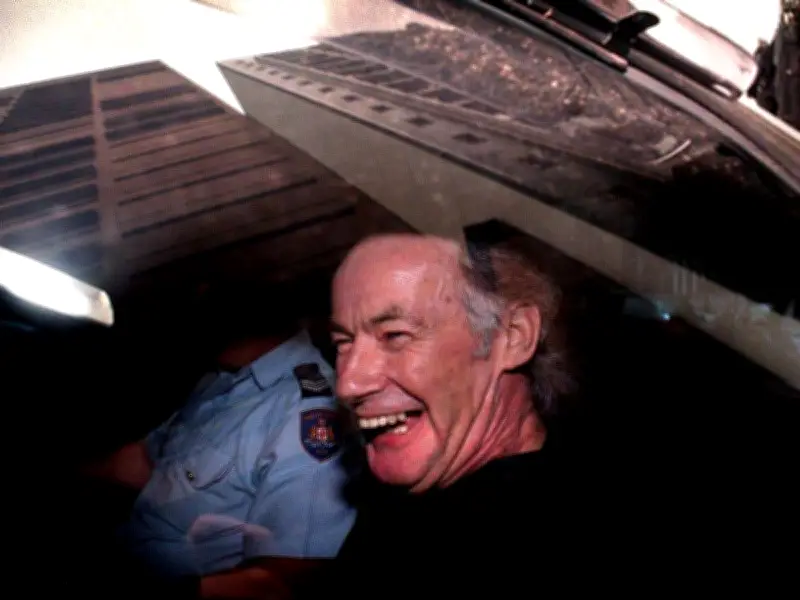
A survivor who narrowly escaped becoming a victim of Australia's worst serial killer has described his terrifying encounter. Steven Clark was hitchhiking as a teenager when a speeding car stopped to offer a lift. The driver, later identified as Ivan Milat, began asking suspicious questions about their plans and who knew their whereabouts.
"As my mate was just starting to close the door, he took off, he hit the accelerator. He hadn't even got the door closed," Mr Clark told ABC. "He was quite happy to ask us questions and begin to find out stuff about us, but he wouldn't volunteer even his name to us."
The driver's erratic behaviour attracted police attention, and he was pulled over for speeding. After receiving a ticket, his demeanour changed, and he dropped the youths off safely. Mr Clark glimpsed the first two letters of the driver's name on the ticket: "I, V." Years later, he recognised the face on the news: Ivan Milat, arrested for the murder of seven young hitchhikers.

Milat's Crimes and Victims
Between 1989 and 1992, Milat kidnapped, assaulted, and killed seven young people, dumping their bodies in Belanglo State Forest, about two hours south of Sydney. The forest became known as "Serial Killer Forest." Three victims were German, two British, and two Australian. Police and activists suspect he may have killed many more, dating back to the 1970s.
An inquiry began in summer 2026 to explore links between unresolved missing persons cases and Milat. Among them is Kay Docherty, who disappeared aged 15 in 1979 while hitchhiking on the same road where Mr Clark was picked up. Her brother Kevin told the inquiry: "I promised my mum, who died in my arms, that I would continue the search for her daughter, my twin sister."
Retired British detective Hugh Hughes believes 20-year-old Keren Rowland, who vanished in 1971, was Milat's first victim. "If he did kill Keren, and I am 95 to 98% certain he did, then she was his first victim," he said.
The Victims' Horrific End
The bodies were discovered between September 1992 and November 1993, buried face down in shallow graves with hands bound. Caroline Clarke, 21, and Joanne Walters, 22, were found by joggers. Ms Walters had been repeatedly stabbed, while Ms Clarke was shot 10 times in the head. James Gibson and Deborah Everist, both 19, were found in October 1993, beaten and stabbed. In November 1993, police found Simone Schmidl, and German couple Anja Habschied and Gabor Neugebauer. Ms Schmidl was stabbed at least eight times, Mr Neugebauer shot six times in the head, and Ms Habschied was decapitated.
How Milat Evaded Justice
Weeks after Keren Rowland vanished in 1971, Milat was charged with kidnapping and sexually assaulting two teenage hitchhikers. He escaped to New Zealand while on bail, and after a trial three years later, walked free when his barrister questioned the victims' mental health records.
Australian MP Jeremy Buckingham suspects Milat may have killed up to 80 people. He campaigned for the inquiry and succeeded after presenting an artist's impression of the suspect in the 1965 Wanda Beach killings, which bore striking similarities to a young Milat. Another possible victim is Peter Letcher, 18, found dead in 1988 with a gunshot wound to the head and multiple stab wounds. Clive Small, who led the Milat investigation, told the BBC: "I'm satisfied the 1987 murder of Peter Letcher was Ivan Milat."
Mr Buckingham told parliament: "I believe it is possible that Milat's long‐term relationships with powerful and corrupt interests protected him from investigation, prosecution and justice for many decades before he was convicted for the Belanglo murders." He added: "What's clear is that it was as plain as the nose on your face that a serial killer was operating in New South Wales in the 1970s."
The Star Witness
British man Paul Onions helped convict Milat. In 1990, Milat picked him up, and when Onions saw a gun and rope, he escaped from the car. Milat pursued and shot at him, but Onions flagged down another car and went to the police. His report was initially dismissed, but years later, back in the UK, he saw news reports about bodies in Belanglo State Forest. He contacted Australian Federal Police and was flown back to Australia. In 1996, he was hailed as a "star witness" but declined a A$200,000 (£110,000) reward.

Milat's Death and Legacy
Milat received seven consecutive life sentences without parole for the murders, plus sentences for attempted murder, false imprisonment, and robbery of Mr Onions. He died in prison in 2019 aged 74, diagnosed with stomach and throat cancer six months earlier. Authorities tried to get him to confess to other crimes, but he remained unyielding, leaving a letter for his brother stating: "I am innocent of the crimes convicted of."
In 2010, human remains were found in Belanglo State Forest, but forensic examination showed they were left there years after Milat was jailed. Former detective Stuart Wilkins said after his death: "He is still without peer as Australia's worst serial killer. It's a real travesty the way he sat there and still denied his absolute guilt in committing those murders and others. It just goes to show his psychopathic personality to the end."