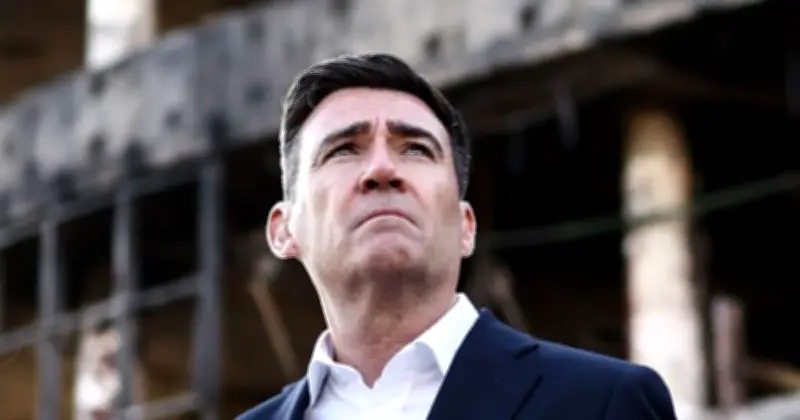
Prime Minister Andy Burnham has been warned that Britain faces an “inevitable” Russian attack on its defence and security infrastructure in retaliation for the UK’s unwavering support for Ukraine.
Security chiefs were on high alert on Tuesday night for a potential Kremlin strike, either targeting the Prime Minister himself or key military sites, after Mr Burnham’s high-profile visit to Kyiv and his decision to deepen military co-operation with President Volodymyr Zelensky.
Senior source warns of Russian retaliation
A senior source said: “The question being asked is, ‘How long do we keep poking the bear before it bites?’ An attack on the UK’s defence and security infrastructure is inevitable, based on our high-profile support for Ukraine. Ourselves and the French are front and centre, and Burnham’s visit to Kyiv and his forthright stance will have been noticed at the Kremlin. There had been some optimism in Moscow that he would be softer than Starmer on Ukraine. That was not the case.

“Russia will want to make a statement, through actions rather than words. That could be a drone attack, or an arson attack. There are Russian sleeper cells in this country that could do either.”
The source told the Daily Mail that Russia is already testing Britain’s security infrastructure daily and that “something bigger is only a matter of time”, provided it remains below the threshold that would trigger a NATO military response.
Pressure on Putin and diplomatic signals
The warning comes as Vladimir Putin is believed to be under internal pressure to confront Britain’s growing role in the conflict. The Russian leader had reportedly been advised that the new occupant of No 10 would prove more accommodating than Sir Keir Starmer.
Those hopes were dashed when Mr Burnham, on his first overseas trip as Prime Minister, reaffirmed “unwavering” support for Kyiv, swapped missile blueprints and battlefield artificial intelligence, and secured what officials described as a “goldmine” of combat data.
Further alarm was sparked by the sudden withdrawal of Russia’s ambassador to London, which sources interpreted as a signal that “something big is coming”. Major UK defence manufacturers involved in producing weapons for Ukraine have already stepped up physical security and cyber defences.
Heightened tensions and recent provocations
Former Russian deputy foreign minister Andrei Fedorov fuelled the tension by refusing to rule out “semi-military” action against Britain. Speaking after Mr Burnham’s Kyiv trip, he told the BBC he could not “100 per cent exclude” visible retaliation, including possible attacks on factories producing drones for Ukraine by “unknown sources”.
The sense of urgency was heightened by an emergency visit to Moscow by CIA director John Ratcliffe, who is understood to have delivered a blunt “just don’t do it” message warning the Kremlin against escalating the war through nuclear use or strikes on Western allies. US intelligence assesses that Russia is primed to act dramatically after its battlefield campaign stalled once more.
Recent provocations have already tested British resolve. In April a Russian Su-35 fighter flew within 20 feet of an RAF Rivet Joint intelligence aircraft. In June, Royal Marines boarded a Russian shadow-fleet oil tanker in the English Channel for the first time.
As Russia prepares to mobilise a further 300,000 troops and after suffering an estimated 1.5 million casualties since the 2022 invasion, the message from Whitehall is clear: the bear has been poked, and Britain must now brace for the bite.