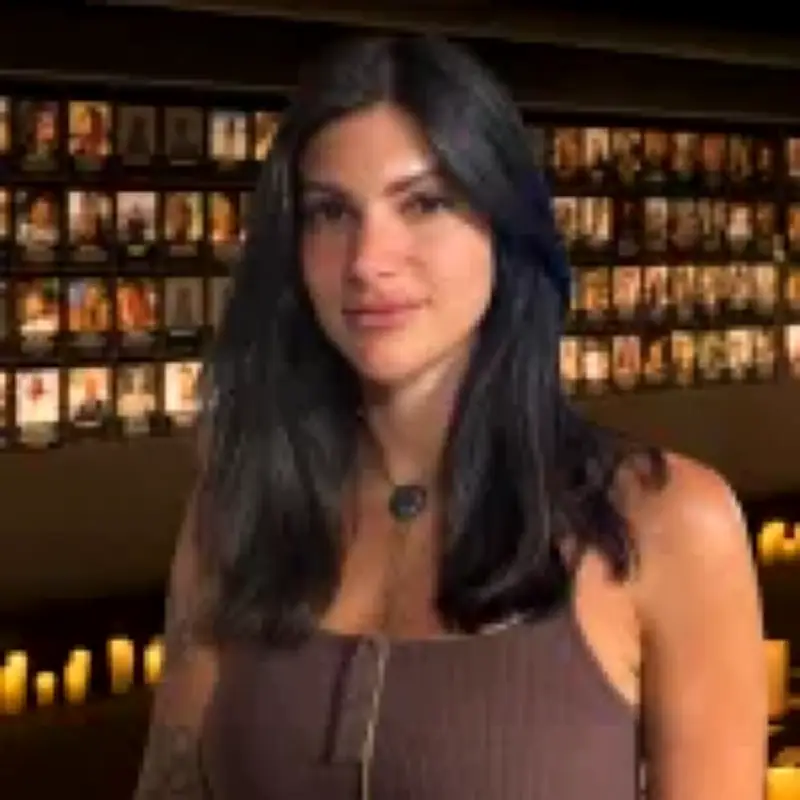
May Hayat, a bartender who was captured by Hamas during the Nova music festival attack on October 7, 2023, has shared her harrowing story at the Nova Exhibition in London. She described how she ran for her life, hid in a pit, and escaped an ambulance moments before it was blown up, but was still caught by the militants.
The attack at the Nova Festival
May, now 32, and her best friend Liron Barda had just finished a night working at a bar at the festival in the Israeli desert when Hamas attacked. Speaking at the exhibition, May recalled: 'We suddenly saw people running, but the music was still playing. We didn't understand what was happening until we saw the rockets in the sky.'
The military wing of Hamas launched a barrage of rockets at 6.30am on October 7 as cover for their ground invasion. Militants blasted through the border fence in numerous locations while others headed towards the festival via paragliders. The event was quickly shut down and festival-goers were told to evacuate, but it was already too late for many.
Escape and capture
At 7am, May got a call from a friend who had tried to flee. 'She yelled, "May, I see terrorists, I see dead bodies, I see blood. I need help."' That was the first time May had heard about the terrorists. Many party-goers who encountered Hamas on the roads returned to the bars with gunshot wounds. While Liron tried to help the injured, May texted her family goodbye.
The bartender hid in a police command post at the festival alongside 50 others. Then a police officer came in and told the group: 'You need to pray as hard as you can and run for your lives.' May ran as bullets whistled past her. She hid in an ambulance in an open field, but something told her it would be a 'death trap'. Moments after she got out, Hamas fighters fired an RPG at the ambulance and killed 18 people.
May met fellow partyer Avi Dadon, and the pair were picked up by another man and driven across the fields. 'When we got to the road, I saw a lot of dead bodies, burnt bodies, body parts, burnt cars, and smoke all over,' she said. The terrorists shot at the car, forcing them to U-turn back to the fields. May and Avi hid in a hole for 15 minutes until they were dragged out by Hamas fighters.
Captivity and release
'They pulled me out first. When I opened my eyes, I found myself surrounded by eight terrorists in civilian clothes, with knives, hammers, and wooden bats. One of them was a 14-year-old child,' May said. 'Then they pulled out Avi. He was on his knees. He begged them; he offered them money. When I saw their reaction, I realised that is what they were looking for. They wanted us to be afraid. So I told myself I had to be strong.'
When one of the terrorists grabbed her hand, they noticed a childhood scar on her arm that she had covered with a tattoo. The Hamas fighters pulled away, but told the pair they were being taken hostage. After walking for two hours, the group stumbled across the bodies of two dead women. There, May saw 'three of the terrorists grab his hands, as one of them stabbed his neck' in front of her eyes. Avi was killed on the spot, but May was dragged further towards Gaza.
However, the terrorists' plan was spoiled when the car they wanted to take did not start. May talked with the group's ringleader all the way back to the Nova festival grounds, where he eventually decided to let her go. She puts her safety down to her tattooed scar, which she used to hate. May claims: 'According to their beliefs [of Hamas terrorists], a scar like this means a strong woman. If something happened to her because of them, the 72 virgins they are promised will not come looking for them in heaven.'
The bartender hid under a stage until she was eventually rescued by the army, but her friend Liron never made it home. She was one of the 378 people massacred at the music festival, while another 44 were taken hostage.
The Nova Exhibition in London
May travelled to London in July to share her story with visitors of the Nova Exhibition. The UK capital is the 10th city to host the immersive experience documenting how the terror attack unfolded. The exhibition, visited by Sadiq Khan and the Archbishop of Canterbury, was scattered with belongings from participants and shows film as their nightmare unfolded. There are burned-out cars and shot-through toilet cubicles, as well as a table of shoes belonging to those who fled.
May believes it is crucial for British people to hear her story. She told Metro: 'London is the place where most visitors did not know what happened to us. We need to commemorate this day and our friends, who cannot share their stories.' The exhibit was extended for a longer run in London due to high demand and welcomed visitors for the last time on Wednesday, July 15. The display is now planning to travel to new cities.
London has been at the centre of antisemitic attacks against Jewish people and community sites, including when two men were stabbed in Golders Green in April. May said she had heard the situation in the UK was 'not good', but added: 'We are people of light. Light always beats darkness. That is why we are here and I am not afraid of them.'
That was the message conveyed by Ofir Amir, 42, one of the co-founders behind the Nova Music Festival, who is now one of the key organisers of the exhibition. Ofir fled the festival in a car as Hamas attacked, but was hit by a bullet in both legs. For four hours, Ofir lay unable to walk, talking to his wife on the phone – who was nine months pregnant – while his friend died beside him.
Ofir told Metro: 'Our lives changed on October 7th. We do not feel responsibility for what happened but we felt we had to do something so no one will deal with this trauma alone.' A week later, Ofir and his friends opened a healing centre for the victims. He then began planning for a memorial, which opened in Tel Aviv two and a half months after October 7. It then evolved into an international exhibition that has toured the world for two and a half years.
'We just cannot stop, there is no other option,' Amir said. 'There is so much hate and denial on social media. We can show the world what happened to us and educate.' The survivor said that the story needs to be told more than ever as antisemitism rises across the world. He added: 'Before we came to the UK, people said you have to be careful there, it is dangerous there. But people said this about Toronto, Berlin and Paris. It is dangerous everywhere. The message is not about a country or religion or about taking sides, it is about what happened at a music festival. People need to see what happens when you feel the hate and when you don't fight antisemitism.'