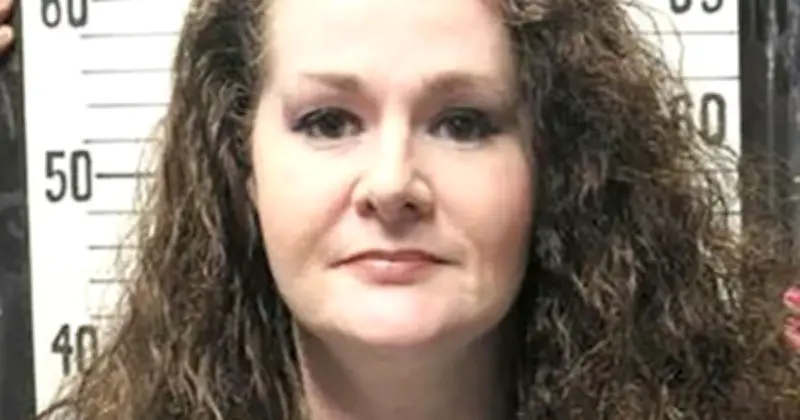
Witnesses to a botched execution have described hearing death row killer Christa Pike snoring for nearly 40 minutes after she was given a second dose of lethal drugs. Pike, 50, survived the attempt to execute her by lethal injection in Tennessee on Wednesday, September 30.
Public radio reporter Catherine Sweeney, one of seven media witnesses at Riverbend Maximum Security Institution in Nashville, said Pike eventually stopped talking and began snoring after a second round of pentobarbital was administered. Under Tennessee's execution protocol, a rock is used to signal that the lethal drugs have been fully administered. Staff place it on a small platform in the death chamber, triggering a five-minute waiting period before the curtain is closed and a doctor checks the prisoner's pulse and certifies their death.
Witnesses hear snoring over loudspeaker
Sweeney wrote: "She continued to snore after the rock was put out the second time and the curtain closed again. We continued to hear her snore over the loudspeaker." The curtain was drawn across the death chamber at 8.16pm, leaving witnesses unable to see what was happening inside.
As the minutes passed, another reporter questioned why it remained closed when a doctor was not certifying Pike's death. Sweeney added: "We could all hear her breathing." At 8.53pm, prison warden Kenneth Nelsen announced over the loudspeaker: "Media witnesses, please exit the area."
Execution timeline and final words
Pike had been sentenced to death for the 1995 murder of 19-year-old Colleen Slemmer. Her execution had already been delayed for hours after a federal circuit court issued a stay, which was later lifted by the US Supreme Court. When witnesses were eventually taken into the witness bay, they spent 45 minutes waiting with the curtain covering the death chamber and the microphone switched off.
At 7.27pm, the curtain was drawn back and Pike could be seen lying on a gurney alongside her spiritual adviser, Mikey Noechel. The pair sang and spoke about Buddhist teachings before Pike delivered her final words. She said: "I just want to say that I'm going to leave this world the way I've spent most of my life, and that is with love." Pike also said she had love for those who hated her and was at peace with her death.
Signs of trouble and aftermath
Moments later, however, she told Noechel that her arm was burning in one particular spot and asked prison staff whether this was normal. Sweeney said Pike continued talking for what seemed an unusually long time, despite prisoners typically showing signs of sedation within minutes. The rock was placed on the platform at 7.41pm. But at 7.44pm, Pike was still quietly talking to Noechel. Sweeney wrote: "My jaw dropped. It was clear to me then that something was very wrong."
After the five-minute period, the curtain closed and Noechel moved into the witness bay. But staff then ordered him back into the death chamber and the curtain reopened. According to the Death Penalty Information Center, Pike is "the first person to survive after being injected with lethal doses of execution drugs." The state's protocol does not set out what should happen if a second round fails to kill a prisoner.
It remains unclear what happened behind the curtain after it closed again, with Pike's lawyers saying they were not allowed inside the death chamber. Emergency vehicles later arrived and witnesses saw a convoy leave with its sirens on. Her lawyers confirmed she was taken to hospital in critical condition and alleged the execution team did not "realize that the IV lines were not correctly placed or that the veins had blown." They claimed pentobarbital had "in whole or in part" entered her body rather than her veins. Pike arrived at hospital with both arms "swollen, burned, and blistered," they said, adding: "She is intubated, on a ventilator, and remains unconscious." Tennessee Governor Bill Lee subsequently suspended lethal injection executions for the remainder of the year.