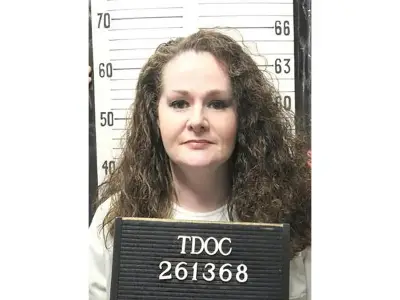
A judge has reopened Christa Pike's legal challenge against lethal injection after her botched execution, while a politician pushes for the electric chair instead.
Legal battle reactivated
Death row killer Christa Pike could escape a second execution after a judge re-opened her legal battle against receiving a lethal injection. The convicted murderer, 50, was set to become the first woman executed in Tennessee in more than two centuries on September 30.
She instead made history as the first US death row inmate to survive a lethal injection when the state's attempt to kill her went horribly wrong. Davidson County Chancery Court Chancellor I'Ashea Myles has now handed Pike a shock lifeline by putting her initial challenge back on the court schedule.
The legal move does not strike down the state's execution protocol, but rather reactivates a lawsuit Pike originally launched in January that got frozen in red tape. Her case had been bounced to the Tennessee Supreme Court, which dismissed the filing on a procedural quirk without actually deciding whether her claims were valid, reports FOX 17.
Political pressure for electric chair
Realising the legal challenge was never decided on its merits, Chancellor Myles stepped in to reopen the original lawsuit in Nashville. However, Pike's potential reprieve comes as a terrifying new threat looms over her fate.
Tennessee is set to elect a new Governor in November, with current leader Bill Lee reaching his second term limit. Republican candidate Marsha Blackburn is currently tipped as the favourite to succeed him. Opening up about the botched execution, Ms Blackburn insisted the state should switch to alternative execution methods to deliver punishment.
Ms Blackburn said: "While there should be a thorough review of what happened and why the process failed, the answer is simple: bring back the electric chair and deliver justice for these victims swiftly."
Medical concerns and aftermath
Pike's legal team had warned before the failed execution that Tennessee's single-drug method using pentobarbital was plagued with issues. In court papers seen by the New York Post, Pike's lawyers wrote: "Tennessee's new lethal injection protocol, calling for a single drug (pentobarbital), is plagued with the same issues that have marked botched executions for decades: secrecy, intentional omission, inattention to detail, and untrained and unlicensed prison personnel attempting to fill medical role.
"As the State of Tennessee seeks to execute its first woman in 250 years, and the only woman on Tennessee's death row - Christa Gail Pike - those problems have come to head."
The new protocol, as applied to the plaintiff and her unique medical conditions, is unconstitutional under the United States Constitution and the Tennessee Constitution. Attorneys added that her "physical characteristics" - such as small veins - made inserting execution needles nearly impossible.
Survival and current status
During the horrific attempt, Pike was jabbed at least seven times with needles, one of which bent at a 90-degree angle, and given two doses of pentobarbital. She was left unconscious in a critical state, with lawyers told she was brain dead. In a miracle turn of events, Pike woke up roughly six days later, started talking, and is now walking again.
Her attorney Randy Spivey later revealed she suffered a blood clot, contracted pneumonia and was unable to eat following the ordeal. Pike was sentenced to death as an 18-year-old for the sadistic 1995 murder of her classmate Colleen Slemmer, 19.
While a senior judge previously ruled she had failed to prove a risk of needless suffering, the catastrophic execution attempt forced state leaders to halt all upcoming capital punishment pending an independent probe. When asked during a court hearing if the execution would be rescheduled, Tennessee Assistant Attorney General William Ayers said: "I can't answer that question."