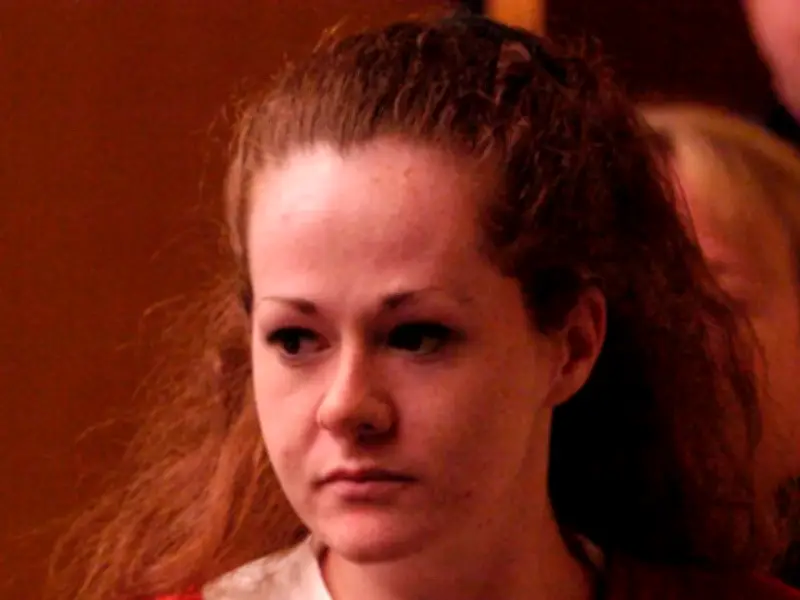
Christa Pike has regained consciousness after a bungled attempted execution left her hospitalised with extensive injuries last week, and is now awaiting a decision on her future after the long ordeal.
The death row inmate, 50, is "conscious and speaking", her lawyers have said, despite having been twice dosed with deadly chemical pentobarbital during a scheduled lethal injection on September 30 in Tennessee, the US. Medics have cleared her body of the substance, which is said to have left her with extensive burns, and she is "handcuffed and shackled to the bed" in hospital.
Recovery called unprecedented
Experts have said her recovery is unprecedented, and authorities are now probing the events leading up to the execution attempt as she faces an uncertain future, with a hearing on the incident due to take place today at 11am CDT (4pm BST) at Tennessee's Davidson County Chancery Court.
Massive interest in Pike's history and sentence have also developed over the last week, so we've explored the grim crimes leading to her death row sentence - and looked in depth at the botched execution.
The murder of Colleen Slemmer
On January 12, 1995, 18-year-old Pike, along with her 17-year-old boyfriend Tadaryl Shipp and 18-year-old friend Shadolla Peterson, brutally tortured and killed 19-year-old Colleen Slemmer. All four were students living at a Job Corps training centre in Knoxville, Tennessee.
Pike believed that Colleen was trying to "steal" her boyfriend, Shipp, and claimed Ms Slemmer had been "running her mouth" about her.
Pike and Peterson lured Colleen into the woods near an abandoned boiler house on the University of Tennessee's agricultural campus, convincing her to sign out of their dormitory with them under the pretence of "making peace" and offering her cannabis.
Once they reached the remote spot, the pair brutally beat, kicked, and slashed their victim using a box cutter and a miniature meat cleaver, with the ordeal lasting between 30 minutes and one hour.
Satanic overtones and trial
Ms Slemmer's murder attracted heightened attention due to its brutal nature, with Pike and Shipp having carved a pentagram into their victim's body.
The death came at the height of the "Satanic panic" of the 1980s and 1990s, stoking fears of devil worship, with Shipp eventually admitting he had carved the symbol. Shipp had as a teenager had kept a satanic altar in his room, and was known by the nickname "Baby Satan" among his fellow Jobs Corps members.
Pike and her boyfriend were arrested three days after they killed Ms Slemmer, with the killer's early testimony about the horror act caught in police tapes.
She told investigators during an interview that she had only intended to scare Slemmer, not kill her. During the trial, police played a taped confession in which Pike described a 30-to-45-minute "torture session".
A jury found her guilty of first-degree murder and conspiracy to commit murder in 1996, and she was sentenced to death aged 20, making her the youngest woman on death row in the entire US at the time.
Fates of accomplices
Pike was 18 when she murdered Ms Slemmer, and her boyfriend 17, but due to the severity of their crime both were tried as adults when they were brought before the court in 1995.
Shipp, however, did not meet age requirements to receive the death penalty like his girlfriend, and when he was convicted of first-degree murder and conspiracy to commit first-degree murder, was sentenced to life in prison without eligibility for parole.
He is now 49, and has been serving his life sentence at Tennessee's Northwest Correctional Complex, although the conditions of his imprisonment have somewhat relaxed in recent years. Shipp has since become eligible for parole, and had his first hearing in October 2025. He was flatly denied by the Tennessee Board of Parole at the time due to the "heinous and heartless nature of the crime". His next review is due in October 2031.
As Pike and Shipp went through the courts charged with the murder of Ms Slemmer, Peterson, the former's best friend, escaped with a lesser charge and ultimately lighter far lighter punishment.
District Public Defender Mark Stephens maintained that, while his client was present when the murder took place, she was unaware Pike and Shipp had planned to murder the 19-year-old.
She agreed to accept a plea deal for a lesser accessory to murder charge in exchange for testifying against her two friends, and was kept behind bars until this was finalised. After around 460 days behind bars, Peterson ultimately went on to serve six years of probation, and in the years since has maintained a private life.
Pike on death row
Pike has spent more than 30 years awaiting her death, all of which time has been in solitary confinement at the Debra K Johnson Rehabilitation Center in Nashville.
Her time awaiting her sentence wasn't spent in deep reflection, as she would go on to also commit crimes while behind bars. In 2001, just five years into her sentence, Pike choked fellow inmate Patricia Jones with a shoestring.
She was convicted of attempted first-degree murder for the attack three years later. In March 2012, it was reported that Pike had made escape plans with two alleged accomplices, one of whom was a corrections officer.
She was rumbled before she had the opportunity to carry it out, however, and the Tennessee Department of Corrections has not disclosed what she had planned. Pike was not charged for the conspiracy, but one of her co-conspirators received a seven-year prison sentence.
Execution date set
Tennessee's Supreme Court officially set an execution date for Pike last year, which was met with several appeals from her legal team, who launched a bid to prevent this from ultimately being carried out.
Her lawyers argue that carrying out the execution by lethal injection would violate her constitutional rights against cruel and unusual punishment, as she suffers from blood clots and obesity.
They also said she was a victim of sexual abuse as a child, a claim that received backing from experts at the UN Human Rights commission, who warned earlier this month that her execution would break international law.
The Tennessee Supreme Court ultimately denied Pike's request for a stay of execution after finding that she was not at "substantial risk" of severe pain or needless suffering on September 25, and it was allowed to go ahead at the Riverbend Maximum Security Institution in Nashville, Tennessee on September 30.
Final request and words
Pike's attorneys revealed that the convicted murderer requested no men be involved in administering the lethal drug. She made the request due to her history of suffering sexual abuse, fearing being put to death by a man would be needlessly traumatic.
"That was her biggest fear as the victim of sexual abuse, that she would be pinned down, prodded, poked, cut," one of her lawyers, Stephen Ferrell, said.
"What I saw was consistent with that," another of her lawyers, Randy Spivey, said in response to a question about whether the execution team had been staffed entirely by women.
Pike was allowed to deliver a final statement before her death, saying she would leave the world "with love" after saying this was how she had lived her life.
She said: "I just want to say that I'm going to leave this world the way I spent most of my life, and that is with love." Pike added that she loved her supporters, and those who hated her.
She then saiid: "I'm at peace and I'm ready to go." Afterwards, continuing in the theme of her statement, the convicted murderer sang "I Love You So Much" with her spiritual adviser.
The execution attempt
Pike was strapped to a gurney in the viewing gallery before the execution was carried out, with curtains opening for a gallery of gathered journalists and family members of her victims at 6.30pm on September 30.
Media witnesses said the events transpired as followed:
- 7.34pm: As the pentobarbital was administered, Pike said: "The vein in my arm feels like it's about to bust."
- 7.39pm: Pike kicked off the sheet that covered her
- 7:41 pm: A "small white rock" appeared in a window, believed to be a "signal that a round of deadly drugs has been pushed through the IV lines."
- 7:46 pm: The blinds closed
- After 7:46pm: The blinds reopened, but Pike was still moving
- 8:05/8:06 pm: The blinds were drawn a second time
- 8:53 pm: Media witnesses were escorted out of the building, they claimed Pike was "snoring" at the time
- 9pm: An ambulance arrived at the facility, and Pike was rushed to Vanderbilt University Medical Center
Aftermath and reactions
Pike's lawyers said that, the day following her intended execution, she was in critical condition, unconscious, intubated and on a ventilator.
They said her arms were left swollen, blistered and burned by the pentobarbital administration, and that she had up to seven pricks from attempted IV line insertion.
She awoke on October 6, with the lawyers saying she was speaking. They branded her recovery "medically unprecedented". "Against all odds, Christa Pike is conscious, speaking, and continues to receive critical medical care," they said.
"Despite the severe damage she endured to her arms, she is still handcuffed and shackled to the bed. Her recovery is medically unprecedented. Her prognosis remains unclear but, at a minimum, we expect a long recovery."
Her attorneys said they are grateful for the first responders and the medical team at the hospital "who treated Christa like a human and have provided exceptional care to her". The hearing at Davidson County Chancery Court will explore what happened wrong during the execution attempt.
The mum of twisted Pike's victim has come out swinging against state officials, saying "they f***** up" after she was let in the dark about the state of the execution.
Speaking to US outlet NBC news, May Martinez, the mum of Colleen Slemmer, said she wanted the execution to be carried out. But, she added: "They went to try to execute her, and she didn’t die." She was left furious with the state's Republican governor Bill Lee, its Department of Correction and attorney general after her daughter's murderer was rushed to hospital.
The mum said the killer had never expressed remorse during the attempted execution on Wednesday, and since the twin attempts has received little communication from officials. She said: "They didn’t say anything, and then, all of a sudden, they asked all the victims to leave. And we left."
"We didn’t know anything until we got up to the office and saw the commissioner. And he said that it didn’t work ... and she’s on her way to the hospital." When asked what her message to the governor and attorney general was by NBC, furious Martinez replied: "They f***** up."
Immediately after the botched execution, Ms Martinez said of Pike: "If I could have gotten in that room, I would have taken the box cutter and cut her up like she did Colleen."
What happens next
It is currently unclear as to what will happen next, but inquiries have been launched by Tennessee officials, with its governor, Bill Lee, has ordered a moratorium on upcoming executions.
The last remaining execution, of Gary Wayne Sutton, will not go ahead, and Mr Lee said he had ordered a "comprehensive, third-party review to determine exactly what occurred".
He added: "A lawfully imposed sentence is among that State's most serious responsibilities, and the people of Tennessee expect it to be done in a manner that is not only legal and constitutional, but is effective."
Among the options being considered is whether Pike should be subject to a second attempted execution, with questions lingering as to whether she is mentally competent to understand why she is being put to death.
Pike has strong arguments that it would be cruel and unusual to try again, and that it would violate the prohibition on double jeopardy, trying or punishing someone twice for the same offense, said Deborah Denno, a Fordham Law professor who has studied execution methods for 36 years.
"She has satisfied this very, very high standard for cruel and unusual punishment," Denno said. "She also has a very good double-jeopardy argument. They carried out every aspect of the execution. She didn’t die, but every process they intended, they did it."
Seattle University Law Professor Michael Russo, who handled capital cases as a public defender in Los Angeles, called the failed execution horrible, but said he doubted whether the Supreme Court would stop the state from trying again on double-jeopardy grounds, should it decide to do so.
"There’s nobody else in the history of the death penalty in this country who has gone through what she’s been through," Russo said. But, he added, "I think what this Supreme Court would say is, her sentence was to die — to be executed — not to suffer an attempt at execution."