Rap legend Tupac Shakur refused to tell police who had gunned him down in his infamous drive-by shooting in Las Vegas in 1996, a Nevada court heard on Monday (August 18).
Shakur's Last Words
According to former Las Vegas police officer Garry Dale, who spoke to the hip hop icon as he lay bleeding in an ambulance on September 7, 1996, Shakur replied: “No, no, we’ll take care of it.” “[Or] something like that,” Dale testified in the Vegas murder trial against now-63-year-old Duane Davis.
Dale rode in the ambulance with Shakur to hospital shortly after the drive-by shooting. Shakur never left that hospital alive, succumbing to his injuries six days later.

Davis Trial Underway
Now, 30 years after Shakur's death, former gang leader Duane “Keffe D” Davis faces trial in Las Vegas, accused of orchestrating arguably the most infamous hit in rap history. Prosecutors allege that Davis organised the hit on Shakur as an act of “revenge”. Tuesday marks the second day of proceedings, with prosecutors showing the court grim photos from the rapper’s autopsy.
Some members of Shakur’s family stepped out of the courtroom before prosecutors showed the photos from the star's 1996 post-mortem. Dr Lisa Gavin, a forensic pathologist and medical examiner for Clark County, Nevada, was among the early witnesses on the second day of evidence. Jurors were shown a photo of a green body bag at the beginning of her questioning, followed by a grisly photo of his body. Shakur's relatives who remained in the courtroom looked away. One woman got up to leave once the photos were shown.
Medical Details and Allegations
The bullet entered Shakur’s chest near his armpit, Dr Gavin said, and travelled through his chest, including through a lung. That caused his lung to collapse and bleed, and doctors ultimately removed the damaged lung in an effort to save his life, she said. More bullets damaged his intestines and other parts of his body, she added. But, despite the best efforts of doctors, it was not enough, with Shakur ultimately succumbing to his wounds days later.
Dr Gavin was not at Shakur’s post-mortem, but was instead called as an expert witness as the examiner from 30 years ago has since died. They also called a forensic expert to the stand to describe the four fatal bullet wounds to his chest.
Davis’ defence maintains there was no merit to allegations that the suspect was responsible for the superstar’s murder. But, according to prosecutors, Davis was full of “visceral anger,” which boiled over when Tupac and his crew allegedly beat up Davis' nephew, Orlando 'Baby Lane' Anderson, while they were in town for a Mike Tyson fight at the MGM Grand hotel.
After the fight, Tupac and his entourage were involved in a casino lobby altercation with Baby Lane. Hours later, Tupac was fatally shot in a drive-by shooting near the Las Vegas Strip roughly three hours later.
In 1997, Shakur's mother Afeni Shakur filed a wrongful death lawsuit against Anderson. The legal battle was reportedly settled out for court shortly before Anderson's death in 1998. He was killed in a shootout at a car wash in Compton, California, in a row over drug money. Police say his death was unrelated to the Shakur investigation.
It took authorities more than 25 years to formally charge Davis, who has acknowledged that his nephew fired the shots while he was in the car. “Duane Davis did not pull the trigger, but what he did do was plan the retaliation for the beating of his nephew,” a prosecutor told the jury during opening arguments on Monday.
Prosecution and Defence Arguments
In Monday’s opening statements, deputy district attorney (DA) Binu Palal told jurors: “Duane Davis did not pull the trigger. But he did plan the shooting in retaliation of the beating of his nephew. Remarkably, you will learn that from Duane Davis himself.”
Davis, 63, could be sentenced to life in prison if he is convicted of murder with a deadly weapon with the intent to promote, further or assist a criminal gang. He has pleaded not guilty for the crime against Shakur.
In his opening remarks, defence lawyer Michael Sanft called the prosecution’s narrative “fiction”. Sanft told jurors Davis was not previously charged, despite implicating himself in interviews and his memoir, because law enforcement knew he was “full of crap”.

Jurors were shown video of Shakur’s entourage attacking Davis’s nephew, Baby Lane, hours before the shooting on September 7 1996. Davis spent the next two hours planning how to get even, said the DA, and Shakur was gunned down “in an act of revenge”. The DA also told jurors Davis had a visceral hatred for Shakur for decades which drove him to speak repeatedly about it.
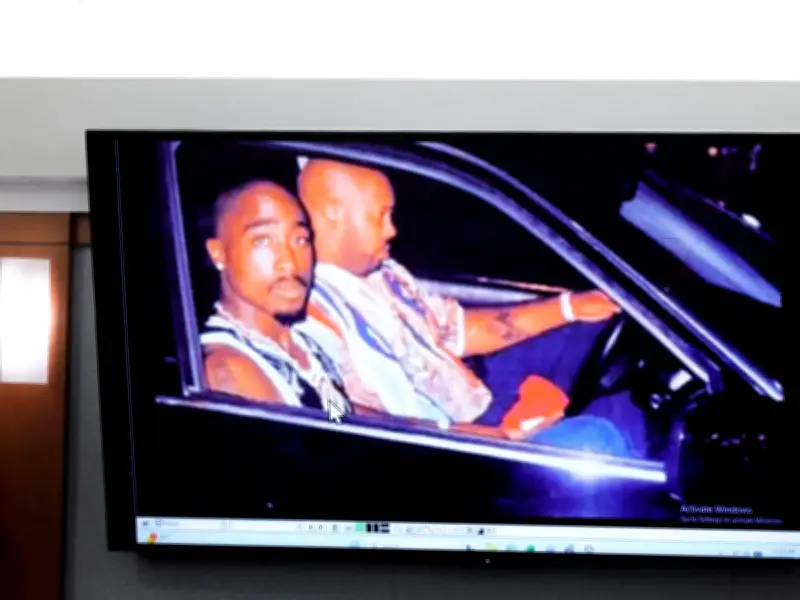
In a 2008 interview with federal investigators, he described handing a gun to the men in the back seat of a white Cadillac that fired on a black BMW with Shakur and Marion “Suge” Knight inside, Palal said. In a 2009 interview with Las Vegas police, Davis admitted his role in the killing, the DA continued. The prosecutor added that Davis further implicated himself in the 2019 memoir he co-authored, Compton Street Legend.
Shakur remains a cultural icon and is considered one of the most influential and versatile rappers of all time, despite dying at 25. A former Las Vegas homicide detective said investigators pieced together the identities of Davis, Anderson and the other two men in the car through informants, but could not find witnesses willing to officially identify them.
A former detective from the Los Angeles Police Department told the court that Davis had briefly been a suspect in the 1997 shooting death of Shakur’s East Coast rival, the Notorious B.I.G., but was later discounted as a possibility. Sanft said outside court that the fact 30 years had elapsed since the crime would be of help Davis. “The length of time is going to be a huge problem for people trying to recall things, to remember things,” the lawyer said. “That’s just not how it works.”