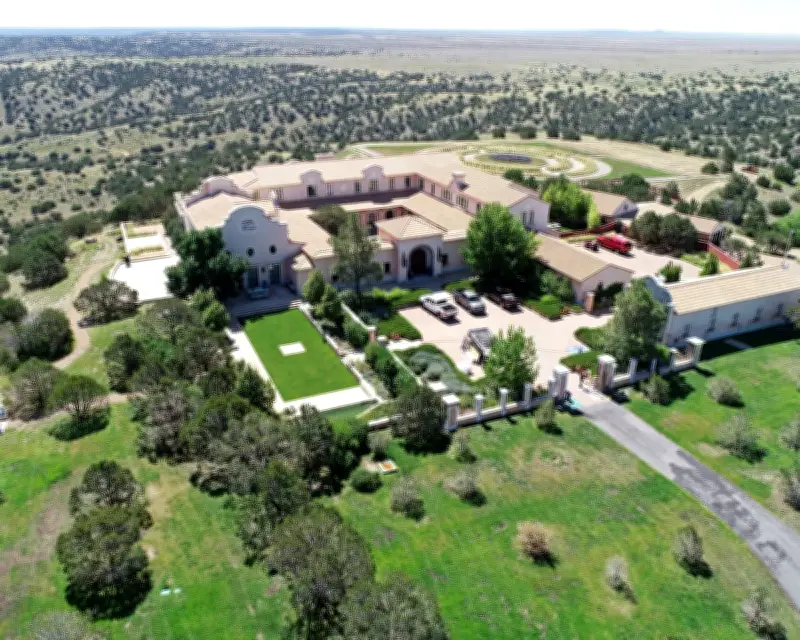
Torrez’s office requested the unredacted files in February after reopening a dormant criminal investigation into activities at Zorro ranch, a 10,000-acre property in desert scrub outside New Mexico. It set a 31 July deadline for the department to share relevant records. As the deadline passed on Friday, the justice department did not respond to a request for comment.
The Guardian reported in February that recent releases of the so-called Epstein files included thousands of mentions of the ranch and numerous photographs of men and young girls there. A succession of survivors had previously given testimony about the abuse they were subjected to. Unlike other properties prominent in Epstein’s sex-trafficking conspiracy in Palm Beach, New York and his private Caribbean island, no federal search of the ranch was ever confirmed to have taken place.
Only 31 pages produced
Torrez set the deadline for federal prosecutors from the justice department and the US attorney’s office for the southern district of New York (SDNY), which led the original Epstein investigation, to allow access to whatever documents they had. Despite promises of cooperation from Todd Blanche, the acting attorney general, and Jay Clayton, the former US attorney for the SDNY now director designate of national intelligence, only 31 pages were ever handed over, Torrez said. They were mostly old news clippings and heavily redacted pages of little use to state investigators.
In a 14 July letter to Blanche, Torrez said he would “pursue all available legal remedies without further notice” if the deadline passed, having made “repeated, documented, good-faith efforts to obtain the unredacted investigative records in the USDOJ’s custody”. The same week he told Albuquerque ABC News affiliate KOAT: “I’m not taking anything off the table. I’m not ruling out a lawsuit.”
Conflict over cooperation
Epstein died in jail in New York in August 2019 while awaiting trial on child sex trafficking charges. The fight for documents relating to his activities at Zorro ranch, which he bought in 1993 from the estate of the former Democratic New Mexico governor Bruce King, became a cat and mouse affair after Torrez reopened an inquiry first launched by his predecessor Hector Balderas in February 2019.
According to the attorney general, the SDNY called him in July to announce it would not cooperate. But Clayton, in his Senate confirmation hearing last month, told Democratic senator Martin Heinrich: “My folks, I think as we speak, are seeking dialogue with the attorney general to see if we can reach an accommodation.” He noted the documents were subject to certain “protective orders”, namely redactions to hide the identities of victims.
Blanche, accused by Democrats in February of a “full-blown cover-up” of the Epstein files, told his own confirmation hearing last month that he was “continuing to work” with the New Mexico department of justice. But Torrez said he had heard nothing further from Blanche or the SDNY.
Meanwhile, the US attorney’s office for the district of New Mexico said in a statement it had “substantively responded” to Torrez’s request on 30 June by emailing the 31 documents. Some, a spokesperson said, were communications directing Torrez to the SDNY. The office “did not lead or handle the Zorro Ranch investigation and therefore neither collected nor retained any investigative materials”.
Threat of legal action
Torrez did not respond to a request for comment on Friday. He told MSNBC’s The Briefing with Jen Psaki on 23 July that he was annoyed by months of stonewalling from Blanche, Donald Trump’s pick for attorney general, whose confirmation is in peril.
“It appears that the administration has been really focused on the management of communications around the Epstein case, rather than acting in a way that demonstrates a commitment to getting to the truth and getting to accountability,” said Torrez.
Especially frustrating, he said, was the conduct of the SDNY after the first, Balderas-ordered investigation was shelved. “We stood down that investigation at the explicit request of the southern district of New York, and so to have them fail to honor their agreement and then not give us access to this file is extremely unusual, and it’s complicating our ability to advance this criminal investigation.”
Blanche, Torrez added, “has the authority right now, with the stroke of a pen, to grant us this access, to let us, our investigators and prosecutors, come and take a look at the files, identify co-conspirators, witnesses, corroborating evidence, identify new potential leads”.
“Every day that goes by that that doesn’t happen is another day that we’ve delayed delivering justice for the survivors.”