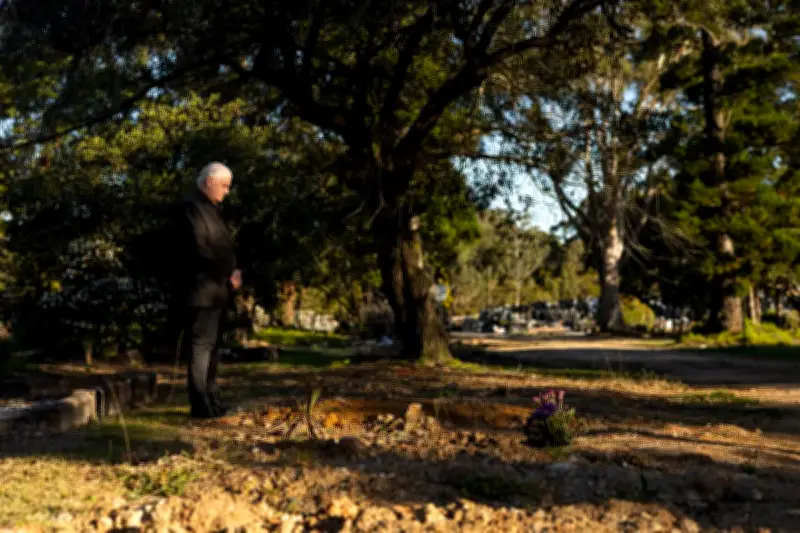
A rough sleeper known as the "king of town hall" in Sydney has been buried in an unmarked communal grave, despite being well known to local homelessness services. His support workers say they were not told about the burial.
The man, who was a familiar presence in the heart of Sydney's central business district, would sit on the town hall steps, offering cheeky advice to passersby and playing music. He slept beneath the steps, in an alcove near the train station. He was housed for a period but struggled without the connections he made daily on those steps.
A 'massive personality' known across services
Jon Swain, an adviser to the Australian Alliance to End Homelessness, who has held senior roles in homelessness coordination in local and state governments, described him as "funny, engaging and very well-known across homelessness services in Sydney."
"He was a massive personality. If you did outreach in Sydney, you knew him," Swain said. Before the man died, Swain and other support workers helped him get into aged care housing support.
When the man died this year, the New South Wales government designated him as a "person without means" and took over responsibility for handling his remains. It then buried him in an unmarked grave at Rookwood cemetery in May, in the same plot as four strangers. Swain had no idea this had happened until he was contacted by the Guardian.
Investigation reveals widespread practice
The Guardian's investigation has identified hundreds of unmarked communal graves used to bury disadvantaged Australians. At least 17 other Australians who were clients of Sydney homelessness support services have also been buried in communal unmarked graves by the NSW government.
Using evidence from family and friends, analysis of cemetery registries and aerial and satellite imagery, the Guardian found that "persons without means" are being buried in bare patches of earth between walkways and old headstones around Rookwood in western Sydney. The vast majority of the graves do not have a plaque or tombstone.
The investigation has prompted an immediate apology from NSW Health, which oversees the process, as well as calls for prime ministerial intervention. The NSW health minister, Ryan Park, has signalled he wants to end the use of unmarked communal graves.
Sector shocked by practice
The practice has shocked the homelessness support sector. Major providers like the St Vincent de Paul Society say they were not aware burials were happening in this way. A homelessness manager at one service, who asked for anonymity, said: "The sector has never been made aware of this practice. These people were loved at some point in their lives, they were somebody's family member or friend. A crowded, yet lonely and desolate end and just like their life on the street these men and women are afforded no privacy in death, and no final resting place of their own."
The practice is particularly galling to Rev Bill Crews, the head of the Rev Bill Crews Foundation, a support service based in Ashfield. Crews makes a point of conducting funerals at his own foundation's expense when he learns that a client or former client has died. But the Guardian's investigation has found three individuals buried in the communal graves who were former clients.
Crews says he was never told about the three cases. "They would all have had a dignified funeral and a proper cremation, their ashes would have been scattered," he says. Crews has known about the use of unmarked communal graves and has been raising concerns with the NSW government for many years, but says he has had no response. "I am so glad now it is coming out. I think nobody believes it, in a way, because it's not talked about. Nobody believes it, so nobody has pushed for change," he says.
Rules not followed, say support workers
There are rules for how NSW Health is supposed to manage burials of this kind. It is required to do everything it can to secure funding from family, friends and others for a funeral. The policy also recommends the agency check with "organisations the deceased may have had an association with while alive", including charities, to see whether they will help fund a funeral.
Swain says that is not occurring. He says many people who experience homelessness spend their lives feeling forgotten by the state and as though no one cares about what happens to them. "That is why it is so troubling to think that, at the very end of a person's life, they may have once again been let down," he says. "There is something profoundly unsettling about the idea that a person could live through such exclusion and then be buried in a way that seems to further diminish their individuality and humanity one final time."
Homelessness Australia's chief executive, Kate Colvin, said governments need to do much more to prevent premature death and improve healthcare for rough sleepers, but also treat people with dignity and humanity when they die. "When someone dies homeless it is often the final indignity in a life marked by poor luck, misfortune or injustice," Colvin said. "In so many cases, people who die homeless also die early, and their homelessness is a huge contributing factor. To further aggravate this by burying them in an unmarked communal grave should be beneath us as a society. Surely we can do better."
NSW Health acknowledged that it has not always treated those without financial means with the dignity and respect they deserved, and said it was "committed to changing the way we work". The NSW government has signalled greater cooperation with community and charity groups to seek funeral funding.
Metropolitan Memorial Parks, which operates Rookwood, said it has not been funded to provide markings on graves for burials of people without means. A spokesperson said: "There is no evidence to support claims that public burial locations are placed between old headstones, on walkways or in open trenches".