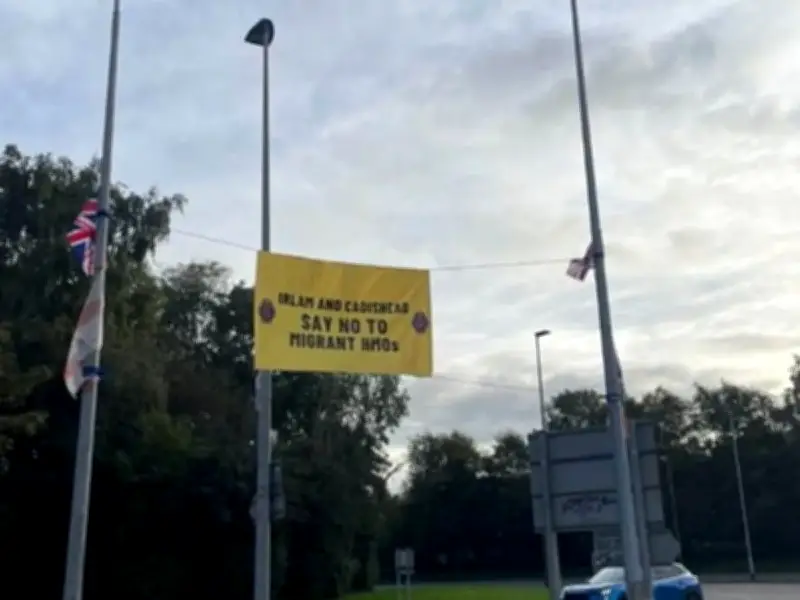
Salford Council has said it will remove roadside banners that oppose 'migrant HMOs', citing serious concerns that they are 'highly likely to spread misinformation and escalate cohesion issues in communities'.
The banners, which read "Irlam and Cadishead say no to migrant HMOs," have appeared across Cadishead and Lower Irlam, strung up on lampposts, under bridges, on billboards and attached to fences.
Council statement on banners
In a statement being shared by councillors, the council said it had taken steps to remove them over 'the potential for inciteful behaviour'. The statement added: "This matter goes beyond the putting up of union flags, which as a tolerant city have remained in place. The council does not house migrants in HMOs and has no such pending applications."
The council said the decision had not been taken lightly, noting that it had seen comments from communities, heard from ward members and spoken to the police. It also highlighted that a number of banners had been attached to road signage in an unsafe way for motorists and the wider public.
Councillor's reaction
The move was welcomed by Cadishead and Lower Irlam councillor Hannah Robinson-Smith, who said in a Facebook post that when highways officers initially attended to remove the flags they were 'surrounded by a gang with dogs, and had to leave'.
"That is absolutely outrageous," she said. "No-one should be made to feel unsafe undertaking their duties within their employment. These are public infrastructure assets; not a personal exhibition space - no matter the messaging being shared."
The council added that HMOs are occupied by a wide range of people from many different backgrounds and are among the most regulated forms of private rented accommodation. Each planning application is decided on its merits in a transparent process, with local residents notified of any applications as they are received.
The council said it does not support banners on roadsides that cause health and safety risks and are divisive to communities, but understands views within the community and welcomes the opportunity to listen and respond to them. It encouraged residents to attend regular community meetings in each ward, attended by the council and the police, and to contact local councillors to share their views.