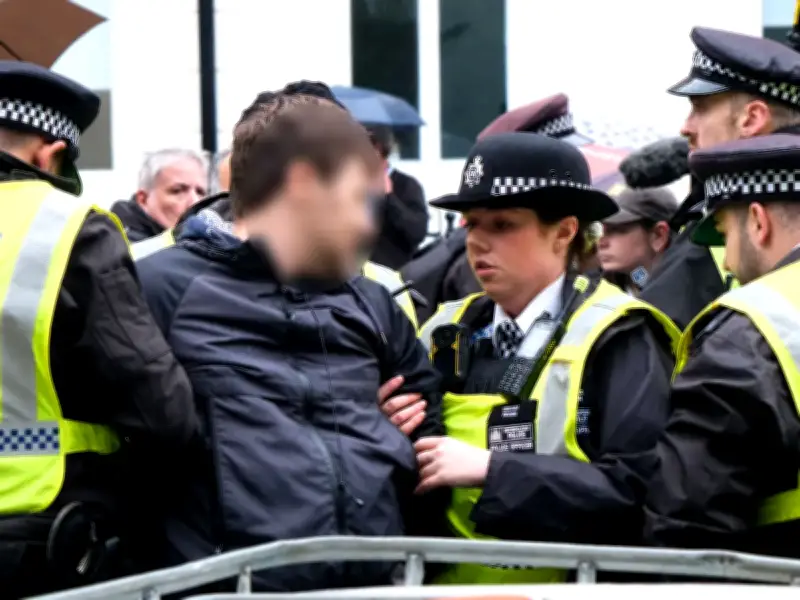
Five people were arrested on suspicion of inciting racial hatred at a spontaneous pro-Palestine protest in Camden, London, on the third anniversary of the October 7 Hamas attacks on Israel. The arrests involved allegedly shouting or chanting slogans calling for intifada, according to the Metropolitan Police.
Protests and Counter-Demonstrations
Pro-Palestine protests took place in London today, with around 100 protesters marching and chanting "free free Palestine" and "free the people, free the land" from Lincoln's Inn Fields to Russell Square. A group at the back of the march held a banner reading: "Holocaust survivor descendants against Gaza genocide."
Counter protesters holding Israeli flags and placards reading: "Stop the Gaza genolie" gathered by Russell Square. Shouts of "scumbags" directed at the pro-Palestine protesters could be heard, while they chanted: "Terrorist supporters off our streets."
Other demonstrations were held in Edinburgh and Glasgow. Student pro-Palestine demonstrations also went ahead despite calls for a ban or for the protests to be moved to a different date.
Arrests and Official Response
The Metropolitan Police said two people were arrested at the central London protest, one for breach of conditions and another for common assault. Separately, the Met said: "Earlier this morning, officers made arrests at a spontaneous protest outside the Board of Deputies in Camden. Five people were arrested for inciting racial hatred, involving allegedly shouting or chanting slogans calling for intifada. They remain in police custody. The protest in Camden has now ended."
Defence Secretary Wes Streeting branded the planned demonstrations "shameful" while Education Secretary Lucy Powell had urged students "to show compassion and protest on another day". The Board of Deputies of British Jews is expected to hold a vigil in Richmond Terrace, just off Whitehall, later today.
University Guidance and Antisemitism Data
Universities UK (UUK), which represents more than 140 institutions, published guidance asking university leaders to maintain close contact with Jewish student groups, review security arrangements and publicise mechanisms for reporting antisemitic incidents. Vivienne Stern, chief executive of UUK, said students and staff taking part in protests should be "mindful that October 7 is an anniversary of a brutal attack on innocent people" and agreed with the Met's request that the demos should have been moved to another day.
Board of Deputies president Phil Rosenberg said they would "not be threatened or intimidated by this small and extremist minority of British society". He added that they would "continue undeterred to advocate for the Jewish people, here and around the world, and to stand up for peace and security for Israelis, Palestinians and the wider Middle East".
The Israeli embassy in London said Britain had "experienced a profound rise in antisemitism, with Jewish people facing intimidation and hatred in streets, schools, universities and online" in the three years since the Hamas attacks. Data from the Community Security Trust (CST), published in August, suggested antisemitism in the UK spiked in the immediate aftermath of the US and Israel launching their war on Iran, and following a double stabbing of two visibly Jewish men in London.
The CST said its research showed there were 1,926 antisemitic incidents recorded across the UK in January to June of 2026 - up by a fifth on the first half of last year and the second-highest total reported to the CST in the first six months of any year. This was exceeded only by the 2,019 incidents recorded in the first half of 2024 - which followed the 2023 Hamas attacks and Israel's subsequent war in Gaza. The Palestinian death toll in the past three years surpassed 74,000 last month, according to Gaza's health ministry, which is part of the Hamas-led government.