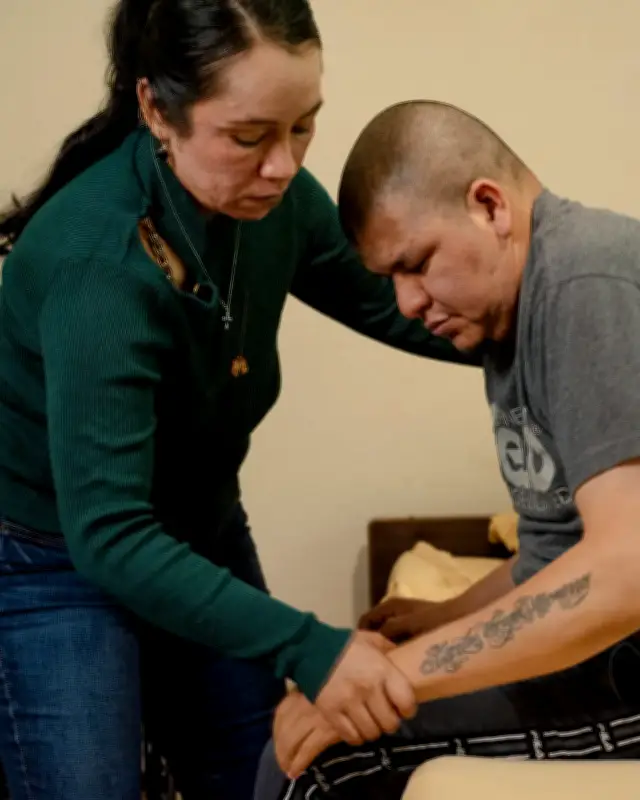
Carlos Vargas Moreno, a 38-year-old H-2A farm worker, suffered a severe heatstroke while weeding a watermelon field in Goldsboro, North Carolina, on 19 July 2022, leaving him unable to walk or care for himself. His family is speaking publicly for the first time about the incident and the lack of accountability they say followed.
Vargas Moreno and other workers had started at 7am, with two 15-minute breaks and a one-hour lunch outdoors. The heat index at 4pm was 98.3F, a level the Occupational Safety and Health Administration (Osha) and the National Institute for Occupational Safety and Health (Niosh) heat safety app classifies as “hazardous” for outdoor workers. Just before 6pm, Vargas Moreno paused to get water, then staggered and collapsed, according to court documents, government records and worker testimony.
His wife, Daysi Romero Arellano, now bathes, dresses, feeds and helps him use the restroom. “Nothing is the same,” she said through an interpreter in August. Due to a brain injury causing cognitive and linguistic deficits, Vargas Moreno cannot verbally describe the events.
Prior death at same company
The employer, Florida Orange Gold, a farm labor contractor formed in 2017 by Jose Javier Gutierrez, had faced a similar tragedy almost exactly two years earlier. On 18 July 2020, Carmen Sebastian Hernandez Mosqueda, a 25-year-old H-2A worker, died from hyperthermia after collapsing while weeding a field. The heat index peaked at 108F that day. There was no supervisor on site, and workers did not call 911 immediately; Hernandez Mosqueda died about 50 minutes after collapsing.
North Carolina’s Department of Labor (NC DOL) cited Florida Orange Gold for multiple violations, including the general duty clause, and proposed a $7,000 penalty. The company was required to implement a heat stress prevention program. In April 2021, months after the citation, Florida Orange Gold submitted a template from the NC DOL website, inserting its name and naming Gilberto Gutierrez as the responsible party, according to testimony from a NC DOL officer.
By the spring of 2022, Vargas Moreno was working for the contractor. He told his wife that workers were not given enough water or breaks, and that they had to buy their own water at the labor camp. From 16 July 2022 until his collapse, he worked between eight and 11 hours daily, with the heat index never below 94.4F.
Collapse and delayed response
When Vargas Moreno collapsed, no Florida Orange Gold supervisor was present. A worker called Jose Gutierrez, who was in another field miles away. Gutierrez did not instruct workers to call 911 and did not call 911 himself. Workers carried Vargas Moreno onto a bus without air conditioning, then placed him on the ground outside until Jose arrived about 15 minutes later. He was loaded onto the bed of a pickup truck. At the emergency room at 6.32pm, Vargas Moreno was unresponsive, covered in vomit, with a body temperature of 109F. He remained hospitalized for almost a year.
Workers deposed in Vargas Moreno’s workers’ compensation case contradicted claims made to NC DOL that they had received heat stress training and agreed to continue working in extreme heat. The NC DOL safety compliance officer who investigated, Johana Ramirez, noted inconsistencies and said she heard of the workers’ decision from company sources, not directly from workers.
Florida Orange Gold required workers to sign a statement: “I understand that if I refuse to do any work or leave early, then I forfeit my job, and the three quarters guarantee housing benefit and transportation.” Losing an H-2A job also means losing the ability to lawfully work in the US.
Lack of standards and accountability
Neither North Carolina nor federal Osha has a heat standard requiring employers to provide drinking water, rest breaks and temperature control. Osha recommends a heat stress prevention plan, and the general duty clause requires employers to provide a workplace “free from recognized hazards”.
In depositions in May 2024, the Gutierrez brothers could not answer basic questions about their heat stress prevention plan. Gilberto said no one was responsible for checking the weather, though his name appears in the plan as the responsible person. Jose was unfamiliar with the term “heat index” and said he didn’t know what electrolytes were.
NC DOL determined Florida Orange Gold again violated the general duty clause after Vargas Moreno’s injury and proposed a penalty of more than $42,000. The company did not respond to requests for comment. Vargas Moreno won his workers’ compensation case, but his civil suit was dismissed last month. Attorneys say the company submitted “false records and sham affidavits”, including 2024 affidavits from H-2A workers claiming they received heat stress training, though many of those same workers said in November 2022 depositions they received no such training.
As recently as this month, Florida Orange Gold was seeking to hire 700 H-2A workers in North Carolina. Leticia Zavala, an organizer with the farm worker advocacy group El Futuro Es Nuestro, said she visited another H-2A worker in the hospital last year with heatstroke. Farm workers are 35 times more likely to die from heat-related illnesses than workers in other industries, a 2022 study found.
Romero Arellano said she went public hoping their story would change conditions. “The people with the power need to do something so that what happened to Carlos doesn’t happen to anyone else,” she said. As for her husband, she said: “Justice is impossible.”