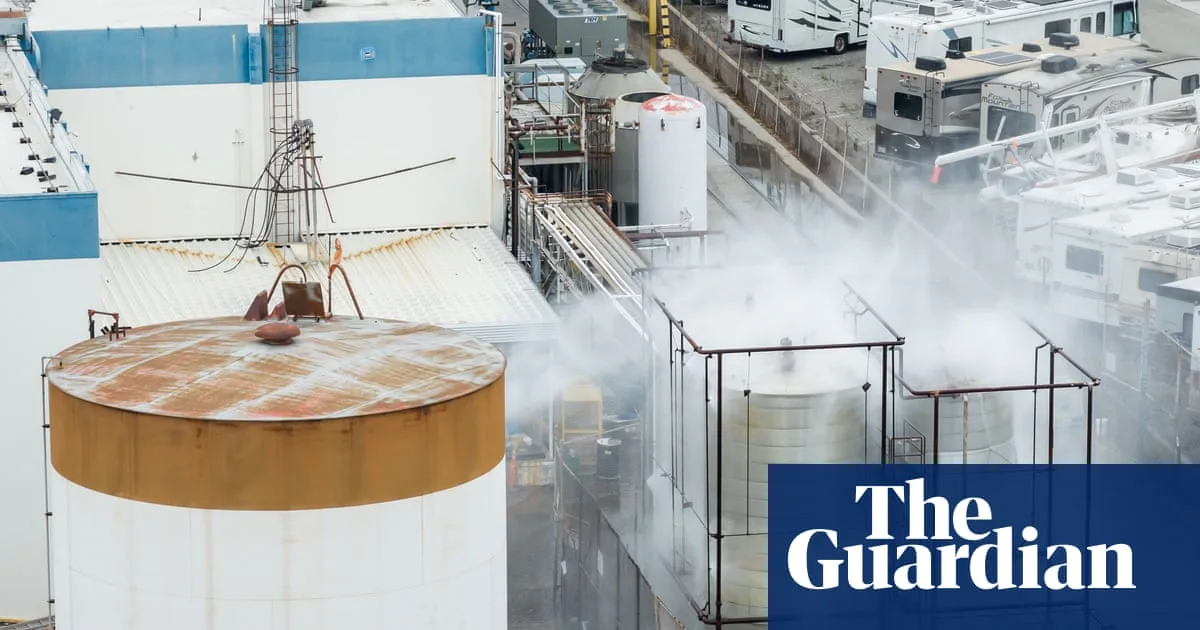
Firefighters in Orange County, southern California, have successfully eliminated the threat of an explosion from a damaged chemical tank, officials confirmed on Monday. The tank, containing methyl methacrylate, had overheated and cracked over the weekend, prompting the evacuation of around 50,000 residents in Garden Grove and surrounding areas.
Overnight operations allowed crews to verify the crack and confirm that temperatures inside the tank were falling, according to Orange County fire authority division chief Craig Covey. He described the results as “incredibly positive news”. The tank’s interior had reached 100F (37.7C) on Sunday, but cooling and monitoring efforts stabilised the situation.
The tank, located at GKN Aerospace Transparency Systems, holds between 6,000 and 7,000 gallons of methyl methacrylate, a chemical used to make plastic parts. Exposure to the substance can cause serious respiratory and neurological problems, as well as skin, eye and throat irritation. Firefighters repeatedly sprayed the tank with water to cool the chemical, while drones monitored temperatures every ten minutes.
President Donald Trump approved a federal emergency declaration following a request from California Governor Gavin Newsom, making federal assistance available through the Federal Emergency Management Agency (Fema). Air quality monitoring tests around the evacuation zone found pollution within normal limits, and containment barriers were set up to prevent any spill from reaching storm drains or waterways.
Andrew Whelton, a Purdue University engineering professor, compared the cracked tank to a soda can: “If you leave it in a hot car it can explode, but if you put a hole in the can, the product is released and the can itself doesn’t explode.” He cautioned that some risk remained while the chemical was still hot and reactive, and that temperatures needed to fall to around 60-70F (15.6-21.1C) for conditions to be significantly safer.
Evacuation shelters were set up, with some residents sleeping in cars or on mats at a local high school. The nearby Disneyland theme parks in Anaheim were not under evacuation orders, but officials said they were monitoring the situation. GKN Aerospace, which employs about 16,000 people globally, agreed in 2025 to pay over $900,000 to settle regulatory violations involving record-keeping and emissions.