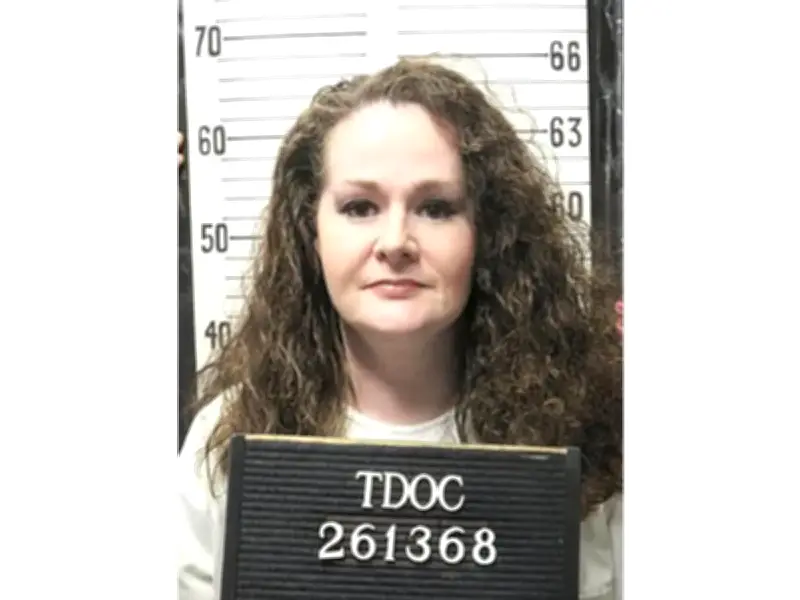
Christa Pike survived Tennessee's attempt to execute her with pentobarbital and is now conscious and talking in hospital while still handcuffed and shackled to her bed. The 50-year-old was supposed to be dead days after being strapped to a gurney and pumped with enough pentobarbital to kill her. Instead, she is awake in a hospital bed, conscious and talking, with prison restraints still fixed to her body as she receives critical medical care.
Her death sentence remains in place. Unless she is left medically incapacitated, Tennessee could attempt to execute her again once its current suspension of executions is lifted.
Texas set to use same drug tonight
While Pike continues to recover in hospital, some 600 miles away, America is set to resume its use of pentobarbital. Texas is scheduled to execute Jamaal Howard, 46, who was convicted of capital murder in the 2000 killing of Vickie Swartout, who was shot once in the chest at the store where she worked.
What happened to Pike inside Riverbend Maximum Security Institution was supposed to be clinical, controlled and final. Instead, witnesses heard Pike crying and whimpering as executioners repeatedly struggled to find a vein. Her arms swelled, blisters appeared, and at one point she complained that one felt as though it was about to burst open.
The drug's history and supply chain
Pentobarbital belongs to a family of medicines called barbiturates, which slow activity in the brain and central nervous system. It was developed in the 1920s by Abbott Laboratories chemist Ernest Volwiler and marketed under the name Nembutal. At therapeutic doses, it could sedate patients, induce sleep, control serious seizures and be used before anaesthesia. At much higher doses, barbiturates suppress breathing, lower blood pressure, induce coma and can eventually stop the heart.
For decades, it has been widely used to put seriously ill or injured animals to sleep. The US Food and Drug Administration describes pentobarbital as a drug used in animals for sedation, anaesthesia and euthanasia. Around 2010, lethal injection usually depended on another barbiturate, sodium thiopental, but supplies dried up as manufacturers objected to their medicines being used in executions and European governments tightened export controls.
Britain banned exports of pentobarbital and other execution medicines to America in 2011. Then Business Secretary Vince Cable said: “We oppose the death penalty in all circumstances.” European restrictions followed. Pentobarbital manufacturer Lundbeck introduced controls designed to prevent its Nembutal from reaching American prisons. Other pharmaceutical companies imposed similar restrictions.
Death penalty states began looking elsewhere. Some turned to specialist compounding pharmacies, whose identities have frequently been hidden behind execution secrecy laws. In Tennessee, the origin of the pentobarbital used on Pike has not been publicly disclosed.
Evidence of pulmonary oedema
Researchers examining autopsies after lethal injections have repeatedly found evidence of pulmonary oedema - fluid flooding into the lungs. One study of 43 executions involving either pentobarbital or another sedative, midazolam, found pulmonary oedema in 33 cases. A larger investigation examining more than 200 autopsies found signs of the condition in 84 per cent. Dr Joel Zivot, the anaesthesiologist advising Pike's defence team, has described findings suggesting some prisoners may effectively experience sensations associated with suffocation while outwardly appearing unconscious.
In Pike's case, the immediate problem appears to have been more basic. Her lawyers say executioners used at least seven needles while trying to establish intravenous lines. They believe the veins ruptured and the pentobarbital leaked into the tissue in her arms rather than circulating properly through her bloodstream. Zivot said the quantity administered should have killed her if delivered correctly. Her swollen and blistered arms, he believes, point towards the drug entering surrounding tissue.
One witness, reporter Tori Gessner, said afterwards: “Nothing about today was normal, typical - at all.”
Execution drug controversies
Pentobarbital is only the latest chapter in America's troubled experiment with execution chemicals. Midazolam, a benzodiazepine sedative widely used legitimately in medicine, was adopted by several states for executions as traditional barbiturates became difficult to obtain. Critics argued midazolam has a “ceiling effect”, meaning increasing the dosage does not necessarily produce ever-deeper unconsciousness.
The issue reached the US Supreme Court after Oklahoma adopted a protocol using 500mg of midazolam followed by a paralysing drug and then potassium chloride, which stops the heart. The Supreme Court ruled in 2015 that Oklahoma's protocol could continue.
But by then, a series of executions had created worldwide alarm. In 2014, Oklahoma prisoner Clayton Lockett writhed and groaned during an execution involving midazolam before dying 43 minutes after the process began. That same year, Arizona inmate Joseph Wood took almost two hours to die after repeatedly gasping during an execution involving midazolam.
In April 2017, Arkansas announced one of the most extraordinary execution schedules in modern American history: eight prisoners were to be put to death over just 11 days because the state's stock of midazolam was due to expire at the end of the month. The proposed executions were arranged in four groups over April 17, 20, 24 and 27. Amnesty International called it a “conveyor belt of death”. Its Americas director, Erika Guevara Rosas, said the schedule showed how far Arkansas was “out of step” with much of the world. Ultimately, four men were executed.
What happens next
Pike, who was sentenced after Slemmer's skull was crushed with a chunk of asphalt and a piece of it kept as a trophy, had spent more than three decades on death row. Tennessee Governor Bill Lee has called the failed execution “deeply disturbing”, ordered an independent investigation and stopped the state's remaining executions this year. The prisons commissioner has resigned. Pike's lawyers have demanded that every syringe, document and piece of evidence from the death chamber be preserved.
Four decades after America adopted lethal injection because it offered the appearance of medicine, the reality has become much harder to disguise. Manufacturers refuse to supply the drugs. States hide where they obtain them. Pharmacies compound them behind secrecy laws. Prison teams struggle to insert intravenous lines. Autopsies reveal damaged, fluid-filled lungs.
Pike now lies awake, talking in hospital, critically ill, handcuffed and shackled to the bed. Once Tennessee's suspension of executions is over, the state that failed to kill Christa Pike once may decide to strap her to a gurney and try all over again.