Jeremy Bamber's legal team has issued a claim for judicial review against the secretary of state for justice and the governor of Wakefield prison, challenging the decision to ban him from talking about his case to the media and long-term supporters. The lawyers argue that the restriction violates his right to free speech and obstructs his access to justice.
Background of the case
Bamber, aged 65, has served 41 years in prison for murdering five members of his family: his adoptive parents, Nevill and June Bamber, his adoptive sister, Sheila Caffell, and her six-year-old twin sons, Daniel and Nicholas. He has always protested his innocence.
Earlier this year, the prison banned him from writing to and phoning journalists and members of his campaign team. Although the wholesale ban has been eased, letters and emails discussing any aspect of his case are not being forwarded, and Bamber is still unable to communicate with journalists and the campaign team by phone.

Prison Service justification
Without giving a specific explanation for the decision in Bamber's case, the Prison Service cited "the need to protect victims from serious distress and maintain confidence in the justice system" as the basis for such restrictions in general.
Initial newspaper reports of the 1985 massacre at White House Farm in Essex called it a murder-suicide, stating that Caffell, who had recently been admitted to hospital with schizophrenia, had killed her family members and then herself. Bamber became a suspect a month later after his former girlfriend Julie Mugford gave a statement to Essex police stating he had told her he was planning the murders. It emerged later that Mugford had agreed to sell her story to the News of the World for £25,000 if Bamber was convicted, and that she would not be charged with burglary and drug-related offences if she gave evidence against him.
Growing media interest
The restrictions have arisen at a time when media interest in Bamber's case is growing. Last year, a six-part New Yorker podcast, Blood Relatives, discovered new evidence suggesting that his conviction was unsafe. Earlier this year, the Guardian commissioned Prof Jason Payne-James to examine the injuries from the crime scene, and he concluded that a silencer had not been used in the shooting of Caffell.
The silencer, discovered three days later in a downstairs cupboard by his relatives, played a crucial role in determining Bamber's guilt during the trial. The prosecution alleged that if a silencer had been used to shoot Caffell, Bamber had killed her because Caffell's arms were not long enough to shoot herself in the throat with the extension added to the rifle, and she would have been unable to walk downstairs to replace the silencer in the cupboard.
In his summing up, Mr Justice Drake said it was "inconceivable" that Caffell could have shot herself with the silencer attached, and if the jury was convinced beyond reasonable doubt it was attached during the fatal shots "on that fact alone" they could convict Bamber. The jury returned a 10-2 majority guilty verdict.
Legal precedent and current challenge
The right of prisoners claiming a miscarriage of justice to contact the media was established in a 1999 case in which Ian Simms and Michael O'Brien – both convicted of murder – successfully argued that a "blanket ban" on journalists interviewing prisoners violated the prisoners' rights to free speech and obstructed access to justice. O'Brien was subsequently exonerated. Bamber will be represented by Tim Owen KC, who was the junior counsel in that landmark ruling.
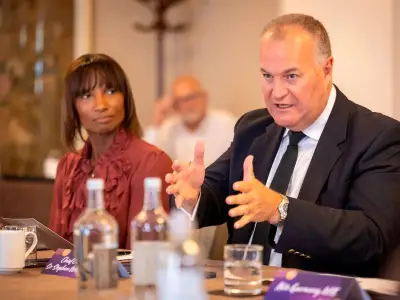
Bamber's lawyer, Mark Newby of Jordans Solicitors, said that the restrictions had come at a "significant moment", with Bamber having a live application before the Criminal Cases Review Commission, the body responsible for referring potential miscarriages of justice back to the court of appeal. He pointed out that the submission "has been informed by significant investigative journalism".

Newby said: "This is an important claim which raises serious questions about the ability of a prisoner maintaining his innocence to communicate with journalists and supporters at a critical stage of his case. Out of respect for the process, we do not propose to discuss the detail of the challenge while the question of permission is before the court. We will say more at the appropriate time."