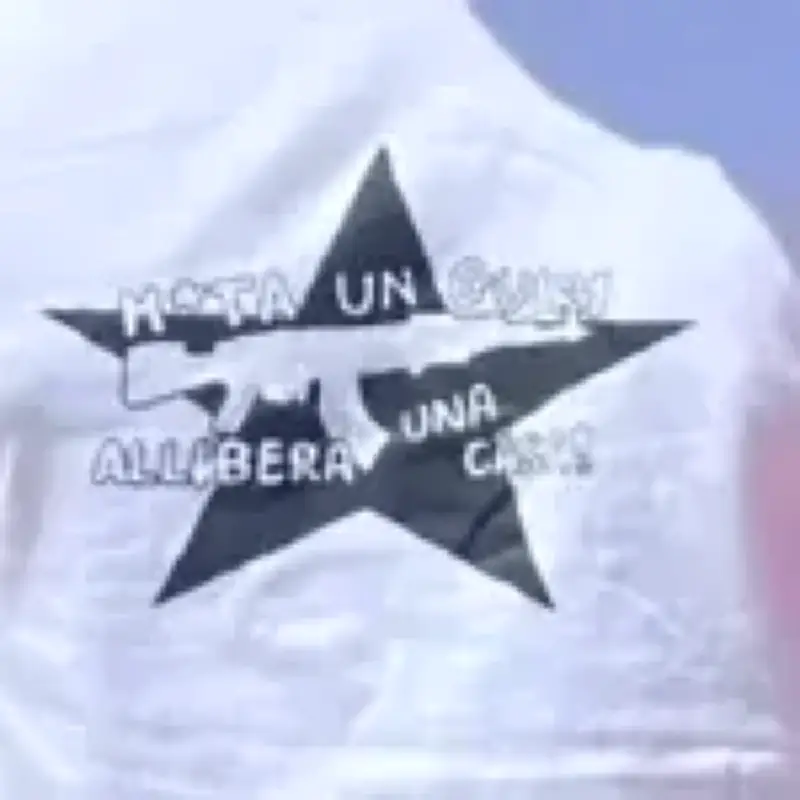
Four members of the Marxist youth organisation Arran are being investigated on suspicion of committing a hate crime after wearing T-shirts bearing the message 'Kill a foreign tourist, free up a house.' Public prosecutors have opposed an appeal lodged by the group to halt the probe by a judge on the holiday island of Menorca.
The T-shirts carried the slogan: 'M*ta un guiri, allibera una casa.' The word 'Mata' without the asterisk translates as 'Kill' in English. 'Guiri' is a term used to describe northern European tourists, such as British holidaymakers partying in Magaluf, usually in a mildly offensive way.
Investigation and Legal Challenge
The activists wore the tops at an assembly held earlier this year at a neighbourhood association hall in the Menorcan rural village of Sant Climent. Police noticed the T-shirts on an Arran Menorca Instagram post during routine internet checks to detect possible hate crimes and reported the four activists to a local court.
An investigating judge agreed to admit a police complaint under Article 510 of the Spanish penal code, which punishes hate speech and incitement to discrimination, hostility or violence, and is understood to have summoned the group members for questioning. The activist group revealed the probe as it claimed the T-shirt campaign was 'satirical.'
Defence Arguments
Josep de Luis, who is defending the four people being probed, said: 'Article 510 does not punish every act that is hostile, offensive, exaggerated or in poor taste. It seeks to protect groups that are vulnerable on the grounds of race, religion, sex, nationality, sexual orientation or sexual identity. A 'guiri' does not form part of a specially-protected group.'
He told local press: 'You can understand the police doing their job, but taking it to court is going too far, and it's even worse that the case has been allowed to proceed. There is no aggrieved party, no real danger, and no incitement to violence but rather a reference to tourism itself, through a campaign against touristification.'
Context of Anti-Tourism Protests
The Canary Islands and the Balearics have been at the forefront of anti-tourist protests in recent years, although they have also taken place in cities like Barcelona and Malaga. Graffiti in English left on walls and benches in and around Palm Mar in southern Tenerife at the start of April 2024 included 'My misery your paradise' and 'Average salary in Canary Islands is 1,200 euros.'
In an apparent UK backlash, a response left in English on a wall next to a 'Tourists go home' message said: 'F##k off, we pay your wages.' Spaniards in several parts of Spain have also glued shut Airbnb key boxes, and Brits have been warned about activists using fake police tape to cordon off popular beauty spots like beach access paths to trick tourists into thinking they are closed.
Critics blame mass tourism for problems like sea pollution, traffic gridlock and lack of cheap, affordable housing for residents, linked to the pushing up of property prices because of Airbnb-style holiday lets. Arran claimed responsibility for a July 2017 attack on a tourist bus in Barcelona, which holidaymakers mistook for a terror raid. The gang slashed the vehicle's tyres and daubed graffiti on its windows in a protest against mass tourism in the Catalan capital. A group spokesman claimed at the time they were acting in legitimate self-defence against a development model which wanted to turn the country into an 'amusement park.'