The inside of an abandoned scam centre in Cambodia has been revealed, showing fake police offices, government meeting rooms and even scripts for romance scams that targeted victims including Britons.
An 80-hectare compound in the Cambodian border town of O'Smach, recently seized by the Thai military following border clashes, has been exposed as a massive hub for cybercrime. Visitors were recently led on a tour of the derelict six-storey facility, uncovering the sophisticated lengths to which criminal syndicates went to defraud victims across the globe.
Fake police stations and government rooms
Inside the buildings, authorities discovered detailed mock-ups of police stations designed for government official impersonation scams. One room was meticulously set up to mimic the "Woodlands East NPC" of the Singapore Police, complete with authentic-looking blue backdrops, uniform shirts hanging on a rack, and official desk stamps.

Another room featured the crest and flags of Brazil's "Policia Federal" above a large wooden desk, highlighting the global reach of the criminals' tactics. Large halls were packed with rows of acoustic-panelled cubicles where scammers operated around the clock.
Scripts for romance and crypto scams
Abandoned whiteboards still bore the handwritten scripts used to snare victims in fake romance and cryptocurrency schemes. One board detailed instructions for a dating site, prompting scammers to ask targets, "For how long have you been on here now?" and guiding them to pursue a long-term relationship by complaining, "I just joined but honestly I have not been liking...".
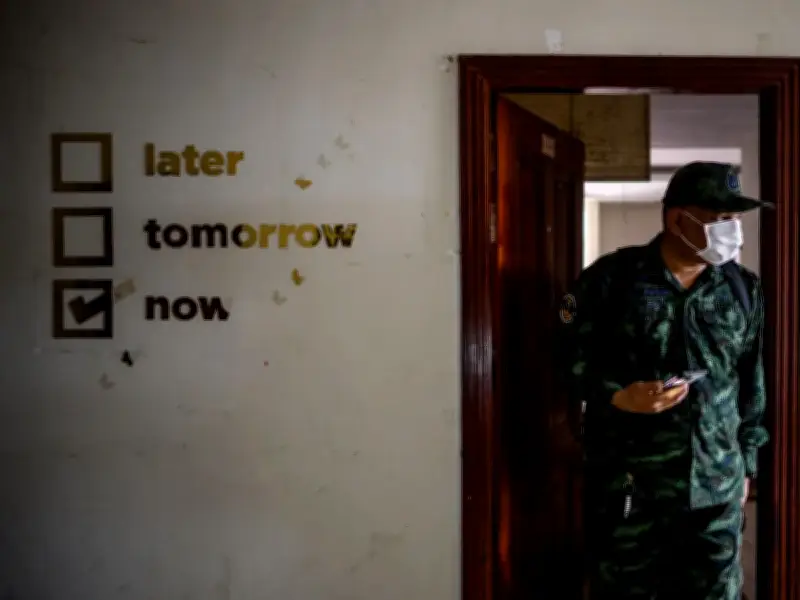
The psychological pressure placed on the trafficked workforce was also evident in the facility's decor. One wall featured a large painted checklist reading "later," "tomorrow," and a boldly ticked box for "now" next to a patrolling Thai soldier.
Compound now in ruins
The compound, which once housed thousands of trafficked workers forced to execute scams, now lies in ruins, with structural damage, standing water, and discarded equipment scattered throughout. The exterior, heavily fortified with bars on the windows, is now guarded by Thai military trucks traversing roads lined with rubble.
The tour comes shortly after the Cambodian government declared it had entirely eradicated the scam compounds that once made the country a global epicentre for cybercrime. According to a statement by Senior Minister Chhay Sinarith, who leads the Commission for Combating Online Scams, authorities investigated nearly 800 locations and detained tens of thousands of suspects, bringing large-scale scam operations "fully under control".
However, this claim has been met with severe scepticism from rights groups and industry experts. Amnesty International and independent anti-trafficking consultants argue that while large compounds may have been disrupted, the syndicates have simply shifted to decentralised operations. These criminal networks, largely run by Chinese gangs, are believed to have relocated to rental properties, condominiums, and guesthouses.
Experts maintain there are credible indicators that significant scamming and the recruitment of foreign workers for forced criminality continue unabated within the country. Meanwhile, Thai officials noted that evidence gathered from the O'Smach site, including financial channels and contact lists, will be shared with international law enforcement agencies in Europe and Asia. This intelligence is expected to support further investigations, asset seizures, and preventative measures across the region.