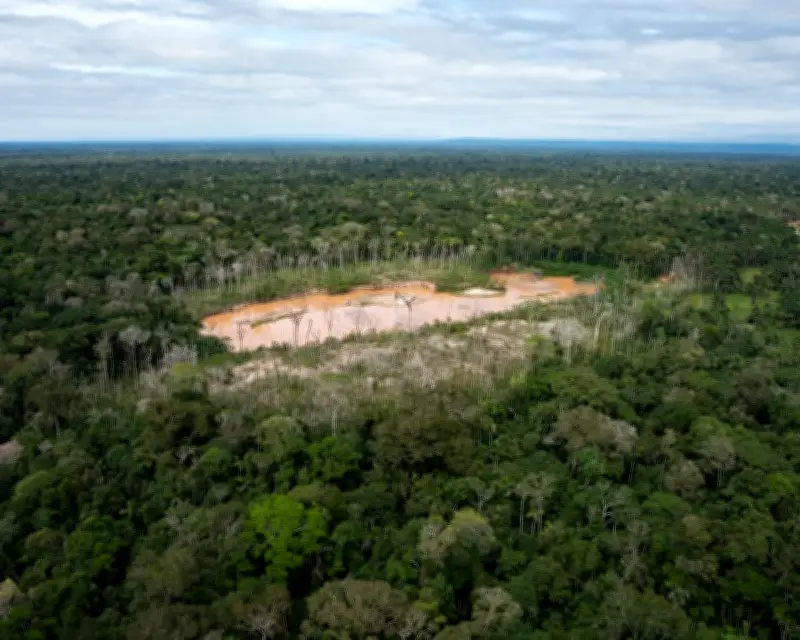
Illegal gold mining has overtaken drug trafficking as Peru's most profitable criminal industry, with soaring gold prices driving widespread deforestation in the Tambopata National Reserve, one of the country's most prized Amazon parks.
During a recent military operation, Peruvian Navy Seals fired warning shots at a fleeing miner who scrambled up the rim of a football pitch-sized crater and disappeared into dense rainforest. Other marines set dynamite charges on a makeshift wooden raft floating in the crater—an enormous pit of opaque, stagnant water equipped with a diesel-fuelled suction pump motor used to sift river sediment for gold particles. Moments later, an explosion shattered the peace of the reserve.
Illegal mining devastates protected rainforest
Located in the south-eastern Madre de Dios region, the reserve attracts about 40,000 tourists a year, many staying in ecolodges along the Malinowski River. But patrols moving by helicopter or boat encounter evidence of illegal gold mining every few hundred metres—operations that have destroyed more than 500 hectares of the park's rainforest in the last year, according to satellite mapping data from Amazon Conservation. In total, over 140,000 hectares have been lost to mining in Madre de Dios, representing 97.5% of all deforestation caused by mining in Peru's Amazon, an area twice the size of California.
Military crackdowns on illegal mining are not new, but skyrocketing international gold prices have spread the destructive activity, empowering local gangs and attracting transnational organised crime. "Dirty" gold has become the country's most profitable illicit industry, surpassing drug trafficking in the world's second-biggest cocaine producer after Colombia.
Gold prices drive relentless mining activity
"Gold prices have risen," said Gen Víctor Cotrina, military commander of Madre de Dios, leading the crackdown. "That's why, if a miner's motor is destroyed, he'll replace it quickly because gold is at its peak price; the very next day he's back to his mining activities." Cotrina noted that unlike drug trafficking, which targets hidden coca plantations, open-pit mining requires no covert operations, making enforcement different. Previous crackdowns were ineffective due to corruption and patchy enforcement, but now with "aerial surveillance and military personnel who are available 24/7 to conduct patrols, we are determined to eliminate mining in this region".
Peru's financial supervisory body ranks illegal gold mining as the top illicit finance threat. For the first time, illegal trade surpassed legal gold production in the first half of this year, according to the Peruvian Economics Institute think tank, which estimates it could reach $18 billion in value by the end of 2026. The country's Financial Investigation Unit found illegal mining accounted for nearly 60% of all investigations by value between 2021 and 2025, far higher than drug trafficking (8%) or tax crimes (4%).
Raids face challenges in curbing destruction
During four days of operations in late August, prosecutors arrested just a handful of suspects. Two women left behind by fleeing miners—Andrea, 30, a single mother working as a cook, and Liz Compi, 20, found with her one-year-old son—were released. Ronal Flores, a deputy prosecutor for Peru's Office of the Attorney General, said arresting most workers was pointless as they lacked knowledge of the larger enterprise. "In these places, the big fish – the owners – are rarely caught. It's usually the low-level operatives who we find," he said, admitting raids could only slow destruction due to budget limits, despite military destroying an estimated $500m in machinery and supplies.
Flores said raids had destroyed about 150 mining barges and motors, but that was "nothing compared to the magnitude of the damage being caused within the reserve". A single dredger operating 24 hours a day can produce up to 50 grams of gold, fetching over $6,000 with gold prices above $4,650 a troy ounce in late August.
Since the Covid-19 pandemic, gold prices have tripled, drawing tens of thousands of miners into protected parks and Indigenous reserves. An estimated 180 tonnes of mercury contaminates Peru's waterways annually, poisoning wildlife and damaging human health, especially among Indigenous communities reliant on freshwater fish.
The latest raids, Operación Mercurio II, follow Operación Mercurio, which began in 2019 and achieved a 62% reduction in illegal mining deforestation, including a 92% drop in the critical hub La Pampa. But miners returned and deforestation surged, with gang Los Guardianes de la Trocha taking control of the $1bn trade. Dirty gold departs as contraband to Bolivia and Brazil, much laundered via the Reinfo registration system, which critics say allows informal miners to work without environmental permits. Congress has backed five extensions of Reinfo despite reform pushes.
"The government's response is moving very slowly," said Flores after another day of raids. "Meanwhile, illegal mining operates 24 hours a day. The miners measure time in grams, not minutes, so we need to rethink how we investigate mining. Unfortunately, as we can see today, they are getting the better of us."