
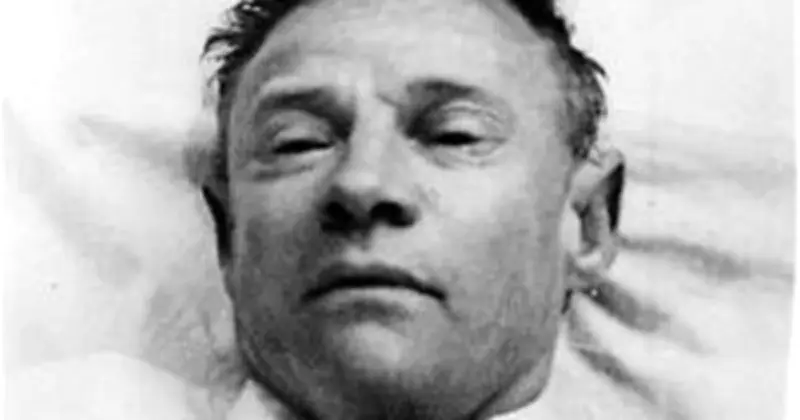
The body of a well-dressed man found on Somerton Beach in Adelaide, Australia, in 1948, with a cryptic message in his pocket, has been identified as Carl 'Charles' Webb, a 43-year-old electrical engineer from Melbourne, following a complex forensic investigation.
Discovery and initial mystery
During the early evening of November 30, a couple strolling along Somerton Beach encountered the man on the shore and reported seeing him lift his right arm before letting it fall. Believing him to be intoxicated, they left, according to Discovery. The following day another walker spotted the man. There was an unlit cigarette resting on his collar, a bus ticket of uncertain usage and an unused train ticket from Adelaide to Henley Beach in his possession, an American-manufactured comb, a packet of chewing gum and a box of cigarettes which, curiously, held cigarettes from a different brand.
Tamám shud - a Persian expression meaning 'it is over' - was discovered in the man's jacket, reports The Guardian. The fragment was subsequently identified as originating from a volume of Persian verse called the Rubiyat, reports the Daily Star.
Investigation and clues
Travel tickets from a neighbouring Australian town indicated he had travelled from close by, while the labels from his garments had been peculiarly removed, prompting detectives to suspect criminal activity. A suitcase subsequently recovered from a locker thought to belong to him held additional clothing with the tags cut out and enigmatic writings, merely deepening the puzzle. A telephone number was also discovered amongst his possessions.
The investigation revealed it belonged to a local nurse by the name of Jessica Ellen Thomson. She claimed she had no knowledge of the deceased man, had no idea why her telephone number would appear in the book, nor why he would have been approximately a mile from her home on the night he died. She consistently denied any knowledge of him and, according to a police officer who was present, she was "completely taken aback, to the point of giving the appearance that she was about to faint."
Identification breakthrough
As far as the pathologist was concerned, the Somerton Beach body was a man somewhere between 40 and 45, around five feet 11 tall and in excellent physical condition. He was clean-shaven and, unusually for the late 1940s, was without a hat. He carried no identification and his dental records remained unmatched. At the post-mortem examination, the pathologist was reported to have stated: "I am quite convinced the death could not have been natural."
Nobody ever came forward to claim the man's body, and so a cast was made of his face to preserve his likeness before he was laid to rest in an unmarked grave. In 2022, scientists managed to follow a complex forensic trail after extracting around 50 hairs from the cast, ultimately identifying him as 43-year-old Carl 'Charles' Webb, an electrical engineer from Melbourne. The identification was achieved after Professor Derek Abbott from the University of Adelaide joined forces with genealogists to construct a family tree encompassing more than 4,000 individuals, ultimately leading them to pinpoint a distant cousin of Webb.
Familial DNA technology was subsequently employed to trace the DNA from the cast back to the relative, confirming with almost certainty that the remains belonged to Mr Webb. "It's a triangulation from two different, totally distant parts of the [family] tree," Dr Abbott told the Australian Broadcasting Corporation. He further remarked that cracking the case felt akin to scaling "Everest". South Australian police are yet to officially respond to the development, which comes three years after Mr Webb's body was exhumed for further examination.
Unresolved questions
How Webb met his end and whether his death is considered suspicious remains unconfirmed, though pathologists at the time suggested heart failure as the most probable cause of death. A coroner, however, declined to rule out the possibility of murder. Very little is currently known about Mr Webb, beyond the fact that he was born in 1905 in Victoria and had been married to a woman named Dorothy Robertson. The couple had parted ways, with Mrs Robertson subsequently relocating to South Australia. It is conceivable that Mr Webb had been attempting to track down his former wife at the time of his death.




