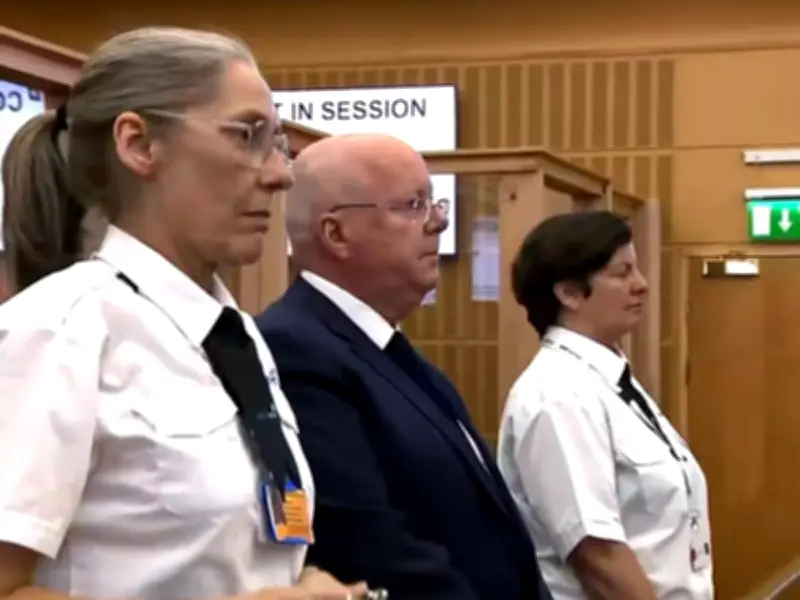
The Lord President refused to allow cameras to capture Peter Murrell’s reaction as he was sentenced, after a fellow judge warned the footage could be used to create memes.
Murrell, the former chief executive of the SNP, was jailed for more than five years in June. He admitted embezzling over £400,000 of party funds during a 12-year period while he ran the party. He is Nicola Sturgeon’s estranged husband.
The judiciary had already allowed the BBC to film part of a hearing in early June which revealed details of the items Murrell purchased with the stolen money. The broadcaster was also permitted to film Murrell entering and leaving the court at his sentencing hearing. But files released under freedom of information legislation show opposition to a bid to film his response while the sentence was imposed.
Judge raised meme concerns
Lord Young, the judge who presided over the case, set out his objections in an email: "It is a very significant step and, I'll be honest, I feel this is going too far and starts being too intrusive for the accused. I feel unease that the accused's reaction, or lack of reaction, to the sentence will be analysed and replayed - possibly as a meme or GIF - going forward. If, in this case or any future case, the accused's expression might be interpreted as unconcern or even relief about the sentence imposed, it could feature as part of the public critique of the severity of the sentence. I think it all becomes very difficult to control."
Lord Pentland, Scotland’s most senior judge, backed his colleague: "I agree with Lord Young that the further request would be inappropriate. It should be refused. They can film him entering and leaving the dock."
The files also reveal that a request for a sketch artist to be seated in the well of the court was granted.
Legal expert agrees with decision
Dr Nick McKerrell, a senior lecturer in law at Glasgow Caledonian University, said he agreed with the refusal: "Cameras in the Scottish criminal courts have had a glacial pace of introduction. Lord Young's comments illustrate why. Filming complex legal arguments for broadcast is one thing. This is now normal in civil courts. Involving live filming of the accused, juries and witnesses is a step too far."
A spokesperson for the Judicial Office for Scotland said: "Members of the public are encouraged to come to their courts and see the entire proceedings for themselves so they can understand what goes on and why. For those who can’t make it to court, filming certain parts of the proceedings in a controlled way ensures a consistent and fair view of justice being done without sensationalising or trivialising the proceedings. The Scottish Courts have been at the forefront of open justice, having permitted cameras since 1992. Filming has always been subject to permission and careful consideration of its impact on the fairness of proceedings to all involved. Over the last few years approval has been given to film more court proceedings, including trials for documentaries, section 76 hearings, high profile civil cases, and the livestreaming of both the Inner House of the Court of Session and the Criminal Appeal Court. Sentencing statements have been allowed to be filmed for many years, but this is restricted to just the Judge or Sheriff and no one else in court can be filmed. To aid understanding of the sentence given in certain cases, filming of the plea in mitigation for news broadcast has also been permitted. However, the accused has never been filmed during sentencing in court for news broadcast. We continue to speak to broadcasters and the media about open justice and carefully consider any application made in this regard."