
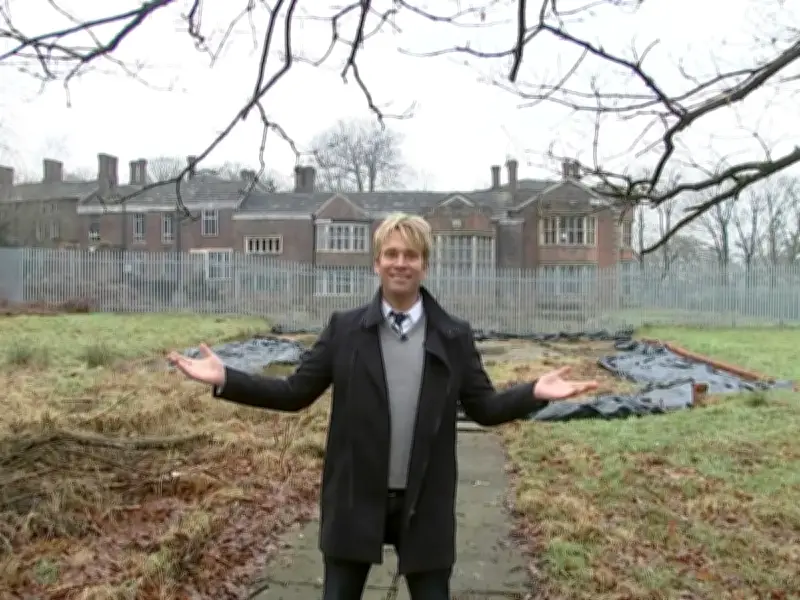
The High Court battle over the future of Hopwood Hall, a Grade-II* listed building, began on September 29, with a Hollywood actor and Rochdale council disputing the terms of a 2017 exclusivity agreement.
Hopwood DePree, an American actor, claims the council broke a legally binding agreement to sell him the 1400s building, which he believes is his ancestral home. The council cut ties with Mr DePree in October 2024.
Planning permission under scrutiny
Day one of the trial at Manchester Civil Justice Centre saw Mr DePree and the council's director of economy and place, Mark Robinson, give evidence. The pair were questioned over the nature of the planning application, which was granted council approval in 2022. Mr DePree wanted to turn the building into a wedding and hospitality venue and a 25-bedroom hotel.
Geraint Wheatley, barrister for the council, said the exclusivity agreement had four conditions: authorisation to reinstate and refurbish the building; an agreed standard of refurbishment; English Heritage approval through listed building consent; and the property would be reinstated in whole, not in part. He added that physical work was not included in the change of use application approved in 2022.
Legal arguments over conditions
Ashley Bowes, barrister for Mr DePree, argued that planning permission for reinstatement does not need to involve external works, which require a different type of permission. Questioning Mr Robinson, Mr Bowes asked whether a building can be significantly changed internally without external work. Mr Robinson agreed this was possible in some cases but not with Hopwood Hall.
Mr Robinson also agreed that significant developments sometimes see planning applications come in phases, a point Mr Bowes suggested could apply to Hopwood Hall. Mr Bowes then raised a redacted internal council email that said 'the fear here is that the developer has the ability to acquire council property for a nominal sum'. Mr Robinson said he was not involved in that email and told the court he was not fearful.
English Heritage support and closing arguments
Mr Bowes asked whether English Heritage were supportive of the scheme, to which Mr Robinson agreed. Mr Bowes said this was the closest English Heritage could do, in terms of legislation, to approve a plan, meeting the threshold of the exclusivity agreement.
When Mr DePree was questioned by Mr Wheatley, he was asked whether he was the 'spearhead' behind the vision for Hopwood Hall's transformation. Mr DePree reluctantly agreed after saying the vision was done in collaboration with the community backing him. It was established that no physical works had been submitted as part of the plans.
In his summary, Mr Wheatley told the court: “We say that failure to meet any of these (four) conditions is fatal to exercise that option [to purchase the hall]. A miss is as good as a mile. There is no planning permission that shows works to be done to the required standard. The absence of planning permission required is one of physical works. There is no English Heritage approval in the sense of listed building consent.”
Mr Wheatley added that the claimant was trying to trigger the purchase agreement 'based on the minimal way' possible from planning permission. The trial continues, with a decision expected from His Honour Judge Hodge KC.




