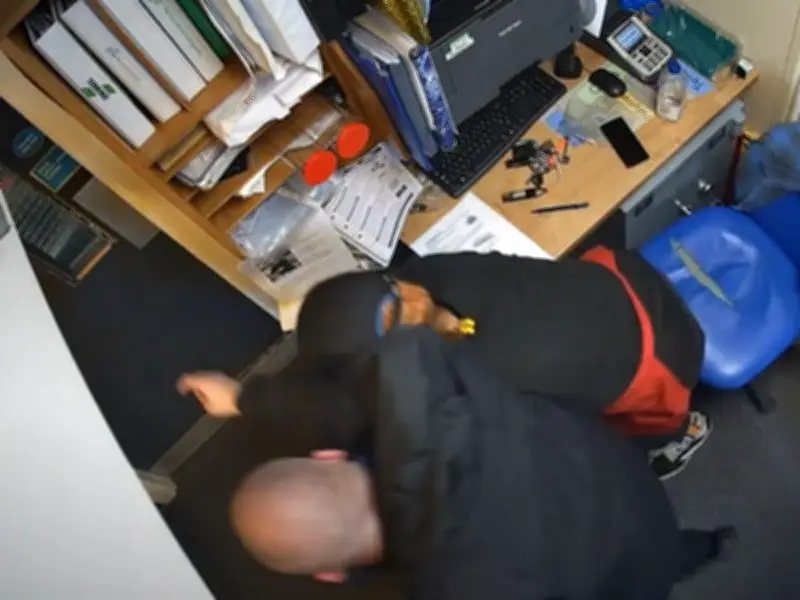
Vincent Foley, of Wythenshawe, was jailed for seven years after pleading guilty to attempted robbery, possession of an offensive weapon and burglary. The attack on a Greggs worker and a subsequent burglary in Handforth, Cheshire, took place in July last year, when Foley was homeless.
Foley, then 44, had 43 previous convictions for 92 offences, including 14 for theft and similar offences dating back to 1996.
Hammer attack and house burglary
Chester Crown Court heard that Foley stormed into the Greggs wearing a balaclava and struck the employee over the head with a hammer. He then struggled to use keys and failed to open the shop's safe in the office area before fleeing the scene empty-handed.
Later the same day, he smashed patio doors and broke into a nearby home, stealing watches, bracelets, a deactivated antique shotgun and a chequebook. On July 7, Foley attempted to write himself cheques for £2,000 and £4,000. The bank refused them and alerted the victim. A week later, he was arrested after the stolen chequebook was found in his car when he was stopped for driving erratically.
'Scarred for life'
In a victim impact statement, the Greggs employee said he was 'scarred for life' after the brutal attack left him covered in blood. He said: “My son said I look scary with the scar. I personally found that quite upsetting. I also had to deal with a lot of anger and frustration, and had to deal with strangers staring at me.”
Adam Lodge, defending, said Foley suffered from PTSD as a result of witnessing a murder 'many years ago' and was bipolar. He had begun to settle down in the two years before the offence, Lodge said, but it 'all fell apart' following the loss of his grandson.
Appeal rejected
At London's Appeal Court earlier this month, Foley argued that his prison sentence was too long. His barrister, Adam Lodge, said the sentencing judge had not taken into account the bereavement caused by the loss of his grandson or Foley's mental health difficulties. Lodge described a 'spiral of out-of-control behaviour' following the death, adding that Foley had shown 'genuine remorse' and was 'making real progress' since being held in custody.
Esther Schutzer-Weissmann, representing the Crown, opposed the appeal, arguing that the sentence 'might even be considered lenient'.
Three Appeal Court judges – Lord Justice Dingemans, Mr Justice Garnham and Judge Hirst – rejected the appeal. In a written judgment, they said it was 'regrettable' that the sentencing judge had not 'expressly shared' their reasons for the sentence, but 'stepping back and looking at this sentence overall, it was not manifestly excessive.'