
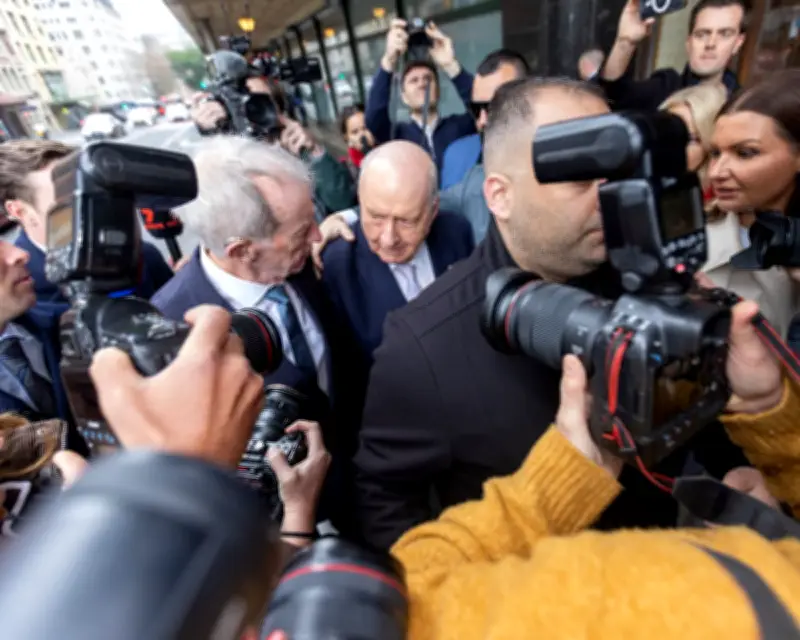
Journalists covering Alan Jones's trial on indecent assault and sexual touching charges faced an 'inauspicious' start as a spelling error and a rogue mobile phone antagonised the judge. Media organisations had to apply individually for access when the six complainants give evidence in an otherwise closed court.
Media access and courtroom disruptions
Last week, seven media organisations, including Guardian Australia, were successful in their applications to sit in the court and report the evidence. Police officers stationed outside the Downing Centre courtroom on level 3 diligently check every reporter's media pass before allowing entry.
One media organisation, the Daily Aus, was late to the party and asked local court judge Glenn Walsh to approve their participation this week. Walsh remarked not once but twice that the social media-first outlet was off to an 'inauspicious' start because they had spelt the judge's name wrong.
The Daily Mail reporter caused a stir when his mobile phone went off twice during evidence despite stern warnings from the court officer to turn all mobile phones off. Jones's large legal team took pity on the reporters filing during their lunch break and brought out a surplus tray of sandwiches to share.
Media resources dedicated to trial
Media companies are dedicating significant resources to the coverage. The ABC alone has a twice-weekly podcast, The Case Of, with Isobel Roe and Stephen Stockwell, and plans for a documentary as well as reporters covering the daily news for radio, TV and online. Guardian Australia has a weekly podcast with Nour Haydar and Amanda Meade, Alan Jones on Trial.
Kyle and Karl's tête-à-tête
Kyle Sandilands and Karl Stefanovic don't want anyone to feel sorry for them, they have assured listeners, in a 35-minute podcast episode that hashed out at length the premature downfall of their respective careers on commercial networks. It was the shock jock's first appearance on The Karl Stefanovic Show since going independent with his own venture, Kyle Sandilands Live, and he's feeling 'invigorated'.
'I'm not looking for the violin at all,' he said, after airing a four-part documentary series on his new app and website that detailed in length the aftermath of his firing. Before his first daily four-hour live show on 10 August, Sandilands said his subscription service had already received 'tens of thousands' of sign-ups. Subscribers pay a flat annual rate of $99 to gain access to his content, which currently includes the documentary and three episodes on 'building the show', to be released in parts, with a timer countdown.
While Sandilands owns 100% of his new platform, his former employer ARN will receive 19.9% of any revenue it generates beyond $3m in its initial stages under their settlement deal. The app, which is free to download, was trending at #46 in entertainment on Thursday, behind the official app for the Royal Queensland Show and Tatts Group's The Lott.
'We've got enough money to run the thing for three years already,' Sandilands told Stefanovic, adding if they hit 200,000 subscribers they'd give away 'bars of gold' and 'houses'. The duo also joked about teaming up and creating their own media empire, owing to the fact they both have the initials KS and are attempting to make it outside the mainstream.
A Murdoch boycott
A campaign urging a boycott of the Daily Telegraph was launched with a website on Wednesday by an opaque coalition of 'community, faith, cultural and civil society organisations' branded under the name The Justice Coalition. Its organisers allege the outlet has repeatedly embarked on a 'sustained pattern of sensational, misleading and inflammatory coverage targeting racial, religious and culturally diverse communities'.
The campaign lead, and only identifiable individual, behind 'Boycott The Daily Telegraph' is Alex McKinnon. He didn't confirm who was paying him for his role. 'This campaign is about consequence,' McKinnon said. 'Editorial decisions have consequences for the people who are misrepresented, stereotyped and placed at risk. There must also be consequences for the institutions that make those decisions.'
McKinnon said the campaign was inspired by the longstanding grassroots boycott of the Sun newspaper, also owned by News Corp, in Liverpool in the UK. The editor of the Daily Telegraph, Ben English, described the campaign as 'blatant censorship' aimed at stopping the paper from 'reporting in the public interest'. 'It's gormless gibberish – a Dennis Denuto-style 'vibe' masking ignorant, ideological intolerance toward anyone who doesn't share their narrow world view,' he told Guardian Australia.
'What's in a name?'
The newly rebranded News24 has experienced a 'mammoth' spike in audiences and been just as 'well-received' online, according to The Australian. Its media reporter, Steve Jackson, wrote a gushing article celebrating Sky News Australia's fresh new look this week, which started with: double quotation markWhat's in a name? Well, an ever-growing audience if you can manage to get the moniker – and hard-hitting news content – just right. The article claimed traffic to the news24.com.au website and the News24 Australia app was 'up 20 per cent when compared with the SkyNews.com.au average', and the channel had also set a Foxtel record. Its source? Internal network data.
The latest Ipsos ranking report, for June, didn't include Sky in the Top 20 news websites, so we'll keep an eye out for the next monthly update. During his earnings call, the News Corp chief executive, Robert Thomson, similarly said News24 had seen a 'tangible increase' in audience reach in recent days.
It comes as, hours after banning the ABC, the Age and Guardian Australia from a major press conference in Melbourne on Monday, One Nation managed to get not one but three of its Victorian candidates into cosy interviews on Sky After Dark. It took rightwing commentator Avi Yemini to question Pauline Hanson at the press conference on why she'd barred major media outlets from attending their preselection announcement, to which she replied: 'I'm not putting up with their rubbish, their spin, their lies.' No spin, apparently, on News24, where candidates Mark Nicholson, Warren Pickering and Colleen Harkin were welcomed with open arms.
'Warren, what a pleasure to meet you,' Paul Murray gushed. 'I think plenty of people will feel exactly like me, that this is exactly the type of person we want in our politics and certainly into our parliament.' Andrew Bolt said he wasn't 'so sure' about the ban, though claimed the bias of the ABC and Guardian had 'just been too much'. 'They must be made to pay,' he said.
ABC turmoil continues
The former bikie turned journalist Mahmood Fazal can't seem to stay out of the spotlight this year after the ABC announced it was expanding its investigation into his reporting while working for the public broadcaster's investigative programs Four Corners and Background Briefing. Late last month, the ABC removed two Four Corners programs, Meth Highway (2024) and Cocaine Nation (2023), from its digital platforms over concerns about the 'veracity' of sources, which were later aired on Media Watch. Fazal's employment was terminated by the public broadcaster in May after an investigation into his involvement in a podcast sponsored by an online casino.
On Friday, the ABC released another statement, announcing it had deleted a May 2023 episode of Background Briefing, 'Remy was 12 when she became a drug dealer', over additional concerns over Fazal's sources. 'The ABC continues to review other content involving the journalist to ensure it meets the ABC's editorial standards,' it said. 'The ABC is committed to the highest standards of editorial integrity. Maintaining the trust of Australians depends on upholding those standards, and we take any concerns about our journalism seriously.'
Days later, Media Watch was back, running a segment alleging that 'Remy', a source used by Fazal, was not a big-time drug dealer as she had claimed. They pointed to a social media video she posted where she further alleged that the car she and Fazal had driven around in was hired by the ABC to project 'an image'. In turn, Fazal posted a second lengthy video to Instagram. He said he could not 'speculate on the motivations' of sources who had been outed and would not 'betray people I gave my word to because it's become politically convenient'.
'My work accepts that reality is messy,' he said. 'Sources are imperfect, people contradict themselves, criminal worlds are opaque, and we try to get as close to the truth as possible,' he said. 'These people aren't even asking, 'were we pursuing the truth?' Instead they're asking, 'how will every decision survive our audit?'' The ABC had no further comment beyond its statement on Friday. On Thursday afternoon, the broadcaster's head of investigations and current affairs, Jo Puccini, resigned, not citing a reason.
Puccini was the last senior editorial figure at the ABC involved in Fazal's now-deleted Four Corners episodes. The former director of news, Justin Stevens, was forced to resign in June; the executive producer of Four Corners, Matthew Carney, resigned last year; and the program's supervising producer, Alice Brennan, was made redundant. The new director of news, Reuters' Simon Robinson, does not start in the role until September.
Nine's AI-powered 'game changer'
Australia's biggest media company, Nine Entertainment, blamed the 'extreme state of disruption' from AI for its decision to cut another 30 jobs at the Sydney Morning Herald and the Age, but 9News is running full steam ahead with a major network transformation that includes artificial intelligence capabilities. This week, Channel Nine was the first free-to-air network to broadcast a live bulletin, 9News Morning, using a 'cloud-based news production' platform, which is trained with AI. Nine is using Saga, an 'AI workspace', and Mimir, a 'production, collaboration and AI tool', to power its technology transformation. The features include facial recognition and transcription services.
The major overhaul, branded 'Future News', has been on the way since January 2025 and is expected to be completed by the end of next year. About 20 jobs have been affected by the rollout, while other staff are expected to multi-skill their roles, including camera operators who will be expected to edit content. Nine's managing director of streaming and broadcast, Amanda Laing, said news was 'our bedrock and a critical pillar of premium content for Nine'.
'Audience behaviour has changed and Australians are consuming news on platforms that best suit their needs,' she said. 'We can now meet them where they are faster than ever before – with important and trusted stories that matter. This is a game changer for Nine, 9News and our audiences.'




