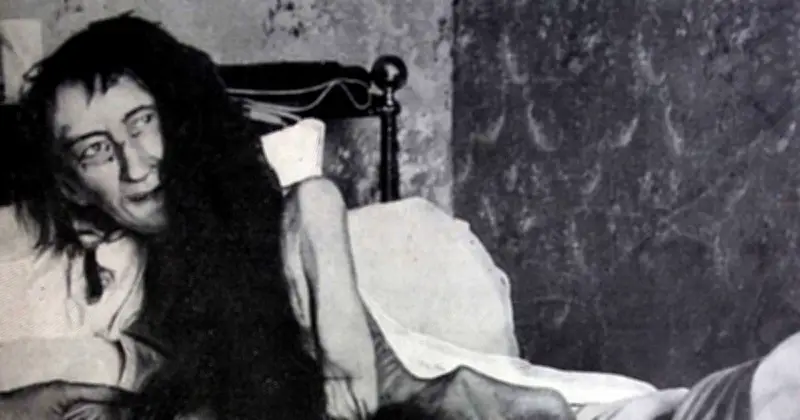
In a harrowing discovery, a woman was found in a revolting "crust made from excrement" after her family imprisoned her in the attic for falling in love with the wrong man. Police Commissioner Bucheton made the shocking find in the attic of the aristocratic Monnier family's grand home. He had been tipped off through a letter alleging a "half-starved" woman had been detained against her will for more than 25 years in a room with "unbreathable" air that reeked.
The Discovery
On the evening of May 23 1901, Bucheton arrived at their door expecting to discover nothing wrong as the Monniers were a respectable French family, according to the New York Times. Nevertheless, Bucheton pressed on and met Louise, who had outlived her husband Emile's death. The pair were highly thought of, philanthropic and sociable, reports the Daily Star.
The couple had a son, Marcel, who had graduated from law school. They also had Blanche, who was characterised as "very gentle and good-natured".
Blanche's Disappearance
Blanche had mesmerised society in her younger years with her striking looks, attracting many eligible suitors. Tragically, beneath the facade of extravagant gatherings and social occasions, Blanche was stalked by tragedy. She had a history of eating disorders and a strained relationship with her difficult mother.
Yet Blanche had not been seen in 25 years. When she was still in her mid-20s, she disappeared without a trace. The family had openly spoken about their sadness and distress over their supposedly missing daughter. Blanche's friends assumed she had fled to start afresh in Paris, breaking free from her traditional family.
The Horrific Conditions
Yet police uncovered a deeply disturbing reality. Commissioner Bucheton and his officers arrived at the Monnier household, sensing their unwelcome presence as they searched each room before making their way upstairs, where they discovered a padlocked door.
Upon forcing it open, they were faced with a severely malnourished woman in her early 50s, lying in her own filth. Her skeletal, unclothed body was on the brink of death, weighing a mere 25kg. She had been surviving on meagre scraps for decades. Officers reported the stench was so overwhelming they were unable to remain in the room. One officer stated: "The unfortunate woman was lying completely naked on a rotten straw mattress."
"All around her was formed a sort of crust made from excrement, fragments of meat, vegetables, fish, and rotten bread. We also saw oyster shells and bugs running across Mademoiselle Monnier's bed. The air was so unbreathable, the odour given off by the room was so rank, that it was impossible for us to stay any longer to proceed with our investigation."
The Motive and Aftermath
Following a confession from her mother, Louise, it emerged she had kept her daughter imprisoned for falling in love with a man she considered wholly unsuitable. The Monniers anticipated Blanche would wed a fellow member of the French elite. However, she had fallen for a penniless lawyer who was deemed wholly unsuitable by her relatives.
The New York Times article published on 9 June 1901 stated: "Time passed, and Blanche was no longer young. The attorney she so loved died in 1885."
"During all that time, the girl was confined in the lonely room, fed with scraps from the mother's table, when she received any food at all. Her only companions were the rats that gathered to eat the hard crusts that she threw upon the floor. Not a ray of light penetrated her dungeon, and what she suffered can only be surmised."
The case sparked substantial public fury, with an irate mob gathering outside the Monnier home. Blanche's mother, Louise, was arrested but died just 15 days following her daughter's liberation.
Her brother Marcel was originally given a 15-month prison term - a tiny fraction of what his sister had suffered - but he was acquitted after asserting that Blanche could have opted to depart at any moment.
Blanche was so deeply scarred she was incapable of resuming her former lively social life as her physical and mental wellbeing deteriorated during her time in captivity. She spent the next 12 years of her life confined to a psychiatric hospital in Bois, where she died in 1913.
She is recalled by the mournful poem, La Séquestrée de Poitiers - The Confined Woman of Poitiers. The identity of the person who wrote the letter has never come to light.